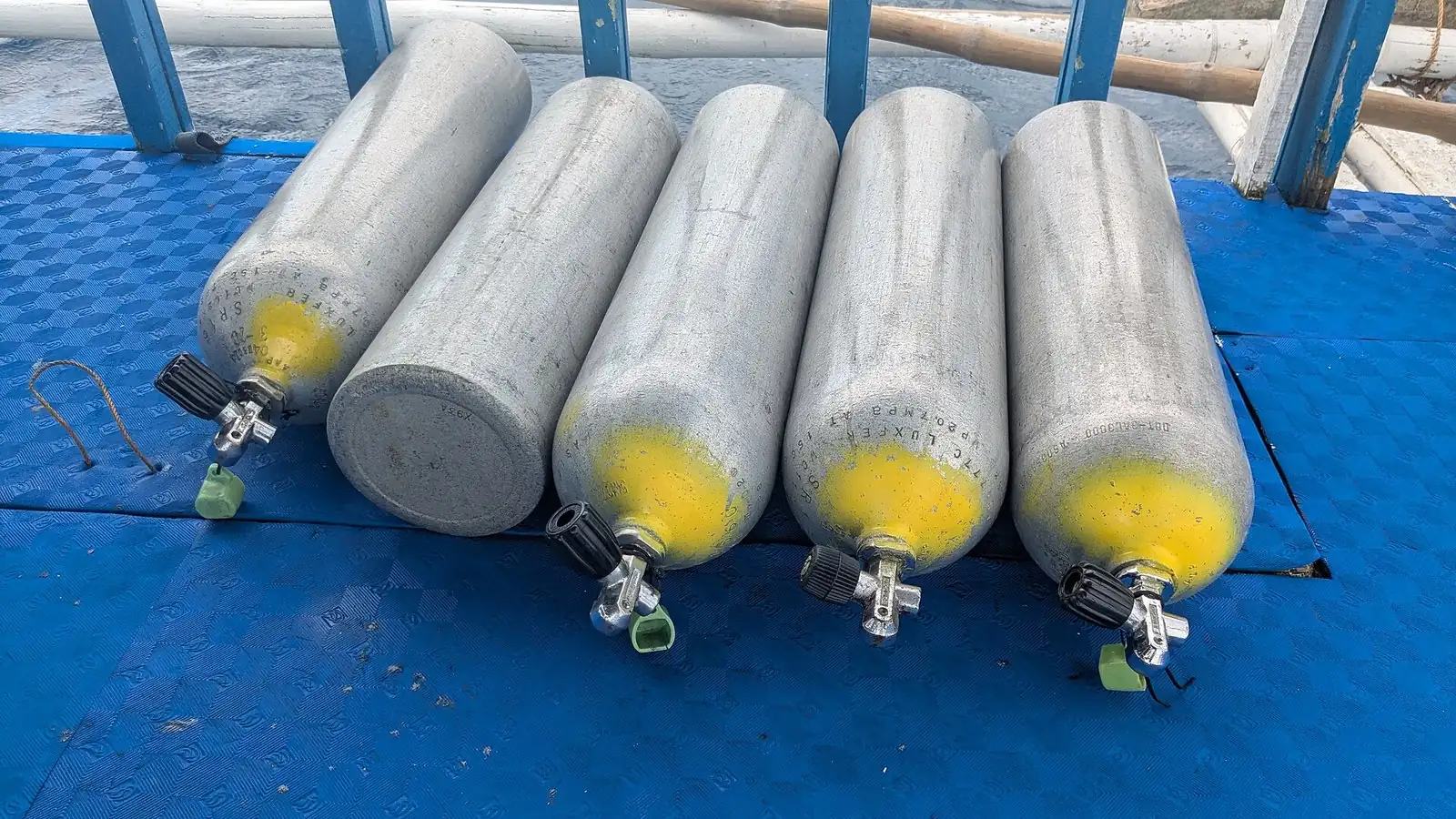
Look at what a dive operator already owns before you pack anything: tanks, weights, racks of BCDs and regulators, wetsuits in every size. Almost everything heavy in a dive kit is waiting at the dock. What isn’t there is small and personal: the mask that fits your face, the computer that knows your last three days of nitrogen, the fins your calves are used to. That’s the whole logic of travel scuba gear. Carry what has to fit you, rent what doesn’t, and check a bag only when the numbers say it pays.
Short answer: Carry on your mask, dive computer and regulator if you own one. Pack full-foot fins and a thin wetsuit if they fit your bag. Rent the BCD on trips under five dive days; tanks and weights come with the boat. A checked dive bag pays only when the trip’s rental bill tops the round-trip bag fee, which starts at $90 on Delta.
Prices, fees and rules on this page were checked on October 1, 2026 against the agencies’, airlines’ and dive operators’ own websites. No brand, shop or airline paid to appear.
On this page: How a dive kit works · Bring or rent · Rent or buy: the math · Carry-on vs checked · Airline fees and limits · Lightweight gear · Dive computer · Wetsuit by destination · Reef-safe sunscreen · Destination rules · How to pack · Gear for beginners · Care and safety · FAQ · Sources
| Decision | What we found (checked Sept-Oct 2026) |
|---|---|
| Always in your carry-on | Regulator, dive computer, mask, spare lithium batteries, medication |
| Almost never packed | Tanks and weights: included with boat dives; confirm with your operator |
| Full rental kit per day | $25 plus $10 for a wetsuit (Cozumel), $35 (Key Largo), $60 (Devil’s Den, Florida) |
| Checked bag on Delta | $45 first bag, $55 second, each way, up to 50 lb (23 kg) |
| Overweight on Delta | $100 for 51-70 lb, $200 for 71-99 lb, each way |
| Dive knife | Checked bag only, sheathed (TSA) |
| Sunscreen in the cabin | 3.4 oz (100 ml) bottles or smaller, in your quart bag (TSA) |
| Wetsuit for most warm trips | 3 mm full suit; 7 mm with a hood for the Galapagos or California |
| Dive computers | From $299.95 list price to $1,599.99 for a flagship watch |
| Flying after diving | At least 12 hours after one dive, 18 after several days of diving (DAN) |
What does a dive kit include, and how does it work?
A scuba kit is a short chain of parts, each doing one job. The tank (cylinder) holds compressed air or nitrox. The regulator drops that pressure in two stages: the first stage screws onto the tank valve, and the second stage in your mouth delivers air only when you breathe in. A spare second stage, the octopus, is there for your buddy, and a hose feeds a pressure gauge or a wireless transmitter so you know how much gas is left.
The BCD (buoyancy control device) is the vest that holds the tank on your back. You add air from the tank with a button to float, and vent it to sink. Weights offset the buoyancy of your wetsuit and body. The dive computer tracks depth and time and works out how much nitrogen your body has absorbed, which tells you how long you can stay and when you can safely fly. Then come the personal pieces: mask, snorkel, fins, boots and an exposure suit.
For travel, that splits neatly into two piles. The heavy, standardized pile (tank, weights, BCD) is something every dive shop stocks. The light, personal pile (mask, computer, fins, suit) is where fit and familiarity matter. The regulator sits in between: it’s the piece divers most often want to own, and the piece most worth protecting in transit. If you haven’t learned to dive yet, the course covers all of this in the pool; our scuba certification guide explains what each agency’s course includes and what students are expected to own.
Travel scuba gear checklist: what to bring and what to rent
Here’s the split we’d use for a typical week of warm-water boat diving from a US gateway. Gear rental prices are from the operators’ own price lists, checked September 2026.
| Item | Bring or rent? | Why | Rental cost seen |
|---|---|---|---|
| Mask | Bring | A leaking mask ruins a dive; fit is personal | $6 a day (Key Largo) |
| Dive computer | Bring | It carries your nitrogen history from dive to dive | $15 a day (Key Largo) |
| Fins (full-foot) | Bring if they fit the bag | Familiar thrust, no blisters | $6 a day (Key Largo) |
| Wetsuit | Bring if thin; rent if 7 mm | Fit, hygiene, and thick suits are heavy | $10 a day (Cozumel) to $20 (Islamorada) |
| Regulator | Bring if you own one | Familiar breathing and controls; small enough for a carry-on | $15 a day (Key Largo) |
| BCD | Rent on short trips | Bulky; rental versions are fine for recreational diving | $12 a day (Key Largo) |
| Tanks and weights | Never pack | Included in boat-dive prices; confirm with your operator | Included |
| Dive light, SMB | Bring | Cheap, light, and not always available to rent | Varies |
Two things push items from “rent” to “bring.” The first is how often you dive: rental fees add up by the day, while your own gear costs the same whether you dive two days or ten. The second is how picky you are about fit. Rental BCDs come in a handful of sizes, rental wetsuits have been worn by strangers, and a rental mask either seals on your face or it doesn’t, which is why a mask is the usual first purchase.
One more category is almost always worth bringing: the small, cheap safety items. A surface marker buoy (SMB) you can inflate at the surface, a whistle or other audible signal, and a small dive light all weigh next to nothing, and they’re the pieces a rental counter is least likely to hand you.
Our take: Carry on your mask, computer and regulator, pack fins and a thin suit, and rent the rest. That covers most trips of up to five dive days without paying for a checked bag. Owning a BCD starts to make sense once you dive often enough that rental charges top the bag fees.
Rent or buy scuba gear: what the numbers say
The rent-or-bring question is really a question of daily rental against round-trip bag fees, so it helps to run real numbers. These use rental prices checked September 2026 and Delta’s fees checked October 2026.
| Trip | Rent everything | Bring your kit as a second checked bag | Cheaper option |
|---|---|---|---|
| Key Largo, 2 dive days | $70 (2 x $35) | $110 ($55 each way) | Rent |
| Key Largo, 5 dive days | $175 (5 x $35) | $110 | Bring, by $65 |
| Cozumel, 5 dive days with wetsuit | $175 (5 x $25 + 5 x $10) | $110 | Bring, by $65 |
| Week-long liveaboard | $140-$350 ($20-$50 a day) | $110 | Usually bring |
| Any trip with a 55 lb (25 kg) bag | As above | $310 ($110 plus $100 overweight each way) | Rent, or lighten the bag |
The last row is the one that catches people. A dive bag that creeps over 50 lb (23 kg) on Delta costs an extra $100 each way, which wipes out any savings from bringing your own gear. If the kit doesn’t fit under 50 lb, take the BCD out and rent one.
Owning gear has costs the table doesn’t show. A regulator needs periodic servicing on the schedule its manufacturer sets, and that service runs whether you dive twice a year or twenty times. If you dive one week a year, renting the BCD and regulator is often the honest answer. If you dive three or four trips a year, or you take long liveaboards, owning starts to win.
The middle path costs nothing in bag fees. Put your mask, computer and regulator in a carry-on, add full-foot fins if they fit, and rent only the BCD and wetsuit. At Rainbow Reef Dive Center in Key Largo, a rental BCD costs $12 a day and a regulator $15 (checked September 2026). A rental computer there is $15 a day, so a $299.95 entry-level computer pays for itself after about 20 dive days, roughly four week-long trips.
Credit cards change the math too. Delta waives the first checked bag for eligible Delta SkyMiles American Express card members and Medallion members, which makes bringing a full kit free on that carrier. Other airlines’ cobranded cards work the same way; check your card’s terms before you decide.
When renting is the better call
Rent when the trip is short, when you’re diving cold water in a 7 mm suit that weighs as much as the rest of your kit, when you’re connecting through several airlines, and when you’re new enough that you don’t yet know what you like. Gear you buy after 20 or 30 dives is gear you’ll keep. Gear you buy before your first trip is often gear you’ll replace.
Carry-on vs checked: where each piece goes
Some of this is law, and some is common sense. The Transportation Security Administration and the Federal Aviation Administration set the hard rules; the rest is about what you can’t replace at your destination if a checked bag goes missing.
| Item | Carry-on | Checked | Notes |
|---|---|---|---|
| Regulator | Yes (recommended) | Yes | DAN advises carrying it in the cabin |
| Dive computer | Yes (recommended) | Yes | Wear it or carry it; it’s expensive and easy to lose |
| Mask and snorkel | Yes (recommended) | Yes | Pack the mask in a hard case |
| BCD, fins, wetsuit | Yes, if they fit size limits | Yes | Usually checked because of size |
| Dive knife or bladed cutter | No | Yes, sheathed or wrapped | TSA knife rule; line cutters with exposed blades count |
| Spare lithium batteries | Yes, terminals protected | No | FAA: 100 Wh per battery; 101-160 Wh needs airline approval |
| Sunscreen, defog over 3.4 oz | No | Yes | TSA liquids rule: 3.4 oz (100 ml) or less in the cabin |
| Scuba tank | Leave it home | Leave it home | If you must fly one, empty with the valve out; check the airline |
The regulator and computer go in the cabin because they’re the two pieces that are both expensive and hard to replace on an island. Divers Alert Network’s travel advice is to carry the regulator, mask and snorkel in the cabin and to put checked dive gear in hard-sided luggage rather than soft or mesh bags. A lost duffel of fins and a wetsuit is solved at the rental counter the next morning. A lost regulator you own is an expensive loss, and the rental that replaces it won’t be the one you trust.
Batteries are the rule people break without knowing it. The FAA requires spare lithium batteries and power banks to travel in the cabin only, with the terminals protected, and limits lithium-ion batteries to 100 watt-hours each unless the airline approves up to two spares of 101 to 160 Wh. That covers removable dive-light batteries, strobe batteries and camera batteries. If you travel with a camera rig, our underwater photography pillar covers housings, strobes and how to pack them.
Knives are simpler: TSA doesn’t allow them in carry-on bags, apart from plastic or round-bladed butter knives, and wants anything sharp in checked bags sheathed or securely wrapped. Most dive knives and many line cutters fall under that rule. Tanks are the one item to leave home. If you ever need to fly one, expect TSA to want it empty with the valve removed so an officer can see inside, and check whether your airline accepts cylinders at all.
Flying with scuba gear: bag fees, weight limits and airline rules
The big US airlines generally treat a dive bag as an ordinary checked bag, so the normal bag fee applies and the normal weight limit matters more than anything else. Delta’s published rules are a useful worked example (checked October 1, 2026):
- Standard checked bags cost $45 for the first and $55 for the second, each way, for bags under 50 lb (23 kg). Delta notes lower fees may apply depending on when the ticket was bought.
- Overweight fees on most routes are $100 for 51 to 70 lb (23 to 32 kg) and $200 for 71 to 99 lb (32 to 45 kg). Bags of 100 lb (45 kg) or more aren’t accepted, and bags over 70 lb aren’t accepted on routes to Europe, Australia and New Zealand.
- One dive bag containing scuba equipment is accepted as a checked bag, and an empty dive tank is allowed. Scuba equipment over 50 lb pays the excess weight fee, and tanks of 100 lb or more or over 115 linear inches aren’t allowed.
- Every passenger flying to or from Key West on Delta is limited to one checked bag. That rule overrides all exceptions, so a Keys diver flying into EYW can’t check a suitcase and a dive bag.
American, United, Southwest and JetBlue publish their own scuba and sports-equipment pages. The pattern is broadly the same, a dive bag priced as a normal bag with overweight charges above 50 lb, but the details differ, especially on tanks and on whether oversize fees are waived. Read your carrier’s page before you pack; a page that changed last month will be the one that applies.
Budget airlines, regional flights and international legs
The weight limit is what bites on onward flights. Small island hoppers, regional carriers and some international airlines use lower checked or total weight allowances than the 50 lb standard, and a connection booked on a separate ticket can charge you twice. Some foreign airlines are known for generous allowances for dive gear, but policies change, so confirm them on the airline’s own site rather than trusting a forum post from 2019.
If you’re booking a long-haul trip with a regional leg, such as Manila to Puerto Princesa or a puddle-jumper to a small Caribbean island, weigh your kit against the smallest allowance on the itinerary. Then decide what to rent at the far end.
Flying home is its own constraint. DAN’s guidelines call for a minimum surface interval of 12 hours before flying after a single no-decompression dive and 18 hours after repetitive dives over multiple days. Plan your last dive day around the flight, not the other way around. That also gives your wetsuit a day to dry before it goes in the bag.
Lightweight scuba gear: where the pounds hide
Lightweight scuba gear is a whole product category: travel BCDs that fold flat, compact regulators, full-foot fins and roller bags with thin shells. Before buying any of it, know where the weight in a kit actually sits. These are ballpark ranges for common designs; weigh your own pieces on a luggage scale.
| Item | Ballpark weight | Lighter option |
|---|---|---|
| Wheeled dive bag (empty) | About 8-13 lb | Duffel or backpack-style bag |
| Jacket-style BCD | About 7-10 lb | Travel BCD, often 4-6 lb |
| Open-heel fins plus boots | About 5-8 lb | Full-foot fins, about 2-4 lb |
| Regulator set with octopus and gauge | About 3-5 lb | Travel regulator, wireless transmitter |
| 3 mm full wetsuit | About 3-5 lb | Shorty or skin suit in very warm water |
| Mask, snorkel, computer | About 1-2 lb | Already light |
The heaviest single item in many kits is the bag. A wheeled hard-bottom dive bag can weigh as much as a BCD before anything goes in it, so a lighter bag often saves more than any lightweight gear purchase. The second place to look is the BCD: travel BCDs use thinner fabric and less padding, and many have back-inflation bladders that fold small. Travel BCDs are worth a look if you dive a few times a year, and the trade-off is durability and pockets.
Travel regulators shave weight with smaller first stages and lighter second stages. The best travel regulator for you is one that breathes well at the depths you dive and that a shop near home can service. Full-foot fins are the third saving and the easiest one: they need no boots, pack flat, and suit warm water. Kona Diving Company, for one, includes full-foot fins on its Big Island charters. Travel fins designed for packing are shorter still, though they give up some thrust in current.
Our take: Spend on a lighter bag before a lighter BCD, and on full-foot fins before either. Most divers can get a warm-water kit, minus tanks and weights, well under 50 lb (23 kg) in a light duffel without buying any specialist travel gear at all.
Which dive computer should travel with you?
If you own one piece of gear, make it the dive computer. It’s the item that matters most on a dive trip, because it tracks the nitrogen you’ve absorbed across several days of repetitive diving, and a rental unit handed to you on day three knows nothing about days one and two. It also tracks your no-fly time, which is the number you need before booking the ride home.
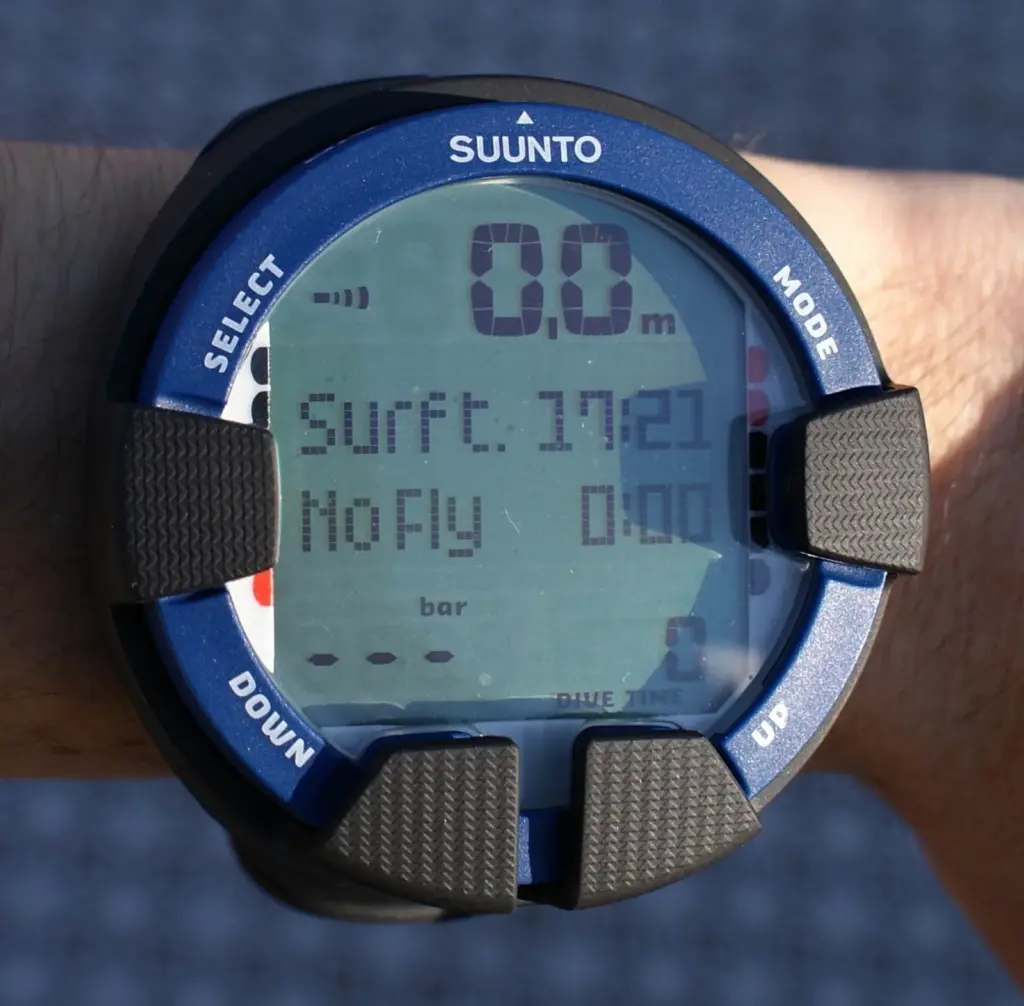
List prices at one US retailer, checked September 2026, give a sense of the range:
| Model | List price | Who it suits |
|---|---|---|
| Suunto Zoop Novo | $299.95 | New divers on a budget |
| Mares Puck 4 | $319.00 | New divers who want a simple wrist unit |
| Shearwater Tern | $595.00 | Frequent travelers who want a watch-sized screen |
| Garmin Descent G2 | $699.99 | Travelers who want one watch for diving and daily wear |
| Suunto Ocean | $719.00 | Same, with Suunto’s ecosystem |
| Shearwater Peregrine TX | $760.00 | Divers who want a large screen and air integration |
| Garmin Descent Mk3i | $1,599.99 | Divers who want every feature, including tank pressure |
For a first computer, look for a screen you can read in dim water without your reading glasses, buttons you can press in gloves, nitrox support (you’ll want it on liveaboards), and a battery you can charge or swap on the road. Smartwatches such as the Apple Watch Ultra can run dive-computer apps, but check the app’s depth limit and whether its full features need a subscription before you count on one.
Charging matters more on a trip than at home. Pack the computer’s charging cable in your carry-on along with any spare batteries, and charge the night before a dive day rather than between dives on a boat. A computer that dies mid-trip is replaced by a rental that knows nothing about your previous dives, which is the situation buying one was meant to prevent.
Which wetsuit thickness for which destination?
Water temperature, not air temperature, decides the suit. Below is the rule of thumb we use, followed by real water temperatures for places US divers fly to most. Monthly figures come from NOAA’s coastal water temperature records and from operators and tourism boards, checked September 2026.
| Water temperature | Typical suit |
|---|---|
| 84°F (29°C) and up | Rash guard, skin suit or 1-3 mm shorty |
| 78-84°F (26-29°C) | 3 mm full suit |
| 72-78°F (22-26°C) | 3 mm full suit if you run warm, 5 mm if you don’t |
| 65-72°F (18-22°C) | 5 or 7 mm full suit, hood helps |
| 55-65°F (13-18°C) | 7 mm with hood, gloves and boots |
| Below 55°F (13°C) | Drysuit, which needs its own training |
| Destination | Water temperature | What we’d pack |
|---|---|---|
| Key West, Florida | 72.5°F (22.5°C) in January to 88.7°F (31.5°C) in August | 5 mm in winter, skin suit in summer |
| Honolulu, Oahu | 76.7°F (24.8°C) in February to 81.7°F (27.6°C) in September | 3 mm full suit year-round |
| Kawaihae, Big Island | 77.6°F (25.3°C) in February to 81.8°F (27.7°C) in September | 3 mm full suit |
| St. Thomas, USVI | 80.2°F (26.8°C) in January to 89.5°F (31.9°C) in September | Skin suit to 3 mm |
| Cozumel, Mexico | 78-85°F (26-29°C) year-round | 3 mm full suit |
| Bonaire | About 80°F (27°C) on average | 3 mm full suit |
| Grand Cayman | About 77°F (25°C) year-round, per the tourism board | 3 mm, 5 mm in winter if you chill |
| Turks and Caicos | About 75°F (24°C) in late January to 86°F (30°C) in July-August | 5 mm in winter, 3 mm in summer |
| La Paz, Sea of Cortez | About 60°F (16°C) in February to 85°F (29°C) in September | 7 mm and hood in winter, 3 mm in late summer |
| Catalina Island, California | 55-59°F (13-15°C) in winter to 70-74°F (21-23°C) in summer | 7 mm with hood in winter |
| Monterey, California | 48-52°F (9-11°C) at diving depth year-round, per local charters | Drysuit, or 7 mm plus hood for the hardy |
| Galapagos | 60-78°F (16-26°C) | 7 mm with hood, year-round |
A few things move the dial. You’ll lose more heat on the third and fourth dives of a day than on the first, so a suit that felt fine on Monday morning can feel thin by Thursday afternoon. Thermoclines and upwellings can drop the temperature sharply within a dive: at Bali’s Nusa Penida, water ranges from about 64°F (18°C) to 81°F (27°C), the cold end arriving with the upwellings of mola season. And thin divers chill faster than the chart suggests. When in doubt, go one step thicker; you can always vent a warm suit by pulling the neck open at the surface.
Thick suits are where renting makes sense. A 7 mm suit with a hood is the bulkiest thing most divers ever pack, and the places that need one (California, the Galapagos, the Sea of Cortez in winter) all have shops that rent them. A 3 mm suit packs small and is worth owning, both for fit and because rental wetsuits are communal by nature.
Reef-safe sunscreen: what to pack and where the law applies
Sunscreen is the one gear item that is now regulated by destination. Selling sunscreens that contain oxybenzone or octinoxate has been illegal in Hawaii since 2021, under a law passed in 2018. In Florida, Key West tried a similar ban, but a 2020 state law reserved sunscreen regulation to the state and nullified it before it took effect, so there’s no Key West ban to comply with.
Elsewhere, the US Virgin Islands, Palau and Bonaire have passed restrictions on similar UV filters, reported when they took effect in 2020 and 2021. Some are bans on sale, and Palau’s reaches what visitors bring in, with confiscation at the airport reported. The lists of banned ingredients differ, so check the current rule before you buy.
The practical answer is the same everywhere. Pack a mineral sunscreen based on zinc oxide or titanium dioxide, and cover up with a rash guard or a thin suit between dives so you need less of it. Remember the TSA liquids limit: bottles over 3.4 oz (100 ml) go in the checked bag, and smaller ones in your quart bag. “Reef-safe” isn’t a regulated term in the US, so read the active ingredients rather than the front of the bottle.
Destination rules that change what you pack
A few places add rules of their own, and each one changes the packing list a little.
- Bonaire: STINAPA, the marine park manager, asks divers to disinfect their gear before the first dive and after the last one, a measure against stony coral tissue loss disease, which reached Bonaire in 2023. Every visitor who enters the water also pays the $40 nature fee, on top of the $75 visitor entry tax that is paid online and scanned at the airport (checked September 2026).
- Bimini, Bahamas: the great hammerhead dives that run November to April require a full 5 mm wetsuit, a hood and gloves, per the operator. Pack them or reserve rentals.
- Galapagos: dive cruises recommend a 7 mm suit with a hood year-round. Rent one if your boat offers it, and the bulkiest item drops out of a long-haul bag.
- Liveaboards: rental gear typically runs $20 to $50 a day (checked September 2026), and on a week-long trip that adds up to more than a checked bag. Bring a full kit if you own one.
- Cruise excursions: PADI’s advice for cruise divers is to bring your own mask and computer and rent the bulky gear, which fits cruise cabin space and port-day logistics.
- Freshwater springs: Florida’s springs parks rent full kits too. Devil’s Den near Williston charges $60 for full gear (checked September 2026), so a drive-in weekend is a good time to bring your own.
How to pack travel scuba gear, step by step
Packing scuba gear well is mostly about sequence. This is the order that keeps you under weight and keeps the irreplaceable pieces with you.
- Decide what you’re bringing. Use the table above. If you’re renting the BCD, say so when you book the dives and give your size.
- Read your airline’s scuba page. Check the bag fee, the weight limit on every leg and any route rules, like Delta’s one-bag limit at Key West.
- Pack the carry-on first. Regulator, computer and charger, mask in a hard case, spare batteries with taped terminals, any prescription medication and your certification card or its app.
- Pack the checked bag around the BCD. Lay the BCD flat, put fins along the sides, roll the wetsuit, and fill gaps with rash guards and towels.
- Sheathe or wrap anything sharp. The dive knife goes in the checked bag, never the cabin.
- Weigh it at home. Under 50 lb (23 kg), or under the smallest limit on the trip. Leave 2 or 3 lb spare for the trip home, when wet neoprene weighs more.
- Label and photograph. Put your name and phone number inside and out, and photograph the contents in case you need to file a claim.
Which scuba gear bag?
DAN’s preference is hard-sided luggage for checked dive gear, since it protects equipment better than soft or mesh bags. Wheeled soft-sided dive bags are the common compromise, though they’re heavy empty. A mesh bag is for the boat, not the plane: pack one folded inside your main bag for carrying wet gear between the dock and your room. Whatever you pick, look at the empty weight first, because every pound of bag is a pound less of gear.
The save-a-dive kit
A small save-a-dive kit fixes the problems that end dives on a boat: a spare mask strap, fin strap, assorted O-rings, a mouthpiece and zip ties, silicone grease, a small multi-tool (checked bag) and some defog. It weighs a few ounces and pays for itself the first time a strap snaps on the way down the ladder.
Mistakes to avoid
- Checking the regulator and computer, then losing the bag on the way out.
- Packing the BCD and a 7 mm suit together and paying $100 overweight each way.
- Taking a brand-new BCD or regulator on its first trip; try it in a pool or quarry at home.
- Forgetting the computer’s charging cable, which is rarely available at the far end.
- Packing the gear wet on the last day and arriving home to a mildewed suit.
- Assuming the return flight has the same limit as the outbound.
A full scuba packing list includes the non-gear items too: certification card, logbook or app, dive insurance details, ear drops if you use them, seasickness tablets and a dry bag for the boat. Keep it in your phone so the next trip starts from a list rather than from memory.
Scuba gear for beginners: what to buy first
Most new divers own a few pieces before they finish their course, because many shops require students to bring their own mask, fins and snorkel. Rainbow Reef Dive Center in Key Largo, for example, has students supply those three items and sells 8-piece open water gear packages from $179, with $50 off when bought with the class (checked September 2026). At Triangle Dive Shop in North Carolina, student gear runs $90 to $300 for a mask, $100 to $300 for fins, $40 to $85 for a snorkel and $60 to $150 for boots.
After that, this is the buying order we’d follow:
- Mask, fins, snorkel and boots. Cheap, personal, and needed for the course. A beginner scuba gear package bundles these.
- Dive computer. The best value per dollar once you’re certified, for the reasons above.
- Wetsuit. A 3 mm suit for the waters you dive most.
- Regulator. Once you’re diving several trips a year and know what breathes well for you.
- BCD. Last, because it’s the easiest piece to rent and the one whose style you’ll change your mind about.
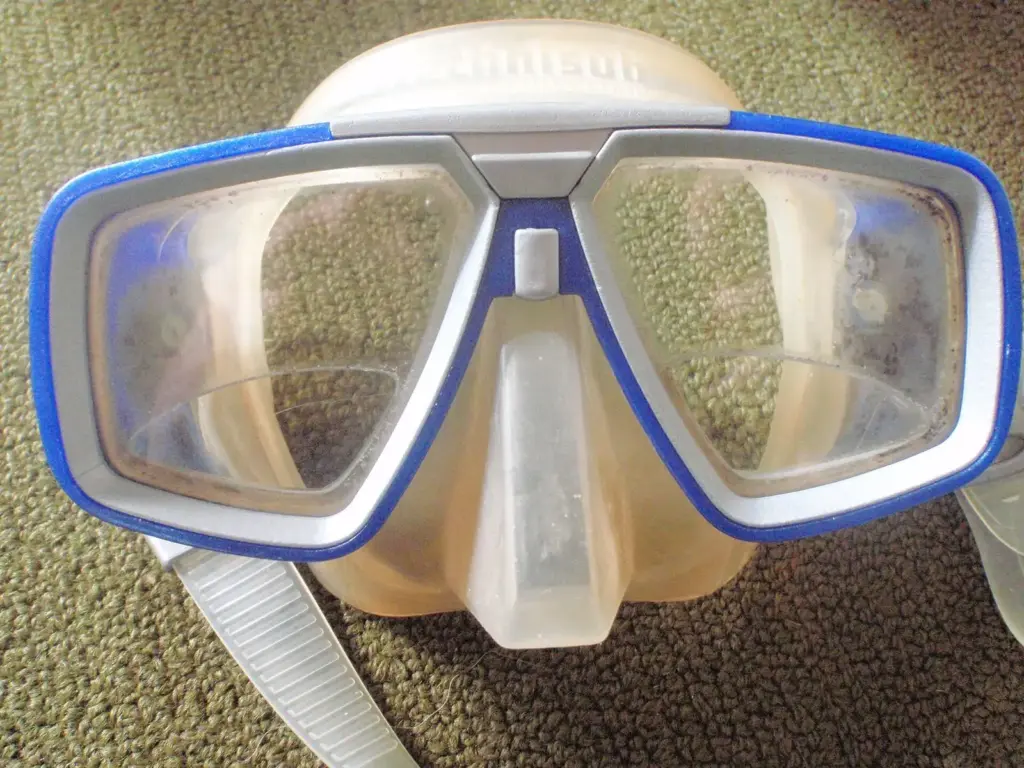
The best scuba mask is the one that seals on your face without the strap, so try several on at a shop before buying online. If you wear glasses, a prescription dive mask is worth buying early: some masks take stock corrective lenses, and custom lenses handle astigmatism and reading prescriptions. Bifocal lenses in the lower part of the mask make a computer readable for many divers over 40.
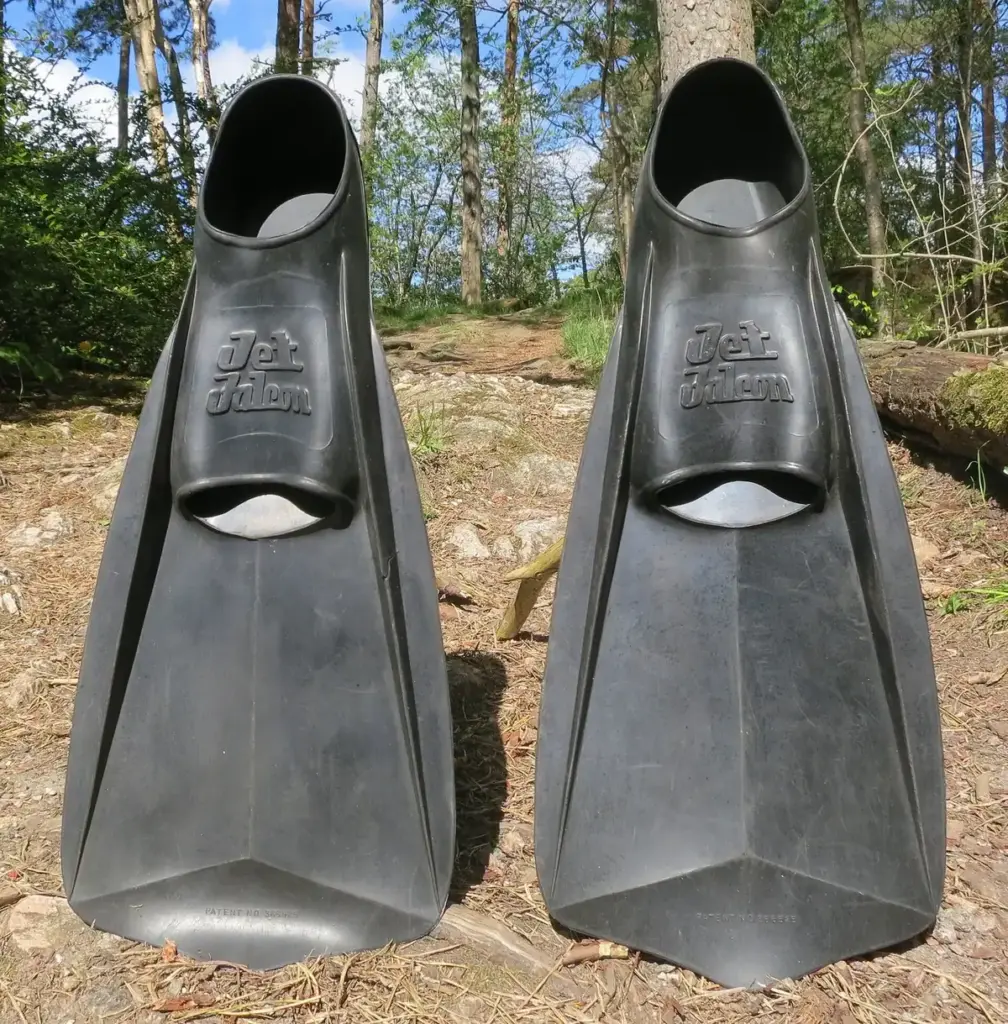
Don’t buy everything at once. Your first 20 dives teach you what you like. In our view, the most common gear regret is a full kit bought the week of certification.
Gear safety, servicing and how long scuba gear lasts
There’s no single lifespan for scuba gear. Masks, fins and BCDs often last many years with a freshwater rinse and dry storage; straps, mouthpieces and inflator hoses are the parts that fail first and are cheap to replace. Wetsuit neoprene loses insulation as its cells compress, so an old suit can feel thinner than its label. Regulators are life-support equipment and need servicing on the schedule the manufacturer sets. A regulator that sat in a closet for three years needs a service before a trip, not on the boat.
Rental gear deserves the same checks. Before the first dive, look at the hoses for bulges and cracks, check the mouthpiece, breathe from the regulator with the tank open while watching the gauge, and test the BCD inflator and dumps. A rental counter that gets defensive about a cracked mouthpiece is telling you something about the rest of its gear.
Gear doesn’t make you a more capable diver. A drysuit, a sidemount rig or a tech computer belongs after the training that goes with it, not before. If a trip calls for gear you haven’t dived, book a refresher or a course at the start rather than learning on a deep wall in current. For the medical side of travel diving, the key numbers are DAN’s flying-after-diving intervals above and dive accident insurance, which DAN membership alone doesn’t include.
Frequently asked questions
How much does scuba diving gear cost?
Entry gear is cheaper than most people expect. A mask, fins, snorkel and boots cost about $290 to $835 at one North Carolina shop, and a Key Largo shop sells 8-piece student packages from $179 (both checked September 2026). Dive computers list from $299.95 to $1,599.99. A regulator and BCD are the big purchases, and renting them costs about $27 a day in Key Largo.
What gear do you need for scuba diving?
You need a mask, fins, an exposure suit suited to the water, a BCD, a regulator with an octopus and pressure gauge, a dive computer, a tank and weights. On a typical vacation boat dive, the operator includes the tank and weights, and rents everything else. Most travelers bring the mask and computer and rent the rest.
How do you pack scuba gear for travel?
Pack the regulator, computer, mask and spare batteries in your carry-on. Put the BCD flat in the checked bag, fins down the sides and the rolled wetsuit in the gaps, with any knife sheathed. Weigh the bag at home and keep it under 50 lb (23 kg) with a little room spare for wet gear on the way home.
Can I bring my regulator in my carry-on?
Yes. Regulators, BCDs, masks, fins and computers aren’t on TSA’s prohibited list, though the checkpoint officer has the final say, and DAN recommends carrying the regulator, mask and snorkel in the cabin. Leave the tank at home, put any dive knife in the checked bag, and keep spare lithium batteries for lights and cameras in the cabin with the terminals protected, as the FAA requires.
Is it cheaper to rent or bring scuba gear?
It depends on how many days you dive. Full rental ran $25 to $60 a day at the operators in this guide, while a second checked bag on Delta costs $110 round trip. On a two-day trip, renting wins. From about four or five dive days, bringing your own gear wins, provided the bag stays under the 50 lb overweight line.
Do airlines charge extra for scuba gear?
Most US airlines charge the normal checked bag fee for a dive bag, with no special fee, and add overweight charges above 50 lb. On Delta that means $45 for a first bag and $55 for a second, each way, plus $100 if the bag weighs 51 to 70 lb (checked October 2026). Check your own airline’s scuba policy before you fly.
How long does scuba gear last?
With rinsing and dry storage, masks, fins and BCDs often last many years, and straps, mouthpieces and hoses are cheap wear parts. Wetsuits lose warmth as the neoprene compresses. Regulators need servicing on the manufacturer’s schedule whether you use them or not, so budget for that cost along with the purchase price when you decide to buy.
Should I buy a dive computer before my first trip?
If you’ll dive more than a few days a year, yes. A computer you wear on every dive keeps track of your nitrogen loading across the trip and tells you when you can fly. Entry models start at about $300, and at $15 a day for a rental, one pays for itself in about 20 dive days.
Sources and verification
Everything on this page was checked between September 23 and October 1, 2026 against the organizations listed below. The page is compiled from their published rules and price lists, and it doesn’t claim any first-hand visits.
- TSA: Knives (What Can I Bring?)
- TSA: Liquids, aerosols and gels rule
- FAA PackSafe: Lithium batteries
- Delta: Baggage policy and fees
- Delta: Excess and overweight baggage
- Delta: Sports equipment, including scuba
- Divers Alert Network: Traveling with scuba equipment
- Divers Alert Network: Guidelines for flying after diving
- NOAA NCEI: Coastal water temperature guide
- STINAPA Bonaire: Bonaire National Marine Park
- Rainbow Reef Dive Center, Key Largo: rental and course prices
- Sand Dollar Sports, Cozumel: dive packages and rentals
- Islamorada Dive Center: charters and rentals
- Devil’s Den, Williston: scuba prices
- Florida Senate: SB 172 (2020)
Also checked: Bluewater Photo’s dive computer list prices; Triangle Dive Shop’s student gear prices; Liveaboards.com’s guide to liveaboard extra costs; PADI’s cruise diving advice; Neal Watson’s Bimini Scuba Center; Beachhopper II, Monterey; Diving Catalina; the Cayman Islands and Turks and Caicos tourism boards; Blue Note Scuba, Cozumel; Buddy Dive Resort, Bonaire; Bonaire’s tourism tax office; Hawaii Act 104 (2018).
Scuba Tourism Guide is an independent publication. It is not affiliated with any agency, park or dive operator named here, and no one paid to be included.
Photo credits
- Scuba tanks on a dive boat, Cebu (featured image): photo by Martin Michlmayr, Wikimedia Commons (CC BY-SA 4.0)
- Suunto Vyper Air dive computer showing no-fly time (2010): photo by Thomei08 at German Wikipedia, Wikimedia Commons (public domain)
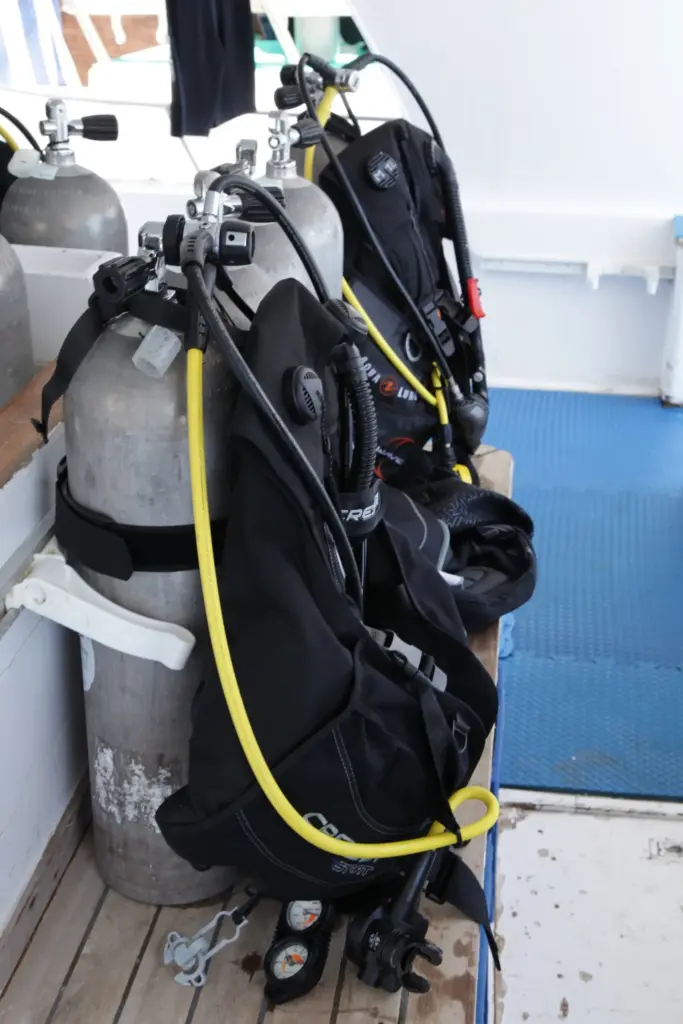
- BCD and regulator on a tank, dive boat at Dahab, Egypt (2012): photo by Grand Parc – Bordeaux, France from France, Wikimedia Commons (CC BY-SA 2.0)
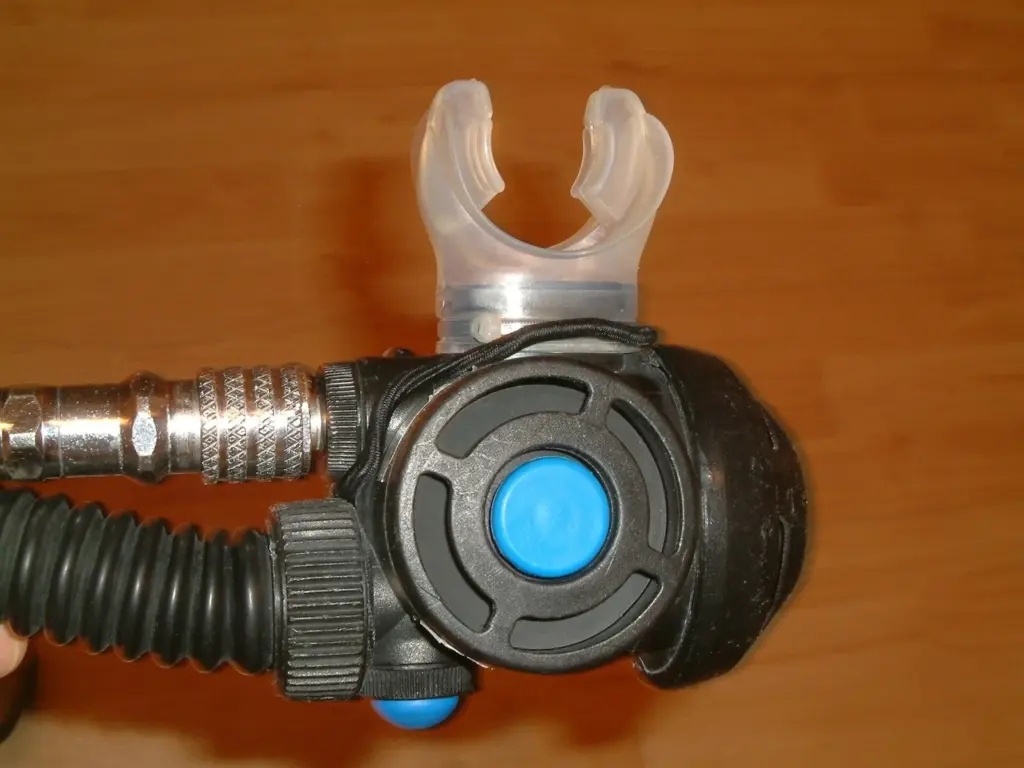
- Regulator second stage and BCD inflator: photo by Mark.murphy at English Wikipedia, Wikimedia Commons (public domain)
- Diving half mask with bifocal lenses (2012): photo by Peter Southwood, Wikimedia Commons (CC BY-SA 3.0)
- Full-foot diving fins (2025): photo by R. Henrik Nilsson, Wikimedia Commons (CC BY 4.0)


