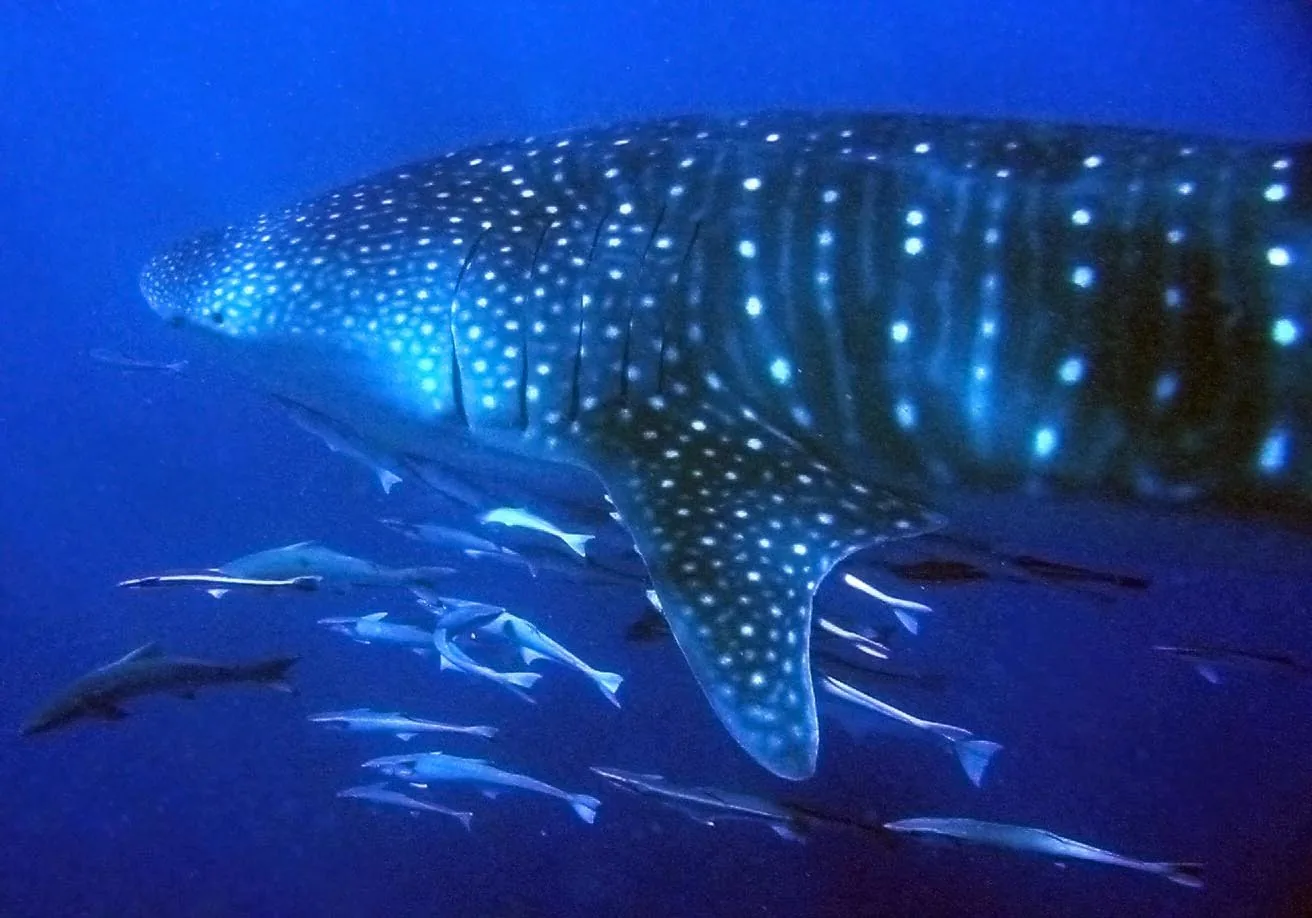
The first thing that surprises people is the mouth. A whale shark cruising at the surface opens a gape more than a yard wide, filtering plankton from the water while a dozen snorkelers kick hard just to keep pace alongside. The second surprise is how calm it all is. The biggest fish in the ocean ignores you completely. If you want to swim with whale sharks, the hard part isn’t the swimming; it’s picking the right place, the right month and an operator that follows the rules, because whale sharks gather reliably in only a handful of places, and each has its own season, regulations and ethics. Here’s the calendar, the costs in dollars, what’s allowed where, and how the other ocean giants fit in.
Short answer: You can swim with wild whale sharks in Mexico (Isla Mujeres and Holbox June-September, La Paz roughly November-April), Belize and Honduras in spring, Ningaloo in Australia March-July, the Maldives year-round and more. Most encounters are snorkel-only, on licensed boats, at about $150-$200 a person (checked September 2026). Skip sites that feed the sharks.
Seasons, rules and prices below were checked on September 23-24, 2026 against government agencies, researchers and operators’ own websites. We name operators so you can compare like with like; none of them paid to appear here.
On this page: At a glance · What it’s like · About whale sharks · Whale shark season by site · Where to swim with whale sharks · Snorkel or scuba · Cost · Is it ethical? · How to swim with them · Help the research · What to bring · Kids · Safety · Other ocean giants · Planning · FAQ
Swimming with whale sharks at a glance
| Question | Answer (checked September 2026) |
|---|---|
| Do you need to dive? | No. Most whale shark trips are snorkel-only; in Mexico, scuba and freediving with whale sharks are prohibited. |
| Closest to the US | Isla Mujeres and Holbox, Mexico (June-September); La Paz, Mexico (roughly November-April) |
| Typical price | 2,800 MXN (about $159) in La Paz; from $190 on a Cancun day tour; add a $20 dock and marine park tax at Isla Mujeres |
| Rules you’ll hear | Keep 3 m (10 ft) from the head and body and 4 m (13 ft) from the tail at Ningaloo; no touching, no flash; small groups in the water |
| Year-round options | South Ari Atoll, Maldives |
| For scuba divers | Galapagos (Darwin and Wolf) June-November, Socorro, Flower Garden Banks off Texas in summer |
| Conservation status | Endangered (IUCN, since 2016); the global population has fallen by about half over 75 years |
| Avoid | Sites where whale sharks are fed for tourists, such as Oslob in the Philippines |
What swimming with whale sharks is really like
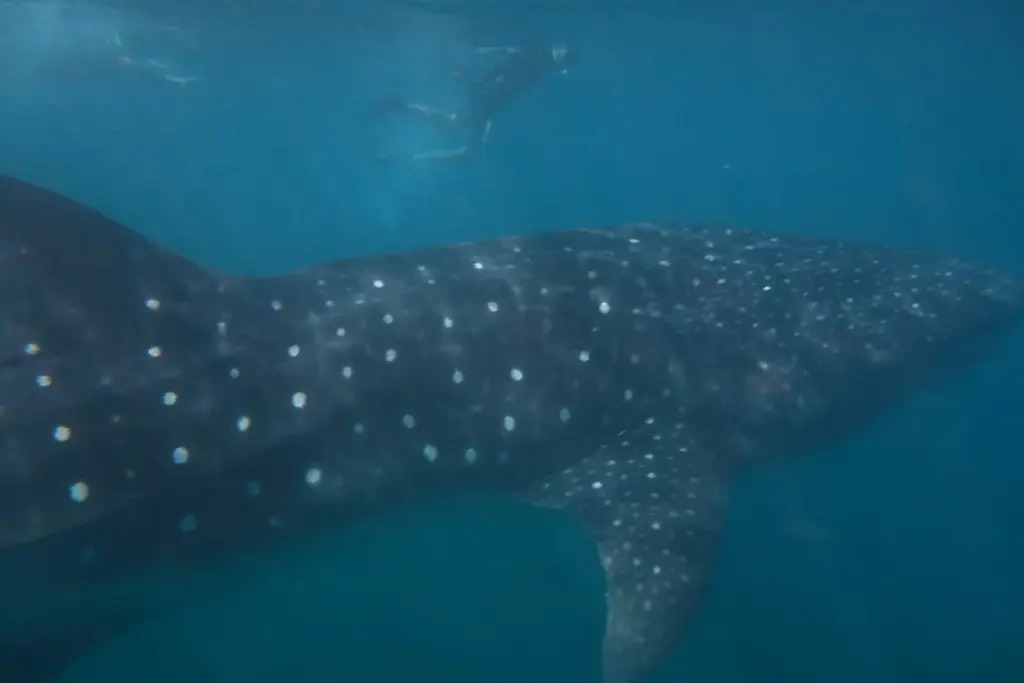
On a typical wild whale shark trip, you leave early by boat and run to an area where the sharks feed near the surface. A spotter finds a shark, the captain positions the boat ahead of it, and a small group slips into the water with a guide. The shark swims toward and past you, often at the surface, while you swim alongside at a respectful distance for a minute or two until it outpaces you or dives. Then you climb back aboard, the next group takes a turn, and you wait for another drop. A good day brings several swims; a slow day brings one or none.
It’s a snorkeling experience more than a diving one. You’ll spend most of the time at the surface in open water, sometimes in chop and current, and you’ll swim harder than you expect, because even a lazy whale shark covers ground faster than a snorkeler. That’s why most operators ask for confident swimmers and many require a wetsuit or life jacket.
About whale sharks: the biggest fish in the sea
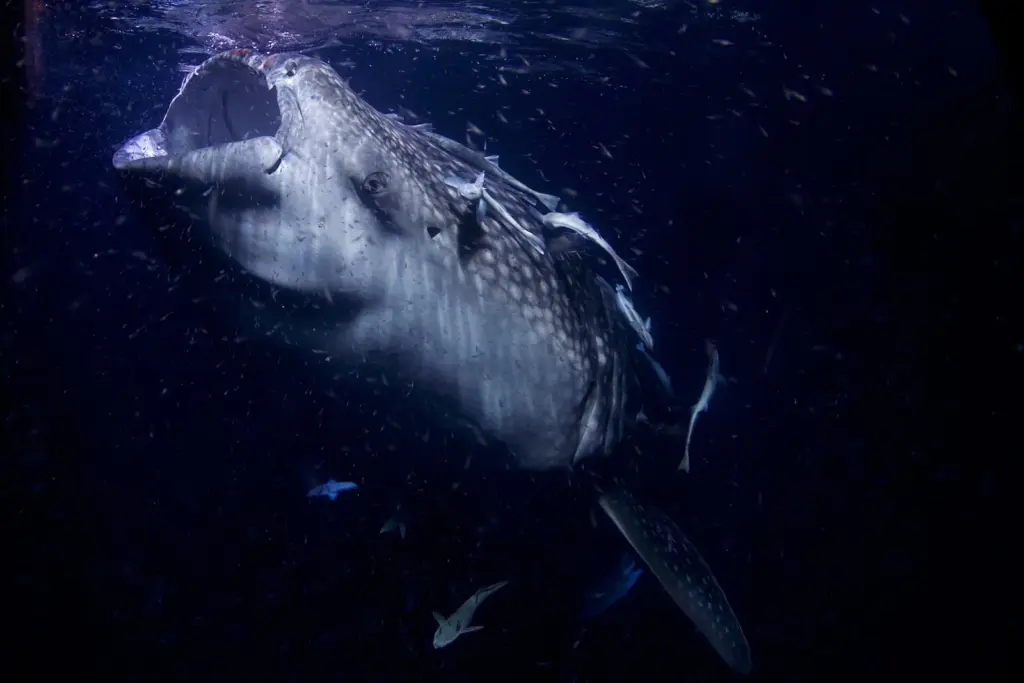
Whale sharks are sharks, not whales, and the largest fish alive. The biggest reliably measured was 18.8 m (61.7 ft). At Ningaloo they’re usually 2 to 12 m (7 to 39 ft) long, and a 12 m shark weighs up to 11 tonnes, according to Western Australia’s parks department. They’re filter feeders that strain plankton, fish eggs and small fish from the water, which is why they gather wherever food blooms: plankton in Mexico’s bays, or the spawn of snapper and grouper off Belize. They rarely enter water cooler than about 70°F (21°C), and satellite tags have shown them diving deeper than 1,700 m (5,600 ft) and traveling thousands of kilometers.
They’re in trouble. The IUCN has listed the whale shark as Endangered since 2016, and it estimates the global population has fallen by roughly half over 75 years, by about 63% in the Indo-Pacific, which holds about three-quarters of all whale sharks, and by more than 30% in the Atlantic. That context matters for the ethics section below: how you swim with them, and who you pay, makes a difference.
Whale shark season: when and where, month by month
Whale shark season depends entirely on where you go. This calendar covers the aggregations most accessible to American travelers, from the operators, governments and researchers who track them.
| Place | Season | Peak | How you meet them |
|---|---|---|---|
| Isla Mujeres and Cancun, Mexico | Mid-May or June to mid-September | July-August | Snorkel only |
| Holbox, Mexico | June-September | July-August | Snorkel only |
| La Paz, Mexico | Roughly October or November to April | November-March | Snorkel only; 5 swimmers per shark |
| Gladden Spit, Belize | March-June | Around the full moon | Snorkel and scuba |
| Utila, Honduras | Late February-April; smaller peak October-December | Late February-April | Snorkel; up to 8 people in the water per boat |
| Flower Garden Banks, Texas | Summer | July-September | Scuba (offshore) |
| Ningaloo, Western Australia | March-July; Exmouth trips to about August | March-July is most reliable | Snorkel; up to 10 people in the water |
| South Ari Atoll, Maldives | Year-round | Varies | Snorkel and scuba, depending on the operator |
| Galapagos (Darwin and Wolf) | June-November | June-November | Scuba, mostly on liveaboards |
| Socorro (Revillagigedo), Mexico | November-December and late April-June | Varies | Scuba, on liveaboards |
| Donsol, Philippines | Reported November-May | Varies | Snorkel |
Seasons are averages, not promises. Wherever you go, the edges of a season carry more risk of a blank day, so give yourself two or three chances rather than one.
Where to swim with whale sharks: the best places
These are the best places to swim with whale sharks for a traveler starting in the US, roughly in order of how easy, reliable and well managed they are.
1. Isla Mujeres, Cancun and Holbox, Mexico (June-September)
Mexico’s Caribbean coast is the easiest whale shark trip from the US and one of the biggest gatherings anywhere: in 2009 more than 400 whale sharks were recorded off the Yucatan Peninsula, one of the largest aggregations ever documented. The sharks feed at an offshore area known as Afuera, roughly 35 km (22 miles) from Isla Mujeres, between Isla Mujeres and Holbox. Tours leave from Cancun, Playa del Carmen, Isla Mujeres, Cozumel, Tulum, the Riviera Maya and Holbox, and prices range from about $150 to $400 depending on where you start, with Isla Mujeres usually the cheapest. Mexico Whale Shark‘s Cancun tour, for example, starts at $190 for about seven hours with transport, breakfast and gear, and takes guests from age 4 on boats of up to 10 (checked September 2026).
The rules are strict. Only one boat may work each whale shark, only two swimmers plus a guide may be in the water with it, scuba and freediving are prohibited, life jackets are mandatory, and about 300 boat licenses have been issued. One Isla Mujeres hotel’s guide describes a typical trip as about 2.5 hours at sea with two or three swims each, on 36-foot boats carrying up to 10 people, with swimmers keeping 2 m from the head and 3 m from the tail, a $20 (or 350 MXN) dock and marine park tax paid in cash, and no children under 4. Holbox, reached by ferry from Chiquila, sits inside the Yum Balam reserve, established in 1994, and has a quieter, small-island feel.
2. La Paz, Mexico (roughly November-April)
In winter, whale sharks, many of them juveniles, feed on plankton in a shallow bay near La Paz, at the southern end of the Baja peninsula. The official season generally runs from October to April or May, depending on conditions, under the national parks agency CONANP. The 2025-2026 season, which closed in May 2026, counted 56 individual sharks and 950 sightings, according to the city, and researchers from Whale Shark Mexico documented 20 new juveniles between October 2025 and April 2026 (HOY BCS).
CONANP allows five snorkelers plus one certified guide in the water with a whale shark at a time, requires a wetsuit or life jacket, and keeps everyone snorkeling rather than freediving. Winter water drops to around 68°F (20°C), so a full wetsuit is standard. The Hook Experiences, a La Paz operator, charges 2,800 MXN (about $159) with a maximum of 10 guests and permits included, and says packaged tours from Cabo, about 2.5 hours away, cost 4,300-5,200 MXN (checked September 2026). Combine it with the sea lion colony at Los Islotes, just over an hour by boat, which is open outside its June 1 to August 31 pupping closure.
3. Ningaloo, Western Australia (March-July)
Ningaloo is the model for how whale shark tourism should work. Western Australia’s parks department, DBCA, licenses every commercial operator, gives each boat a 250 m approach zone with one vessel at a time for up to 90 minutes at six knots or less, and sets the in-water rules described below. Swimmer numbers have grown from about 1,000 in 1993 to more than 36,000 in 2022. Tours run from Exmouth and Coral Bay: Coral Bay’s season typically runs from March to the end of June and Exmouth’s into August, with sightings sometimes continuing to October, and Exmouth Dive and Whalesharks Ningaloo runs swims daily from March to early August. Ningaloo Whale Sharks offers a whale shark guarantee: if you don’t see one, you can go again free or get a partial refund. Humpback swims are possible in the same months, which makes the long flight easier to justify.
4. South Ari Atoll, Maldives (year-round)
The Maldives has whale sharks along the outer reef of South Ari Atoll all year, in water of 80-86°F (27-30°C) with generally excellent visibility. You can see them from resort boats or on liveaboards; Explorer Ventures’ Maldives whale shark trips start at $2,700 (checked September 2026). US travelers should plan their routing carefully: the State Department has rated Qatar at Level 3 since the US-Iran hostilities that began in February 2026, so connections through Europe or Asia are the safer choice.
5. Gladden Spit, Belize (March-June)
Belize’s whale sharks gather in the Gladden Spit and Silk Cayes Marine Reserve, declared in 2000 and about 22 miles (36 km) off Placencia, to feed on the spawn of snapper and grouper from March to June, especially around the full moon. It’s one of the few places where you can meet whale sharks on scuba as well as snorkel, and it fits neatly onto a Belize reef diving trip. Because the sharks follow the spawning, sightings aren’t guaranteed.
6. Utila, Honduras (late February-April, and October-December)
Whale sharks show up in the open water off Utila, one of Honduras’s Bay Islands, with the main season from late February through April and a smaller peak from October to December; they’ve been logged in every month in some years. Local guidelines allow no more than eight people per boat in the water with a whale shark. Utila is a budget-friendly dive island, and whale shark sightings there are a bonus rather than a sure thing.
7. Galapagos and Socorro: whale sharks on scuba
For certified divers, the most dramatic whale shark encounters are in the eastern Pacific. At the Galapagos, whale sharks are very likely at Darwin and Wolf from June to November, when the water runs about 60-70°F (16-21°C) across the islands, warmer at Darwin and Wolf. Liveaboards cost about $5,500-$9,500 for 7-10 nights plus the $200 park tax and $20 transit card, and Ecuador requires a passport valid for six months or more. At Socorro, in Mexico’s Revillagigedo Islands, Nautilus lists whale sharks in November-December and late April-June alongside year-round giant mantas; trips run 8-10 nights from Cabo San Lucas, about 240 miles and a 24-hour crossing each way, at $3,195-$9,790 plus a $35 port fee and park fees. Both are advanced trips with strong currents and deep water.
8. Flower Garden Banks, Texas (summer)
The Flower Garden Banks National Marine Sanctuary, far off the Texas-Louisiana coast, is the one place in US waters where divers have a real chance of a whale shark, most likely in July, August and September. It’s an offshore trip for experienced divers, and August brings its famous mass coral spawning as a second reason to go.
The Philippines: Donsol, and why to skip Oslob
The Philippines has both a wild aggregation and the world’s most controversial whale shark site. Researchers describe a natural whale shark season at Donsol, in Sorsogon, from about November to May. Oslob, on Cebu, is different: the sharks there are fed daily for tourists, which is covered in the ethics section below.
In the US: Georgia Aquarium
If you want to see a whale shark without leaving the country, Georgia Aquarium in Atlanta runs Journey with Gentle Giants programs in its 6.3-million-gallon Ocean Voyager habitat, including a 30-minute dive at 20-30 ft for certified divers 12 and older, alongside whale sharks and manta rays. It’s a controlled setting with captive animals, not a wild encounter, and some travelers will prefer to put that money toward a trip to see them in the ocean.
Snorkel or scuba: what’s allowed where
| Site | Snorkel | Scuba | Group limit in the water |
|---|---|---|---|
| Isla Mujeres, Holbox, Cancun | Yes | No (scuba and freediving prohibited) | 2 swimmers plus a guide per shark |
| La Paz | Yes | No (snorkel only; no freediving) | 5 snorkelers plus a guide per shark |
| Ningaloo | Yes | Not on tours | 10 people |
| Utila | Yes | Check locally | 8 people per boat |
| Gladden Spit | Yes | Yes | Check locally |
| Galapagos, Socorro, Flower Garden Banks | No (open ocean) | Yes | Set by the liveaboard or charter |
If you’re a certified diver hoping to dive with whale sharks, the realistic options are the liveaboard destinations (Galapagos, Socorro), Gladden Spit in Belize, the Maldives and, in summer, Texas’s Flower Garden Banks. Everywhere else, you’ll be snorkeling. That’s not a downgrade: whale sharks feed near the surface, and snorkelers usually see them best.
What swimming with whale sharks costs
| Trip | Price (checked September 2026) | Notes |
|---|---|---|
| La Paz whale shark tour (The Hook Experiences) | 2,800 MXN (about $159) | Maximum 10 guests; permits included |
| Cabo-based La Paz packages | 4,300-5,200 MXN (about $245-$296) | Includes the 2.5-hour transfer each way |
| Cancun whale shark tour (Mexico Whale Shark) | From $190 | About 7 hours with transport, breakfast and gear; ages 4+; up to 10 guests per boat |
| Isla Mujeres dock and marine park tax | $20 or 350 MXN in cash | Charged on top of some tours |
| Maldives whale shark liveaboard (Explorer Ventures) | From $2,700 | Liveaboard trip |
| Socorro liveaboard (Nautilus) | $3,195-$9,790 | 8-10 nights from Cabo San Lucas; park fees extra |
| Galapagos liveaboard | About $5,500-$9,500 for 7-10 nights | Plus the $200 park tax and $20 transit card |
The cheapest way to swim with whale sharks is a snorkel day trip in Mexico, and the Mexican sites are also the closest to the US. Budget for the extras on top: park taxes paid in cash, a tip for the crew, and transfers if you’re staying on the mainland. Peso prices are converted at the European Central Bank’s rate of September 24, 2026 (17.58 MXN to the dollar).
Is swimming with whale sharks ethical?
At a well-run wild aggregation, yes. The sharks come to feed on natural food, the encounter is short and regulated, and tourism money gives governments and fishing communities a reason to protect them. Mexico, Belize and Western Australia all run licensing systems and in-water rules for that reason.
The controversy is about feeding. At Oslob, on Cebu in the Philippines, fishermen hand-feed whale sharks every day so tourists can see them year-round. A 2020 study in Royal Society Open Science described Oslob as the world’s largest non-captive provisioned whale shark tourism destination, with more than 500,000 tourists in 2018 and an average of about 1,415 a day. Despite distance rules, people were within 2 m of a shark in 93% of surveys. Sharks that had visited more often behaved differently and were less likely to show avoidance, and the authors called for urgent improvements in management. Earlier research found that some sharks became year-round residents at Oslob in response to the feeding.
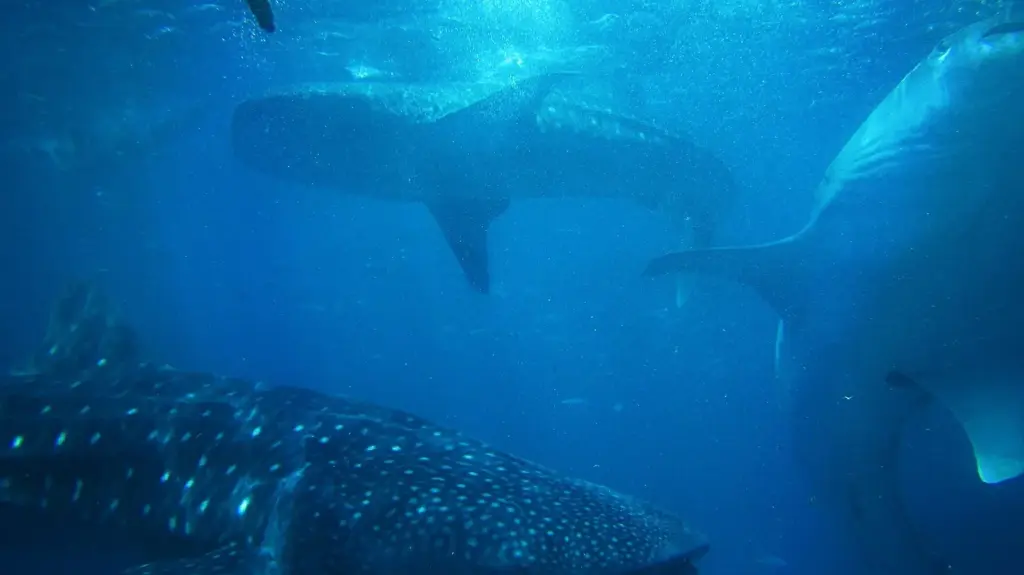
Our take: Skip Oslob and any tour that feeds whale sharks. Choose a wild aggregation with a licensing system and in-water rules, such as Mexico, Ningaloo or the Maldives, keep your distance even when others don’t, and never touch. The difference between an ethical swim and an unethical one is mostly which trip you book.
The same logic applies to other big-animal encounters. Our shark diving guide covers the debate over baited shark dives in more detail.
How to swim with whale sharks: the rules and the technique
Western Australia’s rules at Ningaloo are the clearest in the world, and they’re a good standard anywhere. Swimmers must not touch or ride a whale shark, restrict its movement, come closer than 3 m (10 ft) to the head or body or 4 m (13 ft) to the tail, use flash photography or cameras on poles, use motorized scooters, or have more than 10 people in the water. Boats must stay at least 30 m away and approach from ahead of the shark.
- Practice at home. If you’re rusty, get comfortable snorkeling in open water before the trip, including clearing your snorkel and swimming steadily with fins.
- Enter quietly. Slide into the water when the guide says so; don’t jump or splash.
- Position to the side. The boat drops you ahead of the shark. Move to the side of its path, not in front of its mouth, and let it come past you.
- Keep your distance. Stay about 3 m (10 ft) from the body and farther from the tail, which can sweep suddenly.
- Swim alongside, don’t chase. Swim parallel for as long as you comfortably can, then stop and let it go.
- Watch for signs of disturbance. The parks department lists banking, diving, eye-rolling and sudden changes of speed or direction as signs a shark is being disturbed. Give it more space.
- No flash. Shoot with natural light; the sharks are near the surface anyway. Our underwater photography guide covers the settings.
Mistakes to avoid: booking the cheapest boat with 20 or more people aboard, which means fewer turns in the water; going at the very start or end of the season; chasing a shark that’s diving away; wearing chemical sunscreen that washes off into the water; and forgetting cash for park taxes.
Help the research: photo-ID your whale shark
Every whale shark has a unique pattern of white spots behind its gills, a bit like a fingerprint, and researchers use photos from tourists to track individuals. Western Australia’s parks department asks swimmers to submit photos to the ECOCEAN photo-identification library, which matches pictures to document individual sharks that return to Ningaloo over many years; the same approach lies behind the La Paz count of 56 individuals in 2025-2026. If you take a camera, get a clear side-on shot of the area behind the gills, without flash, and send it to the local research program. It turns your vacation photo into data.
What to wear and bring
- A wetsuit. In La Paz a wetsuit or life jacket is required, and winter water drops to about 68°F. Elsewhere, a thin suit or rash guard protects against sun and jellyfish stings.
- A life jacket if required. Mexico’s Caribbean whale shark tours require them for everyone.
- Your own mask and snorkel. A mask that fits and doesn’t leak makes a two-minute swim far more enjoyable. Bring fins if you have them.
- Sun protection. Hat, sunglasses and a long-sleeved rash guard; you’ll be on an open boat for hours.
- Seasickness remedies. Offshore runs to the feeding areas can be rough.
- Cash. For park taxes, such as the $20 or 350 MXN charge at Isla Mujeres, and for tips.
- A camera without flash. An action camera on a wrist strap is easiest; camera poles are banned at Ningaloo.
Can kids and weaker swimmers swim with whale sharks?
Often, yes, with limits. In Mexico’s Caribbean, Mexico Whale Shark takes guests from age 4, and an Isla Mujeres hotel guide says children under 4 aren’t allowed on the water with the sharks. Life jackets are mandatory there for everyone, which helps nervous or less confident swimmers, because you float at the surface without effort. In La Paz, operators ask for confident swimmers and require a wetsuit or life jacket; The Hook Experiences says no snorkeling experience is needed, but advises against the trip for people with heart, back or respiratory conditions or in advanced pregnancy.
The honest test is whether you can swim steadily for a few minutes in open water, in a mask and snorkel, with waves slapping around you. If that sounds hard, practice in a pool or calm sea first, wear a life jacket, and tell the guide so they can stay close. Children who snorkel comfortably tend to love it; children who panic in open water are better off watching from the boat, where you can often see the sharks’ shadows and fins at the surface.
Is swimming with whale sharks safe?
Whale sharks are filter feeders and pose no danger to swimmers who give them room. The real risks are the ordinary ones of open water: fatigue from swimming hard at the surface, current and chop, seasickness on long boat rides, sunburn, and being hit by a tail or a boat if you ignore the rules. A few precautions go a long way:
- Wear the wetsuit or life jacket the operator provides; in La Paz one or the other is required, and in Mexico’s Caribbean life jackets are mandatory.
- Stay with your guide and your group, and get out when you’re told.
- Take seasickness medication before the boat leaves if you need it.
- Cover up with a rash guard and hat; you’ll be at the surface for hours.
- Be honest about your swimming. Operators in La Paz, for example, say you must be a confident swimmer, and they advise against the trip for people with heart, back or respiratory conditions or in advanced pregnancy.
Beyond whale sharks: the ocean’s other giants
Whale sharks are the headline, but they’re one of many big-animal encounters worth planning a trip around. Each of these has its own guide in this series as it’s published.
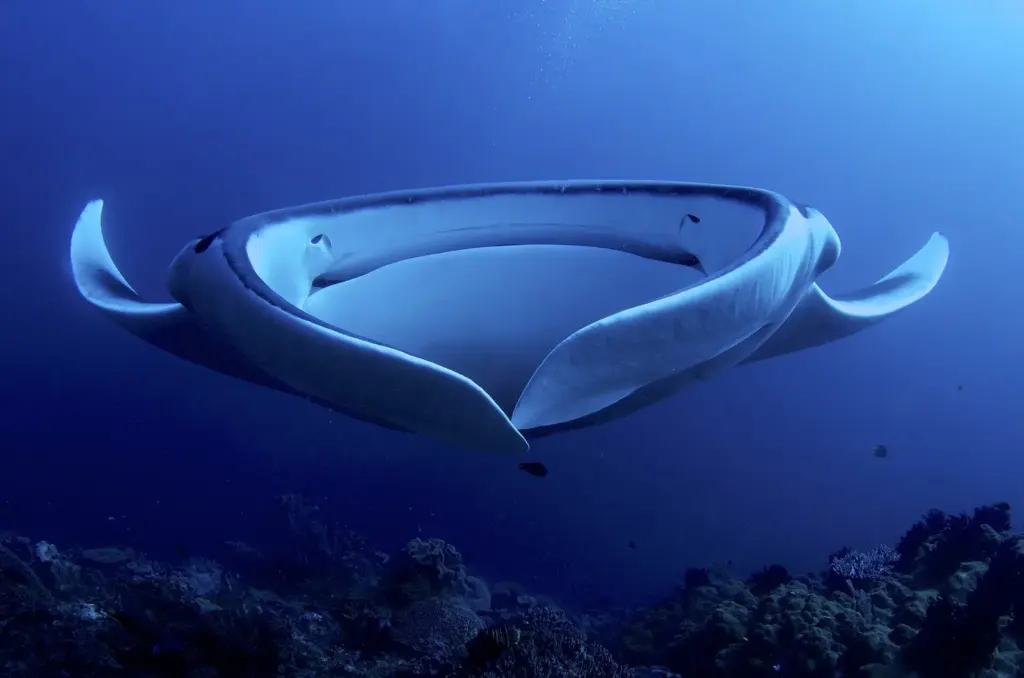
Manta rays
There are three manta species: the giant oceanic manta, up to about 23 ft (7 m) across and listed as Endangered since 2020; the reef manta, up to about 18 ft (5.5 m) and listed as Vulnerable since 2019; and the Atlantic manta. The famous encounters include the Kona manta night dive in Hawaii, where one operator says more than 200 individual reef mantas have been identified and trips cost $149-$250, with snorkeler seats from $160 (checked September 2026), giant mantas year-round at Socorro, reef mantas year-round at Nusa Penida’s Manta Point, peak manta season from December to February in Raja Ampat, and December to March in southern Komodo. Manta ray diving is covered in its own guide.
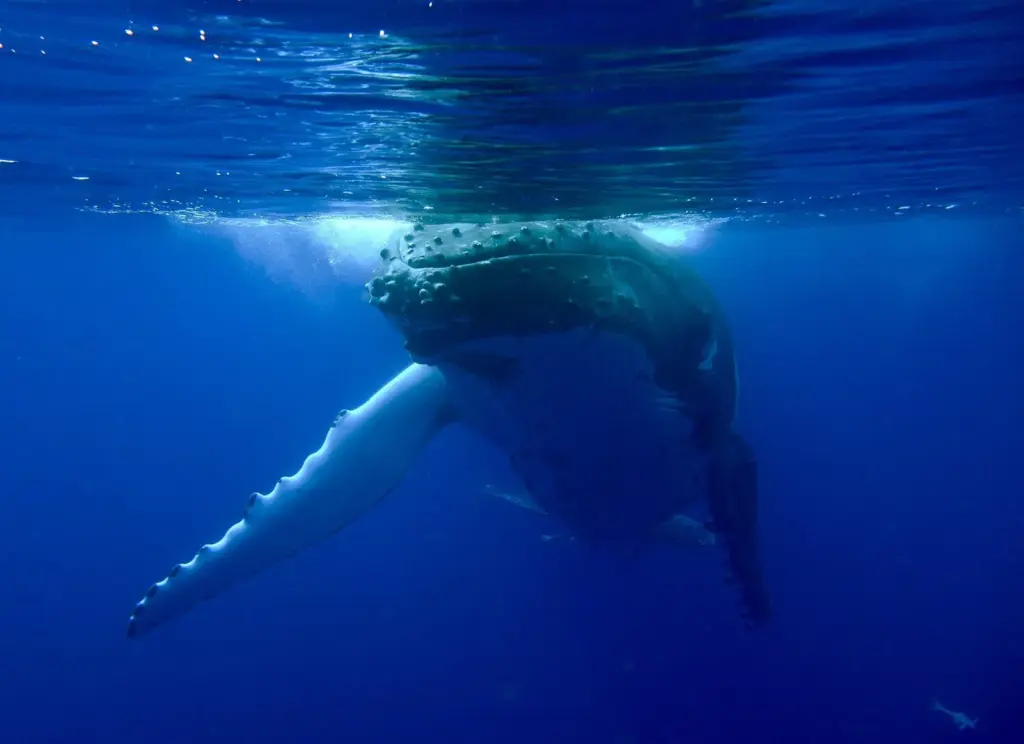
Humpback whales
You can’t swim with humpbacks in US waters: in Hawaii, federal rules bar approaching within 100 yards. Where in-water encounters are allowed, they’re tightly controlled. At the Silver Bank, north of the Dominican Republic, only three vessels are permitted, trips are snorkel-only, and 3,000 to 5,000 humpbacks gather each winter; Explorer Ventures’ Silver Bank trips start at $4,395. In Tonga, the Oceanic Society’s snorkel expedition costs from $6,995, with US travelers routing via Fiji, and Ningaloo offers humpback swims alongside whale sharks. Swimming with humpback whales gets its own guide.
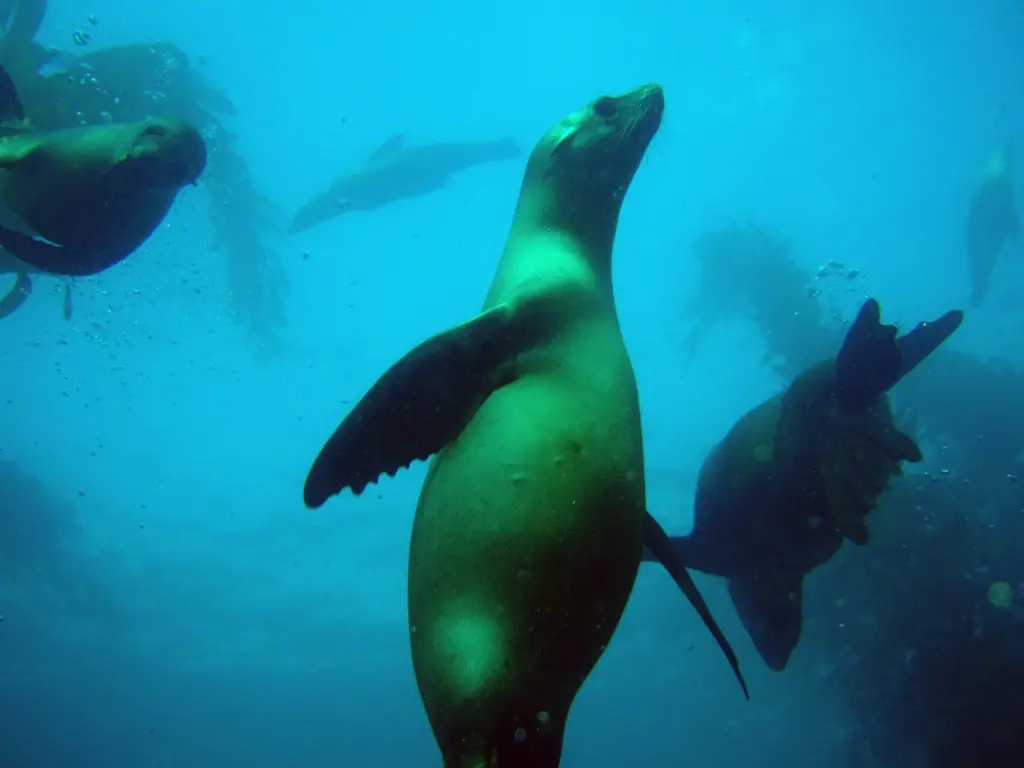
Sea lions, turtles and dolphins
Sea lions are the playful ones. The Los Islotes colony near La Paz, home to more than 200 sea lions, is just over an hour by boat and closed from June 1 to August 31 for pupping, and California’s Channel Islands have sea lions in the kelp. Sea turtles are easy to find in Hawaii, Cozumel and Belize; all six species in US waters are protected under the Endangered Species Act. Wild dolphins are a different case: in Hawaii, a federal rule bars swimming with or approaching spinner dolphins within 50 yards, and NOAA’s general guidance in US waters is to stay 50 yards from dolphins, seals, sea lions and sea turtles and never to feed, touch or ride them.
Mola, octopus, coral spawning and more
- Mola mola. The oceanic sunfish visits Bali’s Nusa Penida, usually from July to the end of October, when cold upwellings can drop the water to about 64°F (18°C).
- Octopus and muck critters. Florida’s Blue Heron Bridge turns up octopus, seahorses and frogfish in 5-20 ft of water, best from an hour before to an hour after high tide. “Muck diving,” a term coined by Bob Halstead for black-sand diving in Papua New Guinea’s Milne Bay, now centers on Lembeh in Indonesia, Anilao and Dauin in the Philippines, and Mabul and Kapalai in Malaysia.
- Coral spawning. At Texas’s Flower Garden Banks, mass coral spawning happens about 7-10 days after the August full moon, generally between 9 p.m. and midnight.
- Night and blackwater diving. Kona’s blackwater dives float you over deep water at night to see larval fish and drifting animals. Big Island Divers charges $199, tethers each diver to a 50-foot line 2-3 miles offshore and asks for 25 logged dives; Jack’s Diving Locker runs its version on Tuesdays and Thursdays for $230.
- Crocodiles. Cuba’s Jardines de la Reina is known for crocodiles as well as sharks.
- Manatees and dugongs. Florida’s Crystal River was made a national wildlife refuge in 1983 specifically to protect manatees; dugongs, their ocean-going cousins, are rarer and shyer, and get their own guide.
Planning a whale shark trip from the US
- Pick the site by month. Summer means Isla Mujeres and Holbox; winter means La Paz; spring means Belize, Utila and Ningaloo; any month works in the Maldives.
- Book a licensed operator with a small boat. Ask how many guests are aboard, how many swim at a time, and what happens if no sharks are found. Some operators offer a free repeat trip or partial refund if you strike out.
- Plan two days, not one. Whale sharks are wild animals, and weather cancels trips.
- Sort out entry paperwork. Mexico needs a passport, with the tourist card fee built into your airfare; the Galapagos needs a transit card and park fee; for Australia, check the electronic travel authorization rules well before you fly.
- Pack light. Mask, snorkel, fins if you have them, a rash guard, a hat, seasickness pills and cash for park taxes and tips.
- Combine it. Isla Mujeres pairs with Cozumel diving or cenotes, La Paz with sea lions at Los Islotes, Belize with the barrier reef, and Ningaloo with humpbacks and reef dives.
Frequently asked questions
Is swimming with whale sharks worth it?
For most people, yes. Swimming beside a fish the size of a bus is one of the most memorable wildlife encounters anywhere, and at a well-run site it’s safe and low-impact. It’s worth it most when you choose a wild aggregation with good rules and a small boat, go in peak season, and allow a spare day in case the sharks don’t show.
Can you swim with whale sharks in Cancun?
Yes, from roughly mid-May or June to mid-September, peaking in July and August. Tours from Cancun, Isla Mujeres, Playa del Carmen, Cozumel and Holbox head to the feeding grounds offshore; Mexico Whale Shark’s Cancun tour starts at $190. Mexico’s rules allow only snorkeling, with two swimmers and a guide per shark and life jackets required.
Can you swim with whale sharks in Hawaii?
Not reliably. Whale sharks pass through Hawaiian waters, but there’s no season and no operator can plan a trip around them. For a whale shark trip from the US, Mexico is the closest option, with Isla Mujeres and Holbox in summer and La Paz in winter. Hawaii’s big-animal highlight is the Kona manta night dive.
Can you swim with whale sharks at the Georgia Aquarium?
Georgia Aquarium runs Journey with Gentle Giants programs in its Ocean Voyager habitat, including a 30-minute scuba dive at 20-30 feet for certified divers 12 and older with whale sharks and manta rays. It’s the best-known way to share the water with a whale shark without leaving the country, but it’s a captive setting, not a wild encounter.
Is swimming with whale sharks safe?
Yes, if you follow the rules. Whale sharks are filter feeders with no interest in people. The risks come from open water: tiring yourself out, current, seasickness and sunburn, plus the tail and the boat if you get too close. Wear the required wetsuit or life jacket, stay with your guide, and keep about 10 feet from the body and farther from the tail.
Is swimming with whale sharks ethical?
At wild, regulated sites, it can be. Tourism gives communities a reason to protect an endangered species, and good operators keep encounters short and respectful. Feeding sites are different: research at Oslob in the Philippines found crowding, frequent rule-breaking and changed behavior in sharks that are fed daily. Choose wild aggregations, keep your distance and never touch.
How close can you get to a whale shark?
Not very close, by the rules. At Ningaloo, swimmers must stay at least 3 m (about 10 ft) from the head and body and 4 m (about 13 ft) from the tail, and an Isla Mujeres guide puts the distances at 2 m from the head and 3 m from the tail. Touching and riding are banned everywhere that has rules. Let the shark come past you; don’t swim toward it.
Can children swim with whale sharks?
Often, yes. Mexico Whale Shark’s Cancun tours take guests from age 4, and life jackets are mandatory in Mexico’s Caribbean, which helps young or nervous swimmers float without effort. Operators everywhere ask that swimmers be comfortable in open water. Children who snorkel confidently usually love it; others can watch from the boat.
When is whale shark season?
It depends on the site: June to September for Isla Mujeres and Holbox, roughly November to April for La Paz, March to June for Belize’s Gladden Spit, late February to April for Utila, March to July for Ningaloo, June to November for the Galapagos, and year-round in the Maldives’ South Ari Atoll.
Sources and verification
Everything on this page was checked on September 23-24, 2026 against the organizations listed below, and the page is compiled from them; we don’t claim first-hand swims with the operators named. Prices are the operators’ published rates and can change, so confirm before you book.
- Western Australia DBCA: whale shark management at Ningaloo
- Legaspi et al. (2020), Royal Society Open Science: provisioning effects at Oslob and Thomson et al. (2017): whale shark residency at Oslob
- HOY BCS: La Paz 2025-2026 whale shark season results
- The Hook Experiences (La Paz) and Mexico Whale Shark
- IUCN Red List: whale shark
- Georgia Aquarium: Journey with Gentle Giants
- NOAA Fisheries: marine life viewing guidelines
- Explorer Ventures, Oceanic Society and Nautilus Liveaboards (liveaboard and expedition prices)
- US State Department travel advisories
Also checked: Belize’s Gladden Spit reserve, the Utila whale shark guide, Exmouth Dive and Whalesharks Ningaloo, Ningaloo Whale Sharks, Privilege Hotels’ Isla Mujeres guide, SSI’s Belize guide, PADI, Scuba Junkie Penida’s megafauna log, the Silver Bank sanctuary operators, the Flower Garden Banks National Marine Sanctuary, and the European Central Bank’s reference rate of September 24, 2026.
Scuba Tourism Guide is an independent publication. It is not affiliated with any agency, park, aquarium or operator named here, and no one paid to be included.
Photo credits
- Whale shark off Exmouth, Ningaloo (featured image): photo by NeilsPhotography, Wikimedia Commons (CC BY 2.0)
- Snorkelers and whale shark, Ningaloo Reef: photo by Sylke Rohrlach from Sydney, Wikimedia Commons (CC BY-SA 2.0)
- Whale shark filter-feeding at night: photo by Arturo de Frias Marques, Wikimedia Commons (CC BY-SA 4.0)
- Whale sharks at Oslob, Cebu, Philippines (2015): photo by Jake Gaviola ijakegaviola, Wikimedia Commons (CC0)
- Giant manta ray filter-feeding: photo by Arturo de Frias Marques, Wikimedia Commons (CC BY-SA 4.0)
- Humpback whale underwater: photo by Sylke Rohrlach from Sydney, Wikimedia Commons (CC BY-SA 2.0)
- California sea lions, Channel Islands National Marine Sanctuary (NOAA): photo by Claire Fackler, CINMS, NOAA. Credit: NOAA/NOS/NMS/CINMS; National Marine Sanctuaries Media Library., Wikimedia Commons (public domain)


