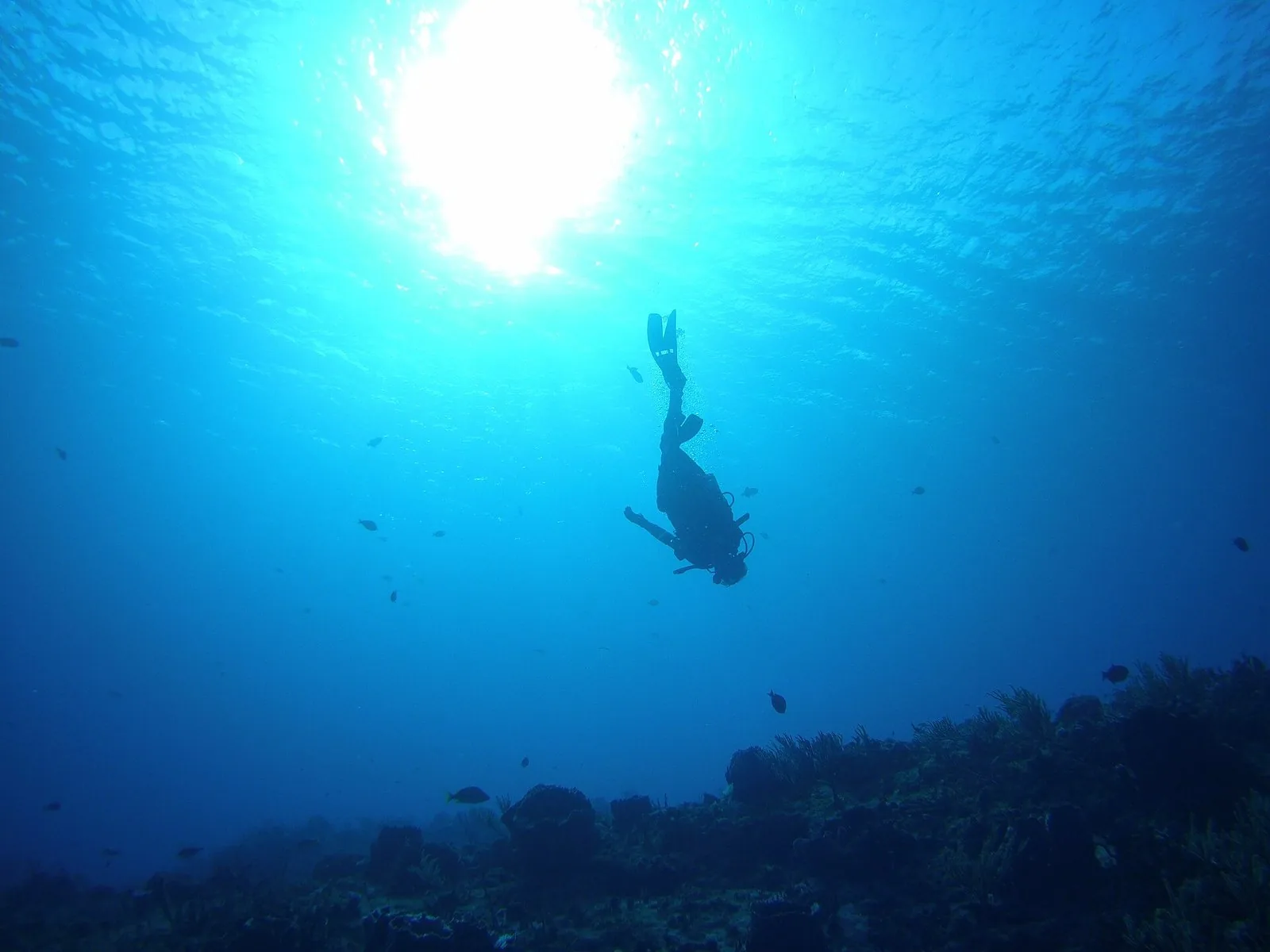
Drop in at Palancar or Santa Rosa and you don’t swim so much as fly. A current running south to north along Cozumel’s west coast carries you past coral towers, swim-throughs and sponge-covered walls while the boat follows your bubbles overhead, and at the end of the dive you simply surface and wait to be collected. That easy, conveyor-belt drift is what made Cozumel diving famous, and it’s why this 30-mile island off Mexico’s Caribbean coast draws so many American divers. Add warm water, 100-foot visibility, nonstop flights from Texas and Miami and a steady stream of cruise ships, and you have one of the easiest dive trips from the US. Here’s how to do it well: the sites, the park fee that many websites still get wrong, the seasons, the shops and what a week really costs.
Short answer: Cozumel has some of the Caribbean’s best drift diving: gentle south-to-north currents, walls and coral pinnacles, 78-85°F water and often 100 ft visibility. Two-tank boat dives cost about $100-$135, plus a 225 MXN (about $13) daily marine park fee (checked September 2026). Beginners dive the shallow reefs; Punta Sur and the deep walls are for experienced divers.
Prices, fees, closures and flight details below were checked on September 23-24, 2026 against the operators’ own websites, Mexico’s national parks agency and the airport’s published routes. We name shops so you can compare like with like; none of them paid to appear here.
On this page: At a glance · Why dive Cozumel · Marine park and fees · Dive sites · How the drift works · Marine life · Best time to go · Getting there · From a cruise ship · Resorts and packages · Dive shops and prices · Budget · Getting certified · Safety · Non-divers · Sample week · FAQ
Cozumel diving at a glance
| Question | Answer (checked September 2026) |
|---|---|
| Skill level | All levels. Shallow reefs such as Paradise and Columbia Shallow suit new divers; Punta Sur and the deep walls are for experienced divers. |
| Best months | Year-round, with about 300 diveable days a year. May-September for warm, calm water; November-March for eagle rays and bull sharks. |
| Water temperature | 78-85°F (26-29°C) year-round; about 77°F (25°C) in winter and 85°F (29°C) in summer |
| Visibility | Typically 80-130 ft (24-40 m) |
| Depth range | 20-30 ft (6-9 m) at Columbia Shallow to 140 ft (43 m) at Punta Sur’s Devil’s Throat |
| Signature marine life | Splendid toadfish (found only here), spotted eagle rays, turtles, nurse sharks, groupers, bull sharks in winter |
| Two-tank boat dive | About $100 a day in multi-day packages to $135 for a single day, plus the park fee where it isn’t included |
| Marine park fee | 225 MXN (about $13) per person per day |
| Getting there | Year-round nonstops to Cozumel (CZM) from Dallas/Fort Worth, Houston and Miami, more in season; or fly to Cancun and take the ferry from Playa del Carmen |
| Entry rules | US passport; visa-free stays up to 180 days; the tourist card (FMM) fee is built into airline tickets |
Is Cozumel diving good? Who it suits, and who should look elsewhere
Cozumel sits about 30 miles (48 km) long and 10 miles (16 km) wide, a flat limestone island a short hop off the Yucatan coast, and its diving happens along the sheltered west and south coasts. The reef there is part of the Mesoamerican Reef, the long barrier system that runs south through Belize and Honduras, and a steady current sweeps along it from south to north. That combination gives Cozumel its signature: gentle drift dives past big coral structures, swim-throughs and deep walls, in water so clear that 100-foot visibility is ordinary.
It suits a lot of people. Beginners get shallow, easy reefs and a huge choice of shops. Experienced divers get walls, caverns and the deep swim-throughs at Punta Sur. Families and non-divers get an easy vacation island with restaurants, beach clubs and a ferry to the mainland. And it’s close: Cozumel’s airport has year-round nonstops from Dallas/Fort Worth, Houston and Miami.
Now the caveats. Cozumel is busy. Cruise ships are in port on many days, popular sites such as Santa Rosa can host many boats at once, and the town is geared to day-trippers. The reefs have been knocked back, too: Hurricanes Emily and Wilma in 2005 together cut live coral cover by 56 percent, most of it from Wilma, and the park now rests heavily visited sites on a rotating basis. The current, while usually gentle, can be strong, and divers who struggle with buoyancy or who don’t like being carried along may not enjoy it. And if you want to dive on your own schedule from shore, Bonaire is a better fit.
Our take: Cozumel is the easiest excellent dive trip from the US. Book a small-boat operator, dive the south end (Palancar, Columbia, Punta Sur) rather than the crowded mid-island sites every day, and come between May and September if you want warm water and fewer crowds. If you’re weighing Cozumel vs Roatan, Cozumel is the pick for drift diving; Roatan, in Honduras, is better known for calmer reef diving and a quieter island.
Cozumel vs Roatan vs Bonaire
These three are the islands Americans most often weigh against each other for a Caribbean dive week. Here’s how they differ on the points that decide it (checked September 2026).
| Cozumel | Roatan (Honduras) | Bonaire | |
|---|---|---|---|
| Diving style | Boat drift dives along reefs and walls | Boat and shore diving; some resorts include unlimited beach diving | Shore diving: more than 85 sites, 54 of them easy to reach from shore |
| US nonstops | Year-round from Dallas/Fort Worth, Houston and Miami | Year-round from Miami, Dallas/Fort Worth, Atlanta and Houston | From Miami, Atlanta, Newark and Houston |
| Fees and entry | 225 MXN a day marine park fee; tourist card fee in the airfare | Visa-free up to 90 days; passport valid 3+ months | $40 nature fee plus $75 entry tax |
| Typical package | 5 nights with 3 dive days from $604 | 7 nights, 12 boat dives and meals from $1,427 (Anthony’s Key Resort sale) | Varies; mostly self-guided shore diving |
| Best for | Effortless drifts, easy flights, cruise-port diving | All-inclusive dive resorts | Divers who want to dive on their own schedule |
Cozumel Reefs National Marine Park: fees, closures and rules
Almost all of the diving is inside Parque Nacional Arrecifes de Cozumel, which Mexico declared in July 1996. It covers about 11,988 hectares (roughly 29,600 acres) along the western and southern shores, from near the International cruise pier south and around Punta Sur. CONANP, Mexico’s national protected-areas agency, manages it.
The fee. The daily park fee is 225 MXN per person, about $13 at September 2026 exchange rates. It applies to divers, snorkelers, glass-bottom-boat passengers and non-diving companions on the boat. It has risen fast: it jumped from 108 MXN to 218.32 MXN on January 1, 2025, and rose again on January 1, 2026. Some operators’ websites still print an old $5 figure, so budget for the real one. Some shops include it (ScubaTony’s prices include park fees and taxes); others, such as Sand Dollar Sports, collect it separately at $13 a day in US cash. Children under 12, seniors, pensioners and visitors with disabilities enter free with documents, students and teachers get 75% off, and Mexican nationals and foreign residents get 50% off.
The annual pass. CONANP’s Pasaporte de la Conservacion costs 3,760 MXN (about $214) and is valid for a year from purchase. It only pays off at around 17 diving days, so it’s for repeat visitors and residents. There’s no weekly or multi-day pass.
Rotating closures. Each month the park closes a few sites to let them recover. For September 2026, Blue Note Scuba listed Palancar Caves, Palancar Bricks, Columbia Shallow and Columbia Deep as closed. Check the current list with your shop before you set your heart on a particular site.
The rules. Don’t touch or stand on coral, don’t collect anything, and follow your guide’s instructions on buoyancy and group spacing. The reef is protected, and it’s still recovering.
The best Cozumel dive sites
Cozumel’s sites run in a line down the west coast to Punta Sur at the southern tip. Roughly speaking, the farther south you go, the bigger the structures and the stronger the current. Depths below come from the operators’ own site guides.
| Site | Depth | Level | Highlights |
|---|---|---|---|
| Paradise Reef | 30-40 ft (9-12 m) | All levels | Easy, shallow; splendid toadfish, octopus and lobster at night |
| Chankanaab Shallows | To 50 ft (15 m) | All levels | Easy reef dive; good for night dives |
| Yucab Reef | 40-60 ft (12-18 m) | All levels | Colorful second dive; lobster, octopus, scorpionfish, toadfish |
| Columbia Shallow | 20-30 ft (6-9 m) | All levels | Aquarium-like, mild current, turtles in grassy patches |
| Palancar Gardens | 30-60 ft (9-18 m) | All levels | Coral garden on the edge of the drop-off; rays in the sand |
| Palancar Reef and Caves | To 98 ft (30 m) | Intermediate | Multi-level drift through caverns and coral tunnels |
| Palancar Bricks | 40-120 ft (12-37 m) | Intermediate to advanced | Big coral structures on the wall |
| Paseo de Cedral | 40-60 ft (12-18 m) | Experienced | Moderate to strong current, swim-throughs |
| Santa Rosa Wall | Wall dive; the guide sets the depth | Intermediate | Tunnels in the wall, barracuda, jacks, eagle rays, turtles |
| Columbia Deep | 60-120 ft (18-37 m) | Experienced | Towering pinnacles split by sand chutes |
| C-53 wreck (Felipe Xicotencatl) | 24-80 ft (7-24 m) | Open Water outside; Advanced inside | 184-ft Mexican Navy minesweeper sunk in 2000 |
| Punta Sur and Devil’s Throat | 60-140 ft (18-43 m) | Advanced; Blue Note asks for 50+ logged dives | Deep passages, the Cathedral chamber, strong current |
Palancar Reef
Palancar is the name most people know, and it’s really a string of sites along the southwest coast: Palancar Gardens at 30-60 ft is a coral garden on the lip of the drop-off, Palancar Bricks runs down to 120 ft, and Palancar Reef and Caves is a multi-level drift through caverns and coral tunnels to a maximum of about 98 ft, with turtles, nurse sharks and, in winter, eagle rays. Two of the Palancar sites were closed in September 2026, which is exactly why the rotation exists: this is the reef everyone wants to dive.
Santa Rosa Wall
Santa Rosa is Cozumel’s most famous wall and one of its most popular first dives of the day. The attraction is the wall itself, cut through with tunnels and overhangs, where you may see lobsters, barracuda, horse-eyed jacks, eagle rays and turtles. It’s generally recommended for intermediate divers because the current can be unpredictable, and because it’s popular, it can be crowded. A good guide will keep you on a sensible depth profile; the wall itself drops far below recreational limits, so watch your computer.
Columbia
Columbia comes in two flavors. Columbia Shallow, at 20-30 ft, has mild currents and so much life that it feels like an aquarium, which makes it a favorite for photographers and new divers. Columbia Deep, at 60-120 ft, is one of Cozumel’s classic wall dives, with towering coral pinnacles divided by sand chutes pouring into the blue. Both were on the September 2026 closure list, so ask whether they’ve reopened.
Punta Sur and the Devil’s Throat
Punta Sur, at the southern tip, is Cozumel’s advanced dive. According to Royal Caribbean’s Cozumel dive guide, you drift through large passages at about 100 ft into a chamber called the Cathedral, and the Devil’s Throat is a passage that starts at 90 ft and narrows as it winds down to 140 ft. Currents are strong, and Blue Note Scuba asks for at least 50 logged dives. This is an overhead environment at depth, beyond Open Water training, so only do it with Advanced certification, deep-diving experience, a guide who dives it regularly, and a gas plan.
The C-53 wreck
The Felipe Xicotencatl, known as the C-53, is a 184-foot Mexican Navy minesweeper sunk as an artificial reef in 2000. It sits upright on sand at about 80 ft, with the top structure much shallower. Open Water divers can explore it from outside; Advanced divers with a guide can enter through the large holes cut in its sides, where glassy sweepers and sardines school.
Night diving in Cozumel
Cozumel’s reefs change after dark. Octopus, lobster, king crabs and the endemic splendid toadfish come out, and shallow sites like Paradise Reef and Chankanaab are the usual choices. ScubaTony charges $145 for a twilight or night dive and requires that you’ve done a daytime two-tank dive the day before, with at least two divers booked (checked September 2026). Other shops set their own rules, but most want to see you dive in daylight first.
Shore diving in Cozumel
Can you shore dive in Cozumel? Yes. Some west-coast hotels have ladders or steps into the water, and shops rent tanks for shore dives. The same rules apply as on the boats, plus two more: the current still runs south to north, so plan to exit down-current from where you entered, and stay close to the shore and away from boat lanes, where dive boats and other traffic pass. Shore diving is a good way to add cheap extra dives, practice buoyancy or shoot photos at your own pace.
Scuba diving in Cozumel: how the drift works
Almost all diving in Cozumel is drift diving. The current runs from south to north along the west coast, so instead of anchoring and swimming out and back, the boat drops you up-current, you descend together as a group, and the current carries you along the reef while the boat follows your bubbles. When the dive ends, you make your safety stop as a group, surface together, and the boat picks you up where you come up.
For most of the year the current is gentle, and it’s what makes Cozumel diving feel effortless. At times, especially during seasonal transitions, it can be strong, and the sites at the far north and far south of the island are then best left to advanced divers. A few habits make drift diving easy:
- Descend quickly and together. The boat drops you where the current will carry you over the reef; hanging at the surface puts you somewhere else.
- Stay close to the guide and the group. The boat follows one set of bubbles, not five.
- Stay low and use the reef’s shelter. The current is weaker close to the reef and behind coral heads, but never hold on to coral.
- Carry a surface marker buoy and know how to deploy it, in case you surface away from the group.
- Don’t fight it. If the current is stronger than you like, tell your guide; swimming against it burns air fast.
Drift diving in Cozumel is the best introduction to drift diving anywhere, and after a week here a lot of divers find still-water diving a little dull.
Cozumel marine life and when to see it
Cozumel has one animal nobody else can offer: the splendid toadfish, a flat-headed fish with electric-yellow fins that lives only in the reefs around the island. Listen for its croak and look for its whiskered head under ledges. Beyond that, expect green and hawksbill turtles grazing on sponges, nurse sharks sleeping under ledges, big groupers, barracuda, jacks, schools of grunts and snappers, angelfish and plenty of lobster and octopus.
| Animal | When | Where |
|---|---|---|
| Splendid toadfish | Year-round | Under ledges on most reefs; active at night |
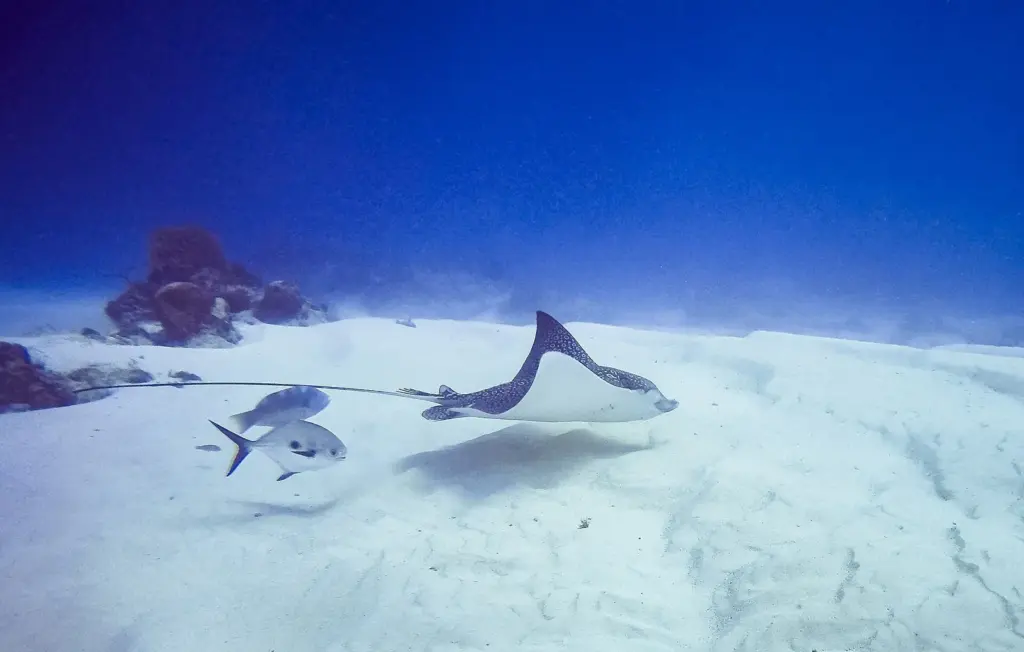
| Spotted eagle rays | November-March is best | Along the deep walls |
| Bull sharks | November-March | Offshore sand areas; ask shops that run dedicated trips |
| Green and hawksbill turtles | Year-round | Reefs and shallow grassy areas, such as near Columbia Shallow and Paradise Reef |
| Nurse sharks | Year-round | Sleeping under coral ledges |
| Whale sharks | Roughly June-September | Off Isla Mujeres and Holbox on the mainland side; tours also depart from Cozumel |
Cozumel’s marine life isn’t about huge numbers of big animals; it’s about healthy reef fish, turtles and the chance of an eagle ray or a shark on any dive. For whale sharks, look to the mainland: the Holbox season runs June to September, peaking in July and August.
Best time to dive Cozumel, month by month
Cozumel can be dived year-round, and operators count about 300 diveable days a year. The water stays between 78°F and 85°F (26-29°C): Blue Note Scuba measured 82-86°F (28-30°C) in September 2026, and winter averages run about 77°F (25°C). The trade-offs are wildlife, crowds and the weather. The Atlantic hurricane season runs from June 1 to November 30, with its climatological peak on September 10 and most activity from mid-August to mid-October. According to NOAA, an average season (1991-2020) brings 14 named storms, 7 hurricanes and 3 major hurricanes, with the first hurricane typically forming in early to mid-August and the first major hurricane in late August or early September. That doesn’t mean a storm will hit Cozumel, but it does mean late summer and fall trips need flexible plans. Winter cold fronts, known locally as nortes, can bring wind and waves that cancel boat dives for a day or two.
| Month | Water | What’s happening |
|---|---|---|
| January | About 77°F (25°C) | Eagle rays and bull sharks; winter crowds; occasional cold fronts |
| February | About 77°F (25°C) | Eagle rays; Presidents’ Day week fills up |
| March | Warming | Last of eagle ray season; spring break crowds |
| April | Warming | Easter week is busy; calmer seas |
| May | Warm | Start of the warm, calm, uncrowded season |
| June | About 85°F (29°C) | Hurricane season begins; whale shark season opens on the mainland |
| July | About 85°F (29°C) | Warm and calm; summer family travel |
| August | About 85°F (29°C) | Warmest water; hurricane risk rising |
| September | 82-86°F (28-30°C) | Peak hurricane risk; fewest visitors; 100+ ft visibility reported in 2026 |
| October | Warm | Hurricane risk still real; quiet island |
| November | Cooling | Eagle rays and bull sharks return; hurricane season ends November 30 |
| December | Cooling toward 77°F | Christmas to New Year’s is the busiest and most expensive stretch |
What to wear. Most divers are comfortable in a 3 mm full suit for most of the year. Winter water around 77°F feels cool by the third dive of a day, so bring a 5 mm suit or a hooded vest if you chill easily; in summer, some divers drop to a shorty or a skin, though a full suit also protects against stings and scrapes.
Our take: For most divers, the best time to dive Cozumel is May through July: warm, calm water, fewer crowds and the lowest hurricane risk of the warm season. Come November to March if eagle rays and bull sharks matter more to you than a couple of degrees. If you travel in August to October, buy travel insurance and keep your plans flexible.
Getting to Cozumel from the US
Flying direct. Cozumel International Airport (CZM) has year-round nonstops from Dallas/Fort Worth (American), Houston-IAH (United) and Miami (American Eagle), plus seasonal flights from Atlanta (Delta), Charlotte (American), Chicago-O’Hare (American, United), Denver (United) and Minneapolis/St. Paul (Delta, Sun Country) (checked September 2026). The airport handled 646,606 passengers in 2025, and Dallas/Fort Worth was its busiest US route. The airport is on the edge of San Miguel, the island’s only town, so transfers are short.
Via Cancun. If there’s no convenient nonstop, fly to Cancun, which has far more US service, then take a shuttle or taxi to Playa del Carmen and the passenger ferry across. Ultramar and Winjet run ferries from the Playa del Carmen terminal at the end of Fifth Avenue; the crossing takes about 30-40 minutes, and 2026 fare guides put a one-way adult ticket at roughly 280-330 MXN. Check the ferry companies’ own sites for current times and fares, and allow at least half a day for the whole trip from Cancun airport.
Entry rules. US citizens need a passport to fly to Mexico and back; a passport is also what US Customs expects when you return by air. Americans can visit Mexico without a visa for up to 180 days. Every visitor needs a Forma Migratoria Multiple (FMM), the tourist permit, and for commercial air arrivals the fee, 983 MXN (about $56) in 2026, is included in your airline ticket. The State Department rates Quintana Roo, which includes Cozumel, at Level 2, “exercise increased caution,” and advises extra care after dark in downtown Cancun, Tulum and Playa del Carmen (checked September 2026).
Scuba diving Cozumel from a cruise ship
Cozumel is one of the busiest cruise ports in the Caribbean, and plenty of cruise passengers dive here. The island has three cruise piers: Punta Langosta near downtown, the International Pier and Puerta Maya farther south. Many dive boats leave from Marina Caleta, south of town. Taxis from the cruise piers to Marina Caleta take about 3-7 minutes and cost around $8-9, and Salty Endeavors says Punta Langosta is under 10 minutes’ walk from the public pier, the International Pier about 10 minutes, and Puerta Maya about 20 minutes, so take a taxi from there. Several shops schedule cruise-diver boats around ship times, such as 8 a.m. and 1:30 p.m.
You can book through the cruise line or directly with a shop. Royal Caribbean’s certified dive tours, for example, require a minimum age of 12, a scuba medical questionnaire and proof of certification. Booking direct can be cheaper and can get you a smaller boat, but you’re responsible for getting back before all-aboard. Pick an operator that plans around your ship’s schedule, bring your certification card and a copy of your ship’s departure time, and don’t plan a deep or long second dive on a port day. And remember the flying-after-diving rule doesn’t apply to your ship, but it does apply to any flight home a day or two later.
Where to stay: Cozumel dive resorts and packages
Almost everyone stays along the west coast, which faces the reefs and the mainland. Your choice is mostly about style:
- Town (San Miguel). Small hotels, condos and guesthouses within walking distance of restaurants and dive shops. The cheapest option and the most convenient for independent divers.
- North of town. Hotels and condos along the coast toward the airport, many with piers or water access. Quieter than town, a short taxi ride from everything.
- South of town. The stretch toward Paradise Reef and Chankanaab has dive resorts and all-inclusives, some with their own dive centers and piers where boats pick up guests.
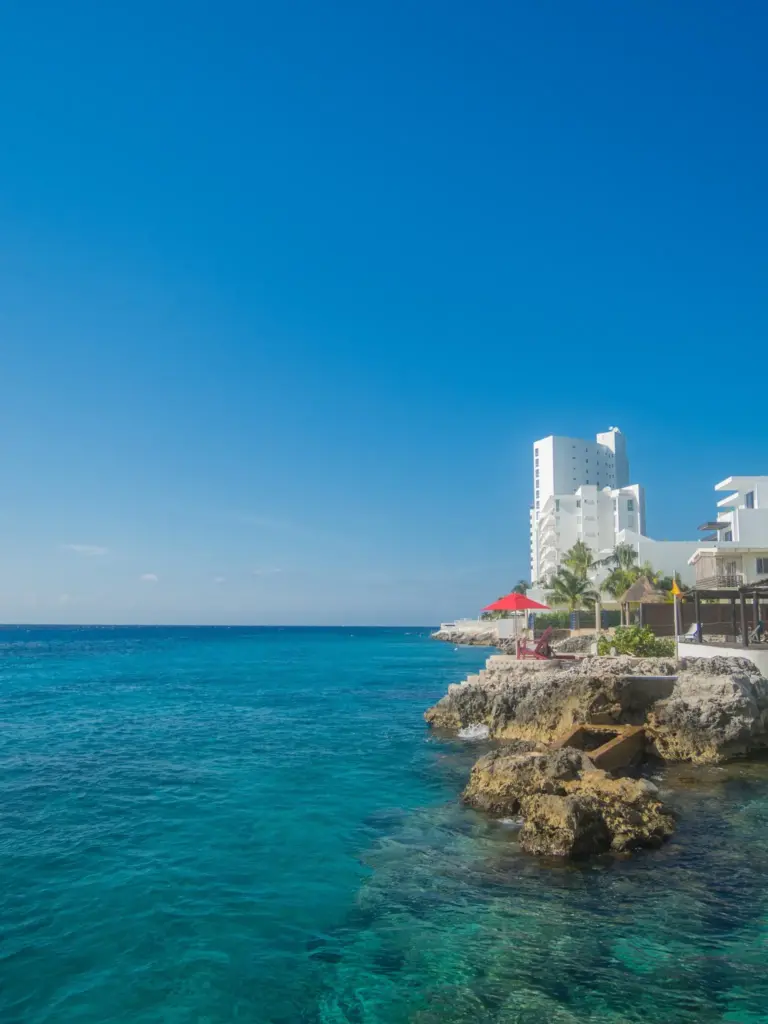
Cozumel dive resorts and dive packages can save money if you’re diving most days. Caradonna’s September 2026 specials, for example, listed five nights at Cozumel Hotel Resort with three days of two-tank morning dives with Dive Paradise from $604 per person (book by September 30, 2026, for travel through December 20, 2026), five nights all-inclusive at Occidental Cozumel with three days of diving with Pro Dive from $795, and five nights at Dreams Cozumel Cape with Dive House from $860 (land-only, per person, double occupancy). Compare those against booking a condo and a dive shop separately, which gives you more choice of operator and boat size.
Choosing a Cozumel dive shop: prices, boats and tipping
Cozumel has a long list of dive shops, so choose on boat size and style rather than price alone. A few examples of what shops charged in September 2026:
| Operator | Price | What’s included | Notes |
|---|---|---|---|
| ScubaTony | $135 two-tank; $125 a trip in a five-trip package; night dive $145 | Tanks, weights, park fees and taxes | Maximum six divers per boat |
| Sand Dollar Sports | Two-tank packages: 2 days $215, 3 days $321, 4 days $420, 5 days $510 | Boat dives | Park fee extra ($13 a day, cash); gear $25 a day, wetsuit $10, nitrox $13 a tank |
| Blue Note Scuba | See its price list | Varies | Publishes a monthly site and closure guide |
What to ask before you book:
- How many divers on the boat and per guide? Small boats of six divers or so mean you’ll dive at your own pace with a guide who knows your name. Big boats are cheaper and busier.
- Is the park fee included? If not, bring US cash or pesos for it every day.
- Nitrox? With deep walls and multi-dive days, nitrox lengthens your no-decompression time. Sand Dollar charges $13 a tank.
- Which sites? Some shops dive the popular mid-island reefs every day; others head south to Palancar, Columbia and Punta Sur. Ask for a plan that matches your experience.
- Pickups? Some shops pick up from hotel piers along the coast, which saves time.
Beyond price, look at safety. A good Cozumel shop briefs every dive, carries oxygen and a radio on the boat, keeps its guide-to-diver ratio small, checks your certification and recent experience, and plans deeper dives such as Punta Sur only for divers with the logbook to match. If a shop won’t tell you how many divers go per guide, or which sites it plans to dive, keep looking.
Tip the crew as you would on any dive boat: a common guideline is $5-$10 per tank for a day-boat crew, and 10-20% of the course price for an instructor.
What a week of diving in Cozumel costs
This is what the diving alone costs for a seven-night trip with five days of two-tank boat dives, using Sand Dollar Sports’ published package and fees as the example (checked September 2026).
| Item | Low | High | Notes |
|---|---|---|---|
| Five days of two-tank boat dives | $510 | $510 | Five-day package |
| Marine park fee | $65 | $65 | $13 a day for five days |
| Nitrox | $0 | $130 | $13 a tank for 10 tanks |
| Rental gear and wetsuit | $0 | $175 | $25 plus $10 a day |
| Crew tips | $50 | $100 | $5-$10 per tank |
| DAN membership | $40 | $40 | Per year; dive accident insurance is extra |
| Diving total | $665 | $1,020 | ScubaTony’s five-trip package, with park fees and taxes included, is $625 |
Add flights, which depend heavily on your gateway (Texas and Miami nonstops are the easiest), lodging in your chosen tier, meals and taxis. A condo in town with a kitchen keeps costs down.
Getting scuba certified in Cozumel
Cozumel is a good place to learn: warm, clear water and shallow, easy reefs. ScubaTony, for example, lists Discover Scuba at $170, the full Open Water course at $560 with SSI eLearning or $650 with PADI eLearning, an Open Water referral (your four open water dives, after you’ve done theory and pool work at home) at $400, and Advanced Open Water from $595 (SSI) or $740 (PADI) (checked September 2026). Blue Note Scuba runs the Enriched Air Nitrox course as a two-tank course in the marine park, which is worth doing here because of the deep walls and repetitive diving.
The smarter plan for most Americans is the referral: do the eLearning and pool sessions near home, then finish your open water dives in Cozumel. You spend your vacation diving instead of in a classroom. And the Advanced course pays off quickly here, because the best walls and Punta Sur are beyond Open Water depth.
Safety: currents, the chamber, hurricanes and insurance
Currents. Cozumel’s current is usually a gentle helper, but it can be strong, especially at the far north and south of the island and during seasonal changes. Stay with your group, carry a surface marker buoy, and don’t dive Punta Sur or the deep walls before you’re ready. Cozumel’s drift style also means you can’t easily return to the boat mid-dive, so plan your air carefully.
Depth. Many of the best walls drop far below recreational limits. Set your computer’s depth and no-decompression alarms, watch them, and consider nitrox for repetitive days.
The chamber. Cozumel has recompression treatment on the island. Grupo Medico Costamed runs a hyperbaric chamber that treats decompression sickness, lists itself as a DAN Preferred Provider, and offers divers a free fitness-to-dive phone consultation with a diving-medicine specialist. In an emergency, alert your crew, then call DAN’s 24-hour line at +1-919-684-9111.
Insurance. DAN membership costs $40 a year and includes up to $150,000 of emergency medical transportation for emergencies more than 50 miles from home; dive accident insurance is sold separately and pays up to $500,000 on DAN’s top plan (checked September 2026). Travel insurance that covers hurricane disruption is worth buying for August to October trips.
Flying home. The CDC advises waiting at least 12 hours after a single no-decompression dive and at least 18 hours after multiple dives or multiple days of diving before flying. On a Cozumel week, that usually means a non-diving last day.
Cozumel for non-divers in your group
- Snorkeling. The shallow west-coast reefs and beach clubs have good snorkeling, and non-divers can ride along on some dive boats (they pay the same daily park fee).
- Whale sharks. In summer, tours from Cozumel and the mainland head to the whale shark gathering grounds off Isla Mujeres and Holbox. Mexico Whale Shark, for one, runs tours departing from Cozumel. The season runs roughly June to September.
- Cenotes. Cenote diving and swimming happen on the mainland. Take the ferry to Playa del Carmen; cenote operators run trips from there and from Tulum and Puerto Aventuras.
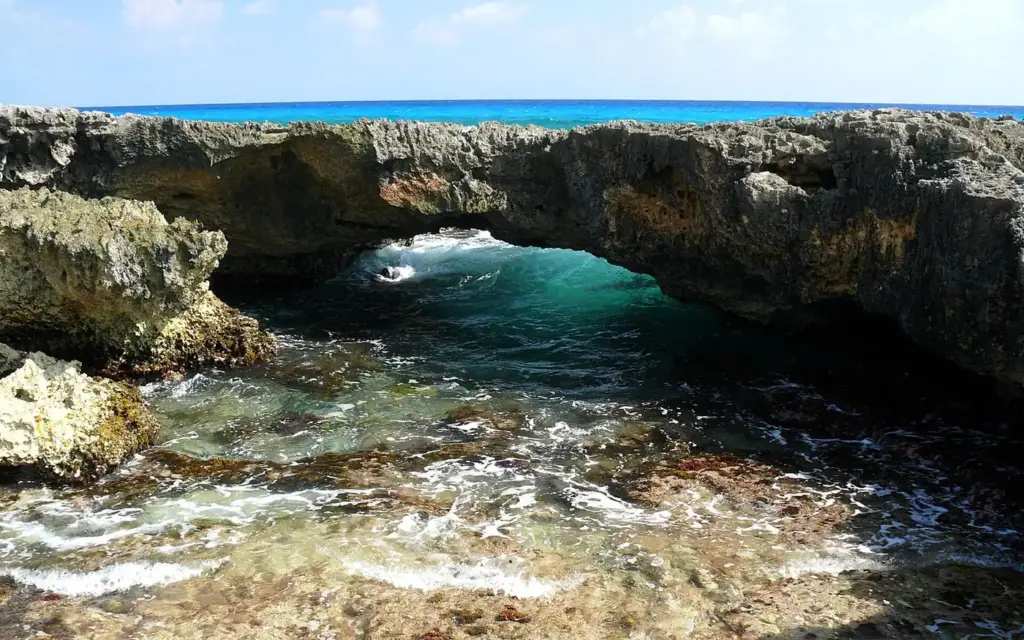
- The east coast. Cozumel’s windward side is wild and undeveloped, with rocky arches and open-ocean surf. Rent a car or scooter for a day and drive the coast road.
A sample seven-night Cozumel dive week
| Day | Plan |
|---|---|
| 1 | Fly to Cozumel. Check in, visit your dive shop, and sort out gear. |
| 2 | Easy two-tank day: a shallow reef such as Paradise or Yucab to check buoyancy and weighting. |
| 3 | Two-tank day on the south reefs: Palancar Gardens and Columbia Shallow (if open). |
| 4 | Two-tank morning at Santa Rosa and a shallower site, then a night dive at Paradise Reef or Chankanaab. |
| 5 | Two-tank day: the C-53 wreck and a reef, or Punta Sur if you’re Advanced and experienced. |
| 6 | Final two-tank morning; last dive finished by early afternoon. |
| 7 | Topside day: the east coast, a beach club, or the ferry to Playa del Carmen. |
| 8 | Fly home, well over 18 hours after your last dive. |
Frequently asked questions
Where should I scuba dive in Cozumel?
New divers should start on the shallow reefs: Paradise Reef, Yucab, Chankanaab and Columbia Shallow. Once you’re comfortable, dive Palancar, Santa Rosa Wall and Columbia Deep, and if you’re Advanced and experienced, Punta Sur and the Devil’s Throat. Check which sites the marine park has closed that month, because the rotation changes where boats go.
Is all Cozumel diving drift diving?
Almost all of it. The current runs from south to north along the west coast, so boats drop you up-current and follow your bubbles instead of anchoring. It’s usually gentle and easy for new divers with a guide, but it can be strong at the north and south ends of the island. Shore dives and a few sheltered sites are the exceptions.
How much is the Cozumel marine park fee?
It’s 225 MXN per person per day in 2026, about $13, for divers, snorkelers and non-divers on dive boats. Some shops include it and others collect it separately in cash, and some websites still show an old $5 figure. Children under 12 and seniors can enter free with documents, and an annual pass costs 3,760 MXN.
Can you shore dive in Cozumel?
Yes. Some west-coast hotels have ladders or steps into the water, and dive shops rent tanks for shore dives. Plan to exit down-current from your entry, because the current still runs south to north, and stay close to shore and away from boat traffic. Shore diving is a cheap way to add dives and practice at your own pace.
Are there cenotes in Cozumel?
Cenote diving is a mainland activity. Divers staying on Cozumel take the 30-40 minute ferry to Playa del Carmen, where cenote operators run trips inland to sites near Playa del Carmen, Puerto Aventuras and Tulum. Book those dives on a different day from a flight, and remember the cenotes charge their own entrance and camera fees.
When is whale shark season in Cozumel?
Whale sharks gather off Isla Mujeres and Holbox, on the mainland side, from roughly June to September, with July and August the peak months at Holbox. Some tours depart from Cozumel. Whale shark swims are snorkel-only, with strict rules on distance and group size, so leave your scuba gear on the island.
When is the best time to dive Cozumel?
Any month works. May to July brings warm, calm water and fewer crowds before the peak of hurricane season. November to March is best for eagle rays and bull sharks, with water around 77°F. August to October is the quietest and warmest period but carries the highest hurricane risk, so buy insurance and stay flexible.
Sources and verification
Everything on this page was checked on September 23-24, 2026 against the organizations listed below, and the page is compiled from them; we don’t claim first-hand visits to the sites or shops named. Prices are the operators’ published rates and can change, so confirm before you book.
- Blue Note Scuba: Cozumel diving guide (site depths, current, seasons and monthly closures)
- Royal Caribbean: Cozumel scuba diving guide (Punta Sur, the C-53, Palancar and cruise-diving requirements)
- ScubaTony and Sand Dollar Sports (prices, inclusions, park fee handling and rules)
- Cozumel International Airport: airlines and destinations
- Grupo Medico Costamed: hyperbaric chamber, Cozumel
- US State Department: Mexico travel advisory
- NOAA National Hurricane Center
- DAN membership and the CDC Yellow Book: Scuba diving
- Caradonna Adventures: dive package specials
Also checked: CONANP’s published park-fee rate, Salty Endeavors, cozumel-tours.com, Mexico Whale Shark, Mexico’s visa policy and FMM rules, the European Central Bank’s reference rate of September 24, 2026 (17.58 MXN to the dollar), 2026 ferry fare guides, and published research on the 2005 hurricane damage to Cozumel’s reefs.
Scuba Tourism Guide is an independent publication. It is not affiliated with any agency, park or dive operator named here, and no one paid to be included.
Photo credits
- Diver descending off Cozumel (featured image): photo by Matthewselig2019, Wikimedia Commons (CC0)
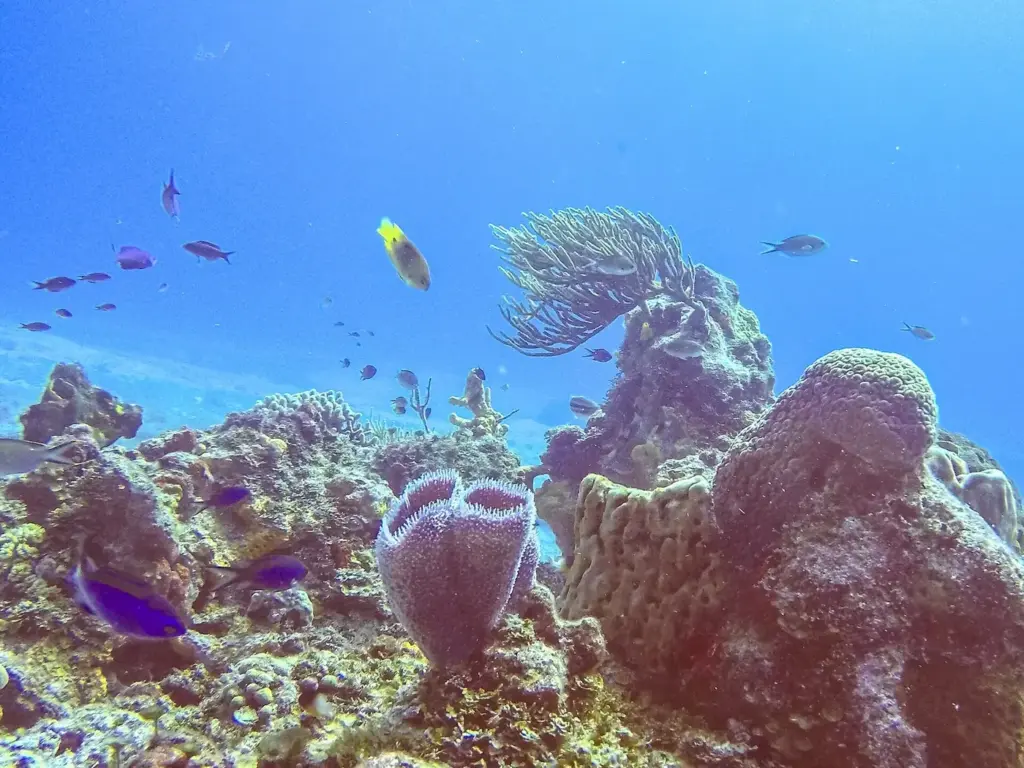
- Reef in Arrecifes de Cozumel National Park: photo by Matthew T Rader, Wikimedia Commons (CC BY-SA 4.0)
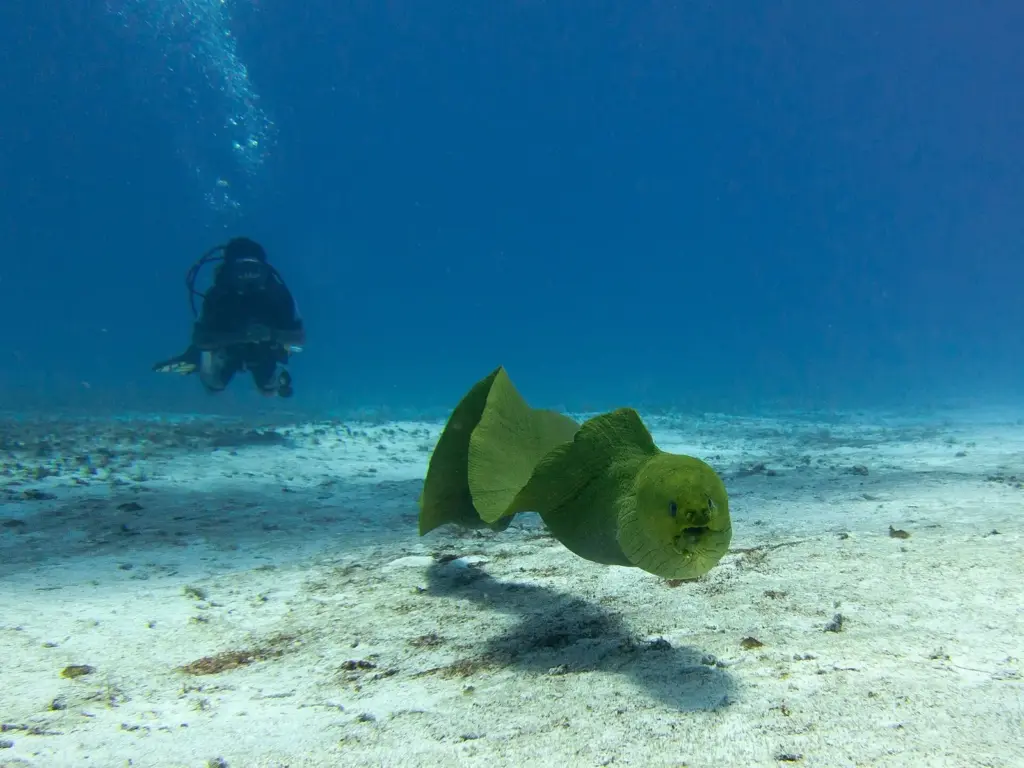
- Green moray eel, Cozumel: photo by P.Lindgren, Wikimedia Commons (CC BY-SA 3.0)
- Spotted eagle ray, Cozumel: photo by Matthew T Rader, Wikimedia Commons (CC BY-SA 4.0)
- Cozumel west coast shoreline: photo by Dronepicr, Wikimedia Commons (CC BY 3.0)
- Rock arch on Cozumel's windward coast: photo by Ken Thomas, Wikimedia Commons (public domain)


