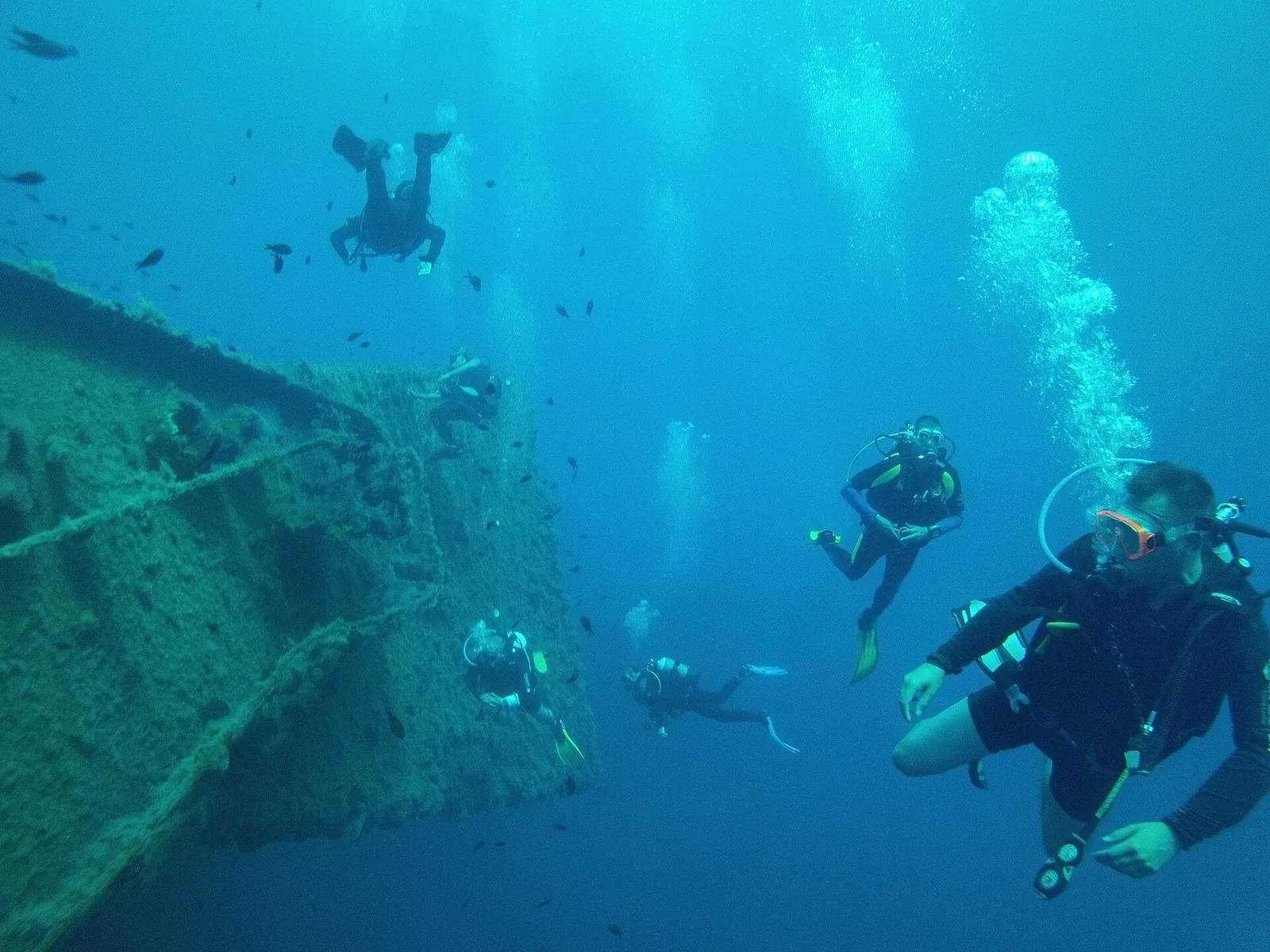
Every wreck is on a clock. Ships sunk as reefs in the 1980s have already been broken apart by hurricanes, storms have rolled the Kittiwake onto its side and split the El Aguila in half, and in the words of one Roatan dive shop, decades of corrosion leave little but “anchors, shafts, cannon, and engines.” That is part of the pull of wreck diving: each ship is a piece of history you can swim through for a limited time, and each one changes from year to year. This guide covers how wreck diving works, the training each kind of wreck needs, and where US divers should go first.
Short answer: Wreck diving means exploring sunken ships, planes and artificial reefs, from the outside on an ordinary Open Water card or inside with wreck training. US divers have excellent wrecks a short flight away in Florida and North Carolina; Truk Lagoon, the Red Sea’s Thistlegorm and Scapa Flow are the classic trips abroad.
Wreck details, prices and course rules on this page were checked between September 23 and October 1, 2026 against NOAA, the training agencies and the dive operators’ own websites. No operator paid to appear.
On this page: Who it suits · Wrecks for beginners · What it costs · Gear · What wreck diving is · Penetration levels · Certification · Training by wreck · Best destinations · Wrecks in the US · WWII, planes and artificial reefs · How to plan · Is it dangerous? · Wreck etiquette · FAQ · Sources
| Type of wreck dive | What you do | Training | Typical examples |
|---|---|---|---|
| Outside only (non-penetration) | Swim along the hull and decks; a direct ascent is always possible | Open Water to 60 ft; Advanced for deeper wrecks | Benwood, Kittiwake exterior, Antilla, Rhone |
| Limited penetration (light zone) | Enter open holds and rooms where daylight from an exit is visible | A wreck specialty course; guide recommended | Open holds on wrecks such as the Thistlegorm |
| Full penetration | Go deep inside, beyond the light, following a guideline | Technical wreck training, redundant gas and lights | Oriskany interior, deep Truk Lagoon wrecks |
| Deep technical wrecks | Dive below 130 ft (40 m) with decompression | Technical certification, trimix for the deepest | Oriskany flight deck, Bianca C, USS Saratoga |
What is wreck diving?
Wreck diving is recreational or technical diving on the remains of ships, aircraft and other man-made structures. There are two broad kinds of wreck. Historic wrecks sank by accident, storm or war: the RMS Rhone in an 1867 hurricane, the Thistlegorm to German bombers in 1941, Truk Lagoon’s ghost fleet in a 1944 air attack. Artificial reefs are ships cleaned and sunk on purpose to create dive sites and fish habitat, such as the aircraft carrier Oriskany off Pensacola or the USNS Vandenberg off Key West.
The appeal is part history, part marine life and part exploration. A ship’s hull gives corals, sponges and fish a hard surface in open sand, so wrecks attract life that the surrounding seabed can’t: goliath groupers and barracuda on Florida’s wrecks, sand tiger sharks in North Carolina’s, schools of fish over the Red Sea’s. And wrecks have structure, from decks and masts to holds and engine rooms, that reefs don’t.
What makes wreck diving different from reef diving is the hazard set. Wrecks can be deep, they sit in current and open water, and their interiors are overhead environments where you can’t swim straight to the surface. Most people’s first wreck dives happen entirely outside the ship on an ordinary certification, and that’s where most wreck diving stays. Going inside is a separate skill with its own training.
Who wreck diving suits, and who should skip it
Wreck diving rewards a particular kind of diver. Here’s the honest trade-off against an ordinary reef trip:
| Wreck diving | Pros | Cons |
|---|---|---|
| Interest | History, scale and structure no reef can match; each wreck has a story | Less color and fewer small creatures than a healthy reef |
| Marine life | Big fish: groupers, barracuda, jacks, sand tiger sharks on some wrecks | Macro life is patchier; some wrecks are bare steel for years after sinking |
| Depth | Plenty of good wrecks at 25 to 60 feet | Many famous wrecks sit at 80 to 130 feet, with short bottom times |
| Conditions | Big structures shelter you from current once you’re down | Offshore wrecks mean longer boat rides, more current and more weather cancellations |
| Access from the US | Florida, North Carolina, Texas, California and Hawaii have excellent wrecks | The legendary wrecks (Truk, the Thistlegorm, Scapa Flow) are long trips |
Wreck diving suits divers who like history, don’t mind deeper dives and want something different from reef after reef. It’s also the most natural next step after Advanced Open Water, because so many famous wrecks sit just past the Open Water limit. It suits less well if you dive only once or twice a year, get anxious in current or at depth, or travel mainly for coral and color, in which case a reef destination will make you happier.
Wreck penetration: outside, light zone and full penetration
Wreck penetration means going inside a wreck, and divers and training agencies split it into three levels. The distinction matters, because the risk rises sharply at each step.
- No penetration. You stay outside the hull, or swim through spaces so open that you can always ascend directly. This is what Open Water and Advanced divers do on guided wreck dives. SSI’s Wreck Diving specialty, for example, is non-penetration only.
- Limited penetration, or the light zone. You enter holds, corridors and rooms only as far as you can still see daylight from an exit. A wreck specialty teaches this, along with laying a guideline from a reel so you can find your way out if silt kills the visibility.
- Full penetration. You go beyond the light, deep into the ship, following a continuous guideline, with redundant gas supplies and lights. This is technical wreck diving, covered by advanced wreck courses from technical agencies, and it carries the highest risk of any wreck dive.
Two hazards make the inside of a wreck unforgiving. The first is silt: decades of sediment settle inside a ship, and a single careless fin kick can cut visibility to zero in seconds. The second is entanglement and collapse: cables, wires and fishing line hang in the dark, and a hull that has been rusting for decades can shed plates and fittings. A guideline, good trim and frog-kicking are the core skills because they deal with both.
Wreck diving certification: what you need and what it costs
For most wreck dives, you don’t need a wreck card at all. You need the depth rating for the wreck and the comfort to dive it. Here’s how the training ladder works:
- Open Water: enough for shallow wrecks such as the Benwood off Key Largo (25 to 45 feet) or the Antilla off Aruba (up to 60 feet), outside only. Our scuba certification guide covers the Open Water course itself.
- Advanced Open Water: the key card for wreck travelers, because so many good wrecks sit between 80 and 130 feet. Roatan’s West End Divers, for example, requires Advanced for dives to 130 feet (40 m), and Captain Hook’s in Key West requires Advanced plus a recent deep dive for the Vandenberg.
- Wreck specialty: SSI’s Wreck Diving course has a minimum age of 10, an Open Water prerequisite, two open-water training dives and a 100-foot (30 m) maximum, and it covers non-penetration techniques only. PADI’s Wreck Diver specialty, per its course page, runs four dives and adds penetration-line and reel skills, starting at age 15 with Adventure Diver certification. Check current prerequisites with the shop, since agencies update them.
- Technical wreck courses: needed for full penetration and for wrecks below recreational limits, along with technical diving and decompression training. These courses assume solid buoyancy, redundant equipment and plenty of experience.
- Nitrox: not a wreck course, but almost essential. Enriched air gives longer no-decompression time on the 80 to 110-foot wrecks that make up much of wreck diving, and many wreck boats offer it.
Course prices vary by shop and region, so price the specialty where you’ll dive. Doing the wreck specialty on a trip to Key Largo, Key West or Roatan is a good way to learn on the wrecks you came to see.
Training and depth by wreck
This table lists well-known wrecks by depth and the minimum training we’d want before diving them, outside only unless noted. Depths come from NOAA, park agencies, operators and published wreck histories, checked September 2026.
| Wreck | Location | Sunk | Depth | Minimum card |
|---|---|---|---|---|
| Windjammer (Avanti) | Dry Tortugas, Florida | 1901 | 0-20 ft | Open Water or snorkel |
| Benwood | Key Largo, Florida | 1942 | 25-45 ft | Open Water |
| RMS Rhone | Salt Island, BVI | 1867 | 30-80 ft | Open Water to 60 ft; Advanced for the bow |
| Antilla | Aruba | 1940 | To 60 ft | Open Water (outside only; breaking up) |
| Kittiwake | Grand Cayman | 2011 | About 35-70 ft since 2017 | Open Water; Advanced for the deeper side |
| SS Thistlegorm | Red Sea, Egypt | 1941 | To about 100 ft (30 m) | Advanced; specialty for the holds |
| Hilma Hooker | Bonaire | 1984 | About 100 ft | Advanced |
| SS Yongala | Queensland, Australia | 1911 | Top 52 ft (16 m), seabed 98 ft (30 m) | Advanced; permit required; no penetration allowed |
| Spiegel Grove | Key Largo, Florida | 2002 | 60-135 ft | Advanced |
| Vandenberg | Key West, Florida | 2009 | Top 40-45 ft; deck 95-100 ft; sand 145 ft | Advanced plus a recent deep dive |
| El Aguila | Roatan, Honduras | 1997 | 110 ft; deck about 80 ft | Advanced |
| U-352 | Cape Lookout, North Carolina | 1942 | About 110 ft | Advanced, nitrox recommended |
| Duane | Key Largo, Florida | 1987 | 120 ft; mast about 60 ft | Advanced |
| Lady Luck | Pompano Beach, Florida | 2016 | Deck 105 ft; sand 131 ft | Advanced |
| MS Zenobia | Larnaca, Cyprus | 1980 | Seabed about 138 ft (42 m) | Advanced; technical for the interior |
| Oriskany | Pensacola, Florida | 2006 | Island top 80 ft; flight deck 145 ft; seabed 212 ft | Advanced for the island; technical for the deck |
| Bianca C | Grenada | 1961 | Upper parts about 100 ft (30 m); seabed 165 ft (50 m) | Advanced at minimum; technical for most of it |
Our take: Advanced Open Water and nitrox open up most of the world’s famous wrecks. Do those two courses before a wreck trip; add a wreck specialty if you want to look inside, and leave full penetration until you’ve trained for it specifically.
The best wreck diving destinations, ranked for US divers
These are the places worth planning a trip around, ranked on the quality and variety of the wrecks, how easy they are to reach from the US and the range of skill levels they suit. Each named wreck gets fuller treatment on its destination’s own page.
| # | Destination | Signature wrecks | Depth | Level | From the US |
|---|---|---|---|---|---|
| 1 | Florida (Keys, Panhandle, Southeast) | Spiegel Grove, Duane, Vandenberg, Oriskany, Lady Luck | 25-145 ft | All levels | Domestic |
| 2 | Truk Lagoon, Micronesia | The WWII Japanese fleet | Varies; many deep | Advanced, tech | United via Honolulu or Guam |
| 3 | Red Sea, Egypt | Thistlegorm and others | To about 100 ft and deeper | Advanced | Via Cairo or Europe |
| 4 | North Carolina | U-352 and the “Graveyard of the Atlantic” | 90-120 ft | Advanced | Domestic |
| 5 | The Caribbean | Kittiwake, Hilma Hooker, Rhone, Bianca C, Antilla | 20-165 ft | All levels | Short nonstops |
| 6 | Coron, Philippines | Japanese WWII supply ships | Reported 33-141 ft | Intermediate+ | Manila, then Busuanga |
| 7 | Scapa Flow, Scotland | Remains of the German High Seas Fleet | To 154 ft (47 m) | Advanced, drysuit | Via the UK |
| 8 | Cyprus | MS Zenobia | To about 138 ft (42 m) | Advanced | Via Europe |
| 9 | The Great Lakes | Freshwater-preserved wooden and steel ships | Shallow to deep | Drysuit, varies | Domestic |
| 10 | Australia | SS Yongala, scuttled navy ships | 52-98 ft (Yongala) | Advanced | Long-haul |
1. Florida: the best wreck diving in the US
No state, and few countries, can match Florida’s wreck lineup. Off Key Largo the Spiegel Grove, a 510-foot Navy landing ship, lies in 60 to 135 feet, and the Coast Guard cutter Duane rests in 120 feet; both were sunk as reefs, the Duane in 1987. Key West has the 522-foot USNS General Hoyt S. Vandenberg, scuttled in 2009, the second-largest artificial reef in the world. Off Pensacola the Oriskany, an 888-foot aircraft carrier sunk in 2006, is the largest. Southeast Florida adds the Lady Luck, a 324-foot tanker sunk off Pompano Beach in 2016 with casino-themed art on its decks, and multi-wreck “wreck treks” off Fort Lauderdale and West Palm Beach.
Prices are reasonable: Captain Hook’s lists Vandenberg two-tank trips from $95, Lost Reef Adventures charges $85 for the trip alone or $135 with gear, and Niuhi Dive Charters charges $225 for an Oriskany two-tank trip (all checked September 2026). NOAA’s Florida Keys Shipwreck Trail links nine historic wrecks, from easy shallow dives to sites past 100 feet. For the full picture see our guides to Florida Keys diving and to scuba diving in Florida as a whole.
2. Truk Lagoon: the ghost fleet
Truk Lagoon in Chuuk, Micronesia, is the world’s great WWII wreck destination. Operation Hailstone, the US Navy attack of February 17 and 18, 1944, sank 32 Japanese merchant ships plus two light cruisers, four destroyers and three auxiliary cruisers, and destroyed more than 250 aircraft. Some holds still carry their cargo, including aircraft parts in the Fujikawa Maru. Water runs 77 to 86°F (25 to 30°C) year-round, and the dry season is November to April. Getting there means United’s Island Hopper from Honolulu or Guam. Many of the best wrecks are deep, which makes nitrox and Advanced training the minimum and technical training the norm for serious penetration.
3. The Red Sea: the Thistlegorm and friends
The SS Thistlegorm is the most famous wreck dive in the world for good reason. The 415-foot British cargo ship was sunk by German bombers on October 6, 1941, near Ras Muhammad, and its holds are still loaded with trucks, motorcycles and railway equipment, with the deepest point at about 100 feet (30 m). Jacques Cousteau found it in the early 1950s. Most divers see it from a liveaboard, with Egyptian trips listed from $1,155 (checked September 2026). Egypt sits at Level 2 on the State Department’s advisory scale, with do-not-travel warnings for North and Middle Sinai; the Red Sea resorts lie outside those zones, but read the advisory before booking.
4. North Carolina: the Graveyard of the Atlantic
North Carolina’s offshore wrecks are the best on the US East Coast, often with sand tiger sharks hovering in and around them. The German U-352, a 220-foot Type VIIC U-boat sunk by the Coast Guard cutter Icarus on May 9, 1942, lies in about 110 feet off Cape Lookout; 15 of its 48 crew died, and NOAA notes it is listed on the National Register of Historic Places and is likely the U-boat most often dived by recreational divers. Olympus Dive Center in Morehead City charges $185 for a full-day two-dive trip to sites at 90 to 120 feet (checked September 2026). These are deep, offshore dives in Gulf Stream water, best suited to Advanced divers with nitrox.
5. The Caribbean: wrecks between reef dives
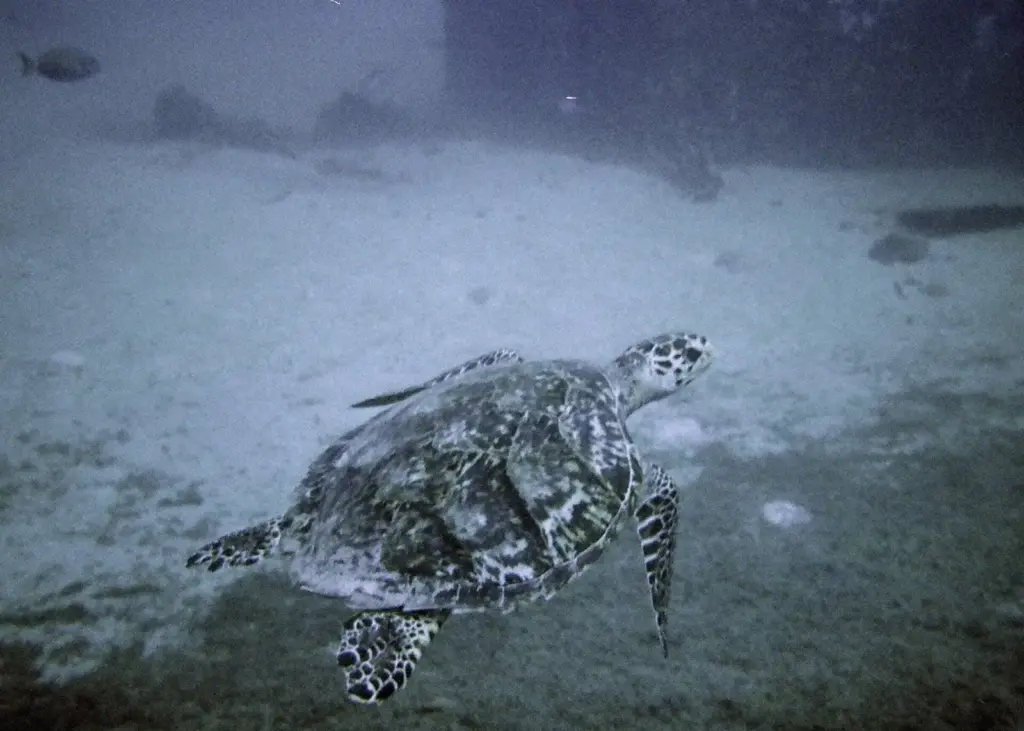
The best wreck diving in the Caribbean is spread across islands rather than concentrated in one place. Grand Cayman’s Kittiwake, a 251-foot submarine rescue ship sunk in 2011, was rolled onto its side by Tropical Storm Nate in 2017 and now sits about 20 feet deeper; Sunset House charges $100 for a one-tank Kittiwake trip (checked September 2026). Bonaire’s Hilma Hooker, a freighter seized in a drug case, sank in 1984 in about 100 feet. The RMS Rhone in the British Virgin Islands, wrecked in an 1867 hurricane that killed 123 people, lies in 30 to 80 feet inside a national park. Aruba’s Antilla, a 398-foot German freighter scuttled by its crew in 1940, is one of the region’s largest wrecks but is breaking up, and some divers now consider it unsafe to enter. Grenada’s Bianca C, a roughly 600-foot liner that sank in 1961, rests in about 165 feet. Cayman Brac adds the MV Captain Keith Tibbetts, a Soviet-built frigate sunk as a reef in 1996, and Roatan the El Aguila at 110 feet.
6. Coron, Philippines
Coron Bay holds Japanese supply ships that, by published accounts, were sunk by US Navy carrier aircraft on September 24, 1944. Published accounts put about ten wrecks at depths of 33 to 141 feet (10 to 43 m), from 98 to 525 feet long, which makes Coron more accessible than Truk for intermediate divers. Divers fly from Manila or Cebu to Busuanga, then transfer to Coron town; wreck boats often do three dives a day because transits can run an hour. Confirm depths and conditions with your operator, since accounts vary.
7. Scapa Flow, Scotland
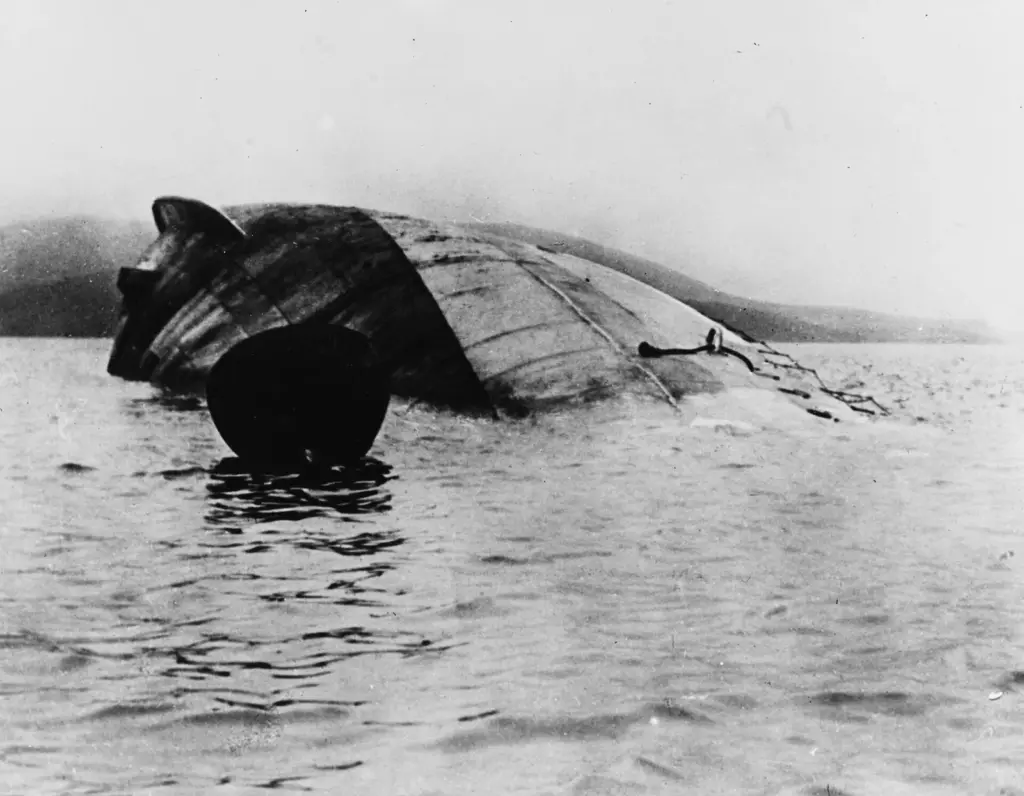
On June 21, 1919, 52 of the 74 German warships interned at Scapa Flow in Orkney sank after their crews scuttled them: 15 battleships, 5 light cruisers and 32 destroyers. Most were salvaged in the 1920s and 1930s, but seven remain (three battleships and four cruisers), protected as scheduled monuments since 2001, in depths to 154 feet (47 m). It’s cold-water, drysuit diving from liveaboards and day boats, and it suits experienced wreck divers. It’s also the best example of the best wreck diving in Europe for history, with Malta’s scuttled tanker Um El Faroud and Cyprus’s Zenobia as warmer alternatives.
8. The Zenobia, Cyprus
The MS Zenobia, a 172-meter (564-foot) ferry, capsized in Larnaca Bay on June 7, 1980, after a computerized ballast fault pumped too much water into her side tanks. No one died. She lies on her port side with her cargo of 104 trucks at a seabed depth of about 138 feet (42 m), and she’s routinely ranked among the top ten wreck dives in the world. Her shallower side is within recreational depths for Advanced divers; the interior is technical territory.
9. The Great Lakes
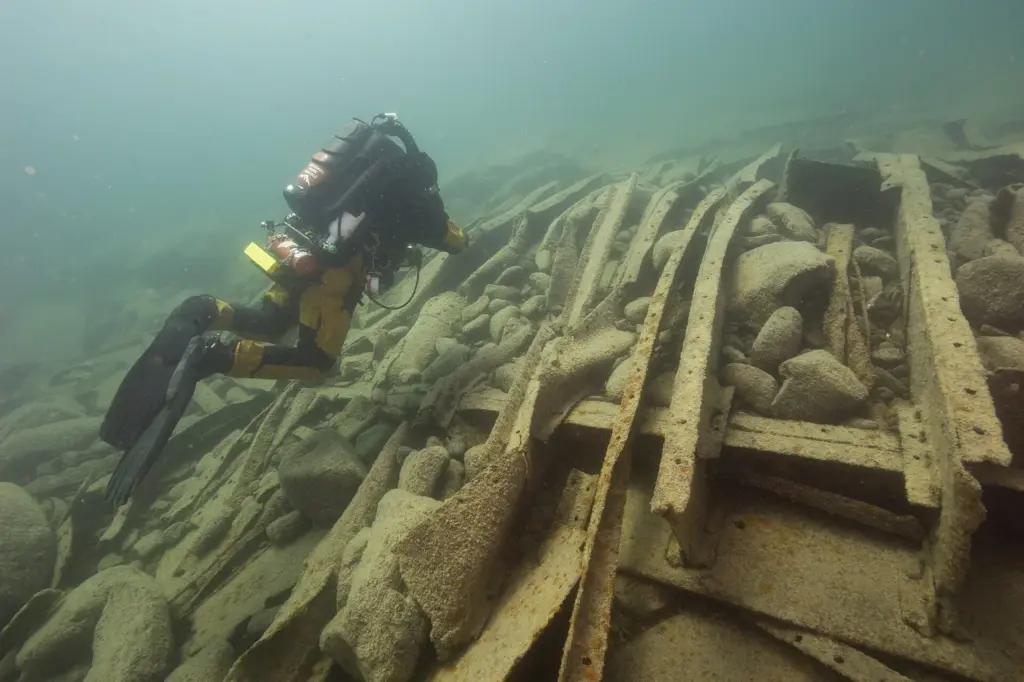
Cold fresh water preserves wrecks far better than warm salt water, and the Great Lakes hold some of the best-preserved shipwrecks anywhere. NOAA designated Thunder Bay in Lake Huron as the first national marine sanctuary in the Great Lakes in 2000, and its Wisconsin Shipwreck Coast National Marine Sanctuary, designated in 2021, covers 962 square miles of Lake Michigan with 36 historic shipwreck sites, 27 of them on the National Register of Historic Places. Expect drysuits, cold water and variable visibility, and plan with local charters, which know the conditions and the rules.
10. Australia
The SS Yongala, a steamer lost in a cyclone off Queensland in March 1911, is Australia’s signature wreck and one of the best wreck dives for marine life anywhere: surveys have logged 79 species there, with humphead wrasse and zebra sharks among the regulars. The top sits at about 52 feet (16 m) and the seabed at 98 feet (30 m), access requires a permit, and penetration is prohibited. Australia has also scuttled navy ships as dive sites, including HMAS Brisbane off Mooloolaba in 2005 and HMAS Canberra off Barwon Heads in 2009.
Best wreck dives in the US
US divers don’t need a passport for excellent wreck diving. Beyond Florida and North Carolina, three regions stand out:
- Texas: the USTS Texas Clipper, a 473-foot former training ship sunk 17 miles off South Padre Island on November 17, 2007, is the largest of 13 ships in the Texas Artificial Reef Program, which says the reef brings in $1.4 to $2 million a year from divers and more than $1 million from anglers.
- Southern California: San Diego’s Wreck Alley includes the Canadian destroyer HMCS Yukon, sunk as a dive site in 2000.
- Hawaii: off Oahu, the Sea Tiger sits upright at 120 feet with dives generally at 80 to 100 feet, and a Corsair fighter that ditched in 1946 lies at 107 feet. Waikiki Dive Center’s two-tank wreck-and-reef trip costs from $169 (checked September 2026).
The Florida Panhandle deserves its own mention: alongside the Oriskany, its Shipwreck Trail includes the USS Strength, a WWII minesweeper sunk in 1987 in 80 feet off Panama City, the El Dorado, a 157-foot vessel deployed in 2019 in 103 feet, and the Mohawk Chief tug in 125 feet off Destin.
WWII wrecks, plane wrecks and artificial reefs
WWII wreck diving is a field of its own. Truk Lagoon and Coron hold Japanese fleets sunk by US aircraft in 1944, the Thistlegorm went down to German bombers in 1941, the U-352 and the Benwood (a freighter sunk in a 1942 wartime collision off Key Largo) sit off the US coast, and the Antilla was scuttled off Aruba in 1940 when Germany invaded the Netherlands. These wrecks are often war graves, which shapes how they should be dived.
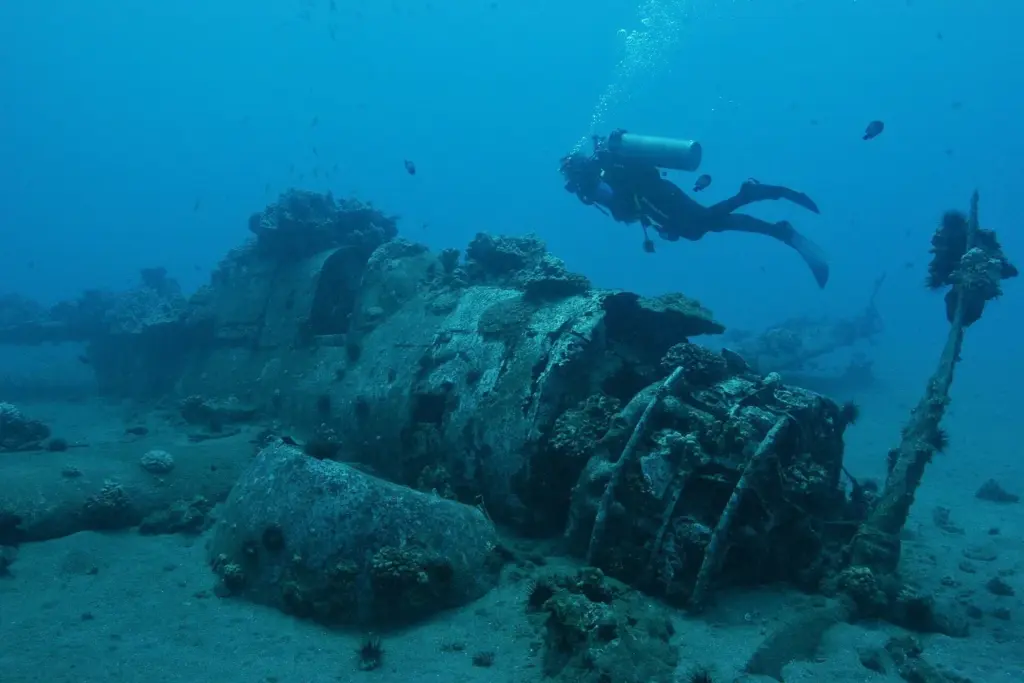
Underwater plane wrecks are rarer and smaller than ships, which makes them easy to see on one dive. Hawaii has several, including the Corsair off Oahu at 107 feet, and Truk Lagoon’s holds carry fighter aircraft as cargo. Planes break up faster than ships, so treat them gently.
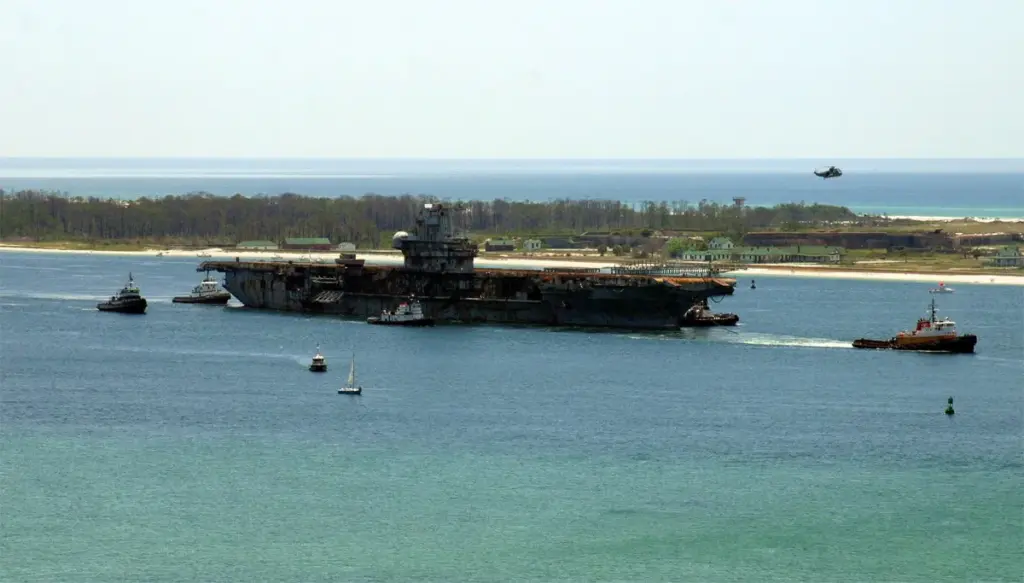
Artificial reef diving has grown into the most accessible wreck diving of all. Ships are cleaned of fuel, oils and hazardous materials, stripped of entanglement hazards and sunk at chosen depths, often upright and close to port. The Oriskany is the largest vessel ever sunk as an artificial reef, a record set to be broken by the SS United States: Okaloosa County, Florida bought the 1950s liner for $1 million in October 2024, moved it from Philadelphia to Mobile, Alabama, in early 2025 for remediation, and plans to sink it off Destin. As of our September 2026 check, the county said the deployment date was still to be determined, with at least 30 days’ notice to be posted.
The largest wreck dive in the world, then, is the Oriskany: 888 feet long, sitting upright in 212 feet of water about 22.5 nautical miles southeast of Pensacola Pass, with the top of its island at about 80 feet, according to Escambia County, which manages the reef. Pirate shipwrecks are the opposite case: centuries-old wooden wrecks rarely leave more than ballast stones, cannon and anchors, which is what you’ll find on most “pirate wreck” dives.
How artificial reefs are made
Sinking a ship on purpose is slower and more expensive than it sounds. The Vandenberg needed $8.6 million in funding before it went down off Key West in 2009, and planners trimmed the 524-foot ship so its highest point sits 40 to 45 feet below the surface, deep enough for boats and shallow enough for Open Water divers to see the top. Okaloosa County estimated the SS United States project at about 18 months and $10 million when it bought the liner. And things go wrong: the Spiegel Grove sank prematurely and upside down on May 17, 2002, hours before its planned scuttling, was finished on its side that June, and was rolled upright by Hurricane Dennis in July 2005.
The payoff is real. The Texas Clipper alone brings South Padre Island an estimated $1.4 to $2 million a year from divers, according to the state, and artificial reefs take diving pressure off natural reefs nearby. For divers, they offer something historic wrecks can’t: big, intact, deliberately prepared ships with entanglement hazards removed, at depths chosen for recreational diving.
Best wreck dives for beginners
You don’t need to wait for an Advanced card to start. These wrecks suit newly certified divers, outside only and with a guide where noted:
- The Windjammer, Dry Tortugas: the iron-hulled Avanti, built in 1875 and wrecked on Loggerhead Reef in 1901, lies in 0 to 20 feet in Dry Tortugas National Park; check the park’s mooring notices before you go.
- The Benwood, Key Largo: a 360-foot freighter sunk in a 1942 collision, broken and spread across the sand in 25 to 45 feet between French Reef and Dixie Shoals.
- The RMS Rhone, British Virgin Islands: the stern lies in about 30 feet; save the bow, at about 80, for after your Advanced course.
- The Antilla, Aruba: up to 60 feet, big and full of fish, but stay outside; storms are breaking it up.
- The Kittiwake, Grand Cayman: its shallowest point now sits about 35 feet down, and a guided dive keeps you to the parts that suit your rating.
Your first wreck dives are also the time to build the habits that matter later: a frog kick that doesn’t stir up sand, a light even in daylight, and the discipline to stay outside however inviting a doorway looks.
What wreck diving costs
Wreck trips cost about the same as reef trips at the same destination, with a premium for long offshore runs. Published prices, checked September 2026:
| Wreck or trip | Operator | Price |
|---|---|---|
| Vandenberg, Key West, two tanks | Captain Hook’s | From $95 |
| Vandenberg, trip only or with full gear | Lost Reef Adventures | $85 or $135 |
| Key Largo two-tank reef and wreck trip | Rainbow Reef Dive Center | $99 |
| Oriskany, Pensacola, two tanks | Niuhi Dive Charters | $225 |
| U-352 and other offshore wrecks, two dives | Olympus Dive Center, Morehead City | $185 |
| Kittiwake, one tank | Sunset House, Grand Cayman | $100 |
| Wreck and reef, two tanks, Oahu | Waikiki Dive Center | From $169 |
| El Aguila and Roatan fun dives | West End Divers | $35-$45 a dive plus 15% tax |
| Red Sea liveaboard week (Thistlegorm routes) | Master Liveaboards | From $1,155 |
Add nitrox, which most wreck divers want for 100-foot dives, gear rental if you need it, and crew tips. Offshore wrecks such as the Oriskany and North Carolina’s U-boats are weather-dependent, so build a spare day into the trip in case a boat is canceled.
Wreck diving gear: what to bring
Ordinary recreational gear handles most wreck dives outside the hull. A few additions make them safer and better:
- A primary light and a backup. Even on daylight dives, a light shows color in shadowed holds and lets you signal your buddy.
- A cutting tool. Fishing line and old cable collect on wrecks. Line cutters and shears work better than knives; pack them in checked baggage if you fly.
- A surface marker buoy and reel or spool. Offshore wrecks sit in current, and you may need to ascend away from the mooring line.
- A nitrox-capable dive computer. On 100-foot wrecks, enriched air adds meaningful bottom time.
- Stiffer fins for the frog kick. A frog kick moves water backward and up rather than down into the silt.
- For penetration only: a penetration reel, redundant gas such as a pony bottle or doubles, and the training to use them.
- For cold wrecks: a drysuit and the training for it, for Scapa Flow and the Great Lakes.
How to plan a wreck diving trip, step by step
- Pick the wreck, then check its depth. Use the table above. If it’s deeper than 60 feet, you need Advanced Open Water; deeper than 100 feet, add nitrox and recent deep experience.
- Train before you travel. Do Advanced and nitrox at home or early in the trip. Some operators, such as Captain Hook’s on the Vandenberg, ask for a recent deep dive before they’ll take you.
- Choose the right season. Offshore wrecks depend on calm seas: summer for North Carolina and the Great Lakes, the dry season for Truk, spring and fall for the Red Sea.
- Book an operator that briefs properly. Look for small groups, a detailed wreck briefing and guides who know which areas are open and which are off-limits.
- Bring the right kit. A primary light and a backup, a surface marker buoy, a cutting tool and a computer that handles nitrox. For penetration, add a reel and redundant gas.
- Plan your gas and your bottom time. Deep wrecks burn air quickly, and no-decompression limits are short at 100 feet. Turn the dive early, not late.
- Leave a day before flying. DAN’s guidelines call for at least 12 hours after a single no-decompression dive and 18 hours after several days of repetitive diving.
A sample Florida Keys wreck week
Florida is the easiest place for an American to build a wreck trip without a passport. A week that works for an Advanced diver with nitrox:
- Day 1: Fly into Miami and drive 61 miles to Key Largo, about an hour and a half in light traffic.
- Day 2: Warm up on the shallow Benwood and a reef dive.
- Day 3: The Spiegel Grove and the Duane, on nitrox, with a guide on the first visit.
- Day 4: Drive down the Overseas Highway to Key West; afternoon off.
- Day 5: Two dives on the Vandenberg, whose top sits 40 to 45 feet down and deck at 95 to 100 feet.
- Day 6: The Cayman Salvager and a reef with a Key West operator, or a day trip to the Dry Tortugas and the Windjammer.
- Day 7: No diving; fly home the next morning, outside DAN’s 18-hour guideline after multi-day diving.
Mistakes to avoid
- Following a guide inside a wreck you’re not trained to penetrate.
- Diving a 100-foot wreck on air with no deep-diving experience.
- Kicking up silt with flutter kicks near or inside a wreck.
- Ignoring the current on offshore wrecks; NOAA warns that swift currents can occur on the deeper Shipwreck Trail sites.
- Touching or taking artifacts, or disturbing a war grave.
- Trusting an old description: wrecks move, collapse and roll over after storms.
Is wreck diving dangerous?
Wreck diving outside the hull, within your training, is about as safe as any open-water dive at the same depth. The danger rises with three things: depth, overhead environments and changing structures. Deep wrecks bring nitrogen narcosis, short no-decompression limits and fast gas use. Penetration removes the direct route to the surface and adds silt, entanglement and disorientation. And wrecks change: Tropical Storm Nate rolled the Kittiwake onto its side in 2017, Hurricane Georges broke the Eagle in half in 1998, Hurricane Mitch split the El Aguila the same year, and storms keep breaking up the Antilla.
The rules that keep wreck divers safe are simple. Dive within your training and depth rating. Never go inside without wreck training, a guideline and a light, and turn back at the first sign of silt. Carry a cutting tool for line and net. Use nitrox on deep wrecks and plan gas conservatively. And buy dive accident insurance: Divers Alert Network sells it separately from membership, and its 24/7 emergency line is +1-919-684-9111.
Our take: Stay outside until you’ve done a wreck course, and treat the inside of a ship like a cave. The guideline, the backup light and the gas reserve exist because the way out isn’t overhead.
Wreck etiquette: war graves, artifacts and the law
Many wrecks are graves. The Rhone killed more than 120 people, and military wrecks such as the U-352 and the ships of Truk Lagoon went down with their crews. Treat them the way you’d treat a cemetery: no souvenirs, no posing on remains, no disturbance.
The law backs this up in many places. The Yongala sits in a protected zone where access requires a permit and penetration is prohibited. The Rhone has been inside a national park since 1980, and the remaining Scapa Flow wrecks have been scheduled monuments since 2001. In US waters, national parks and national marine sanctuaries protect their historic wrecks, so removing anything can bring penalties. The simplest rule is the safest: look, photograph and leave everything where it lies.
Good wreck etiquette also means using the mooring lines rather than anchoring on a wreck, staying off fragile structures, keeping fins off silt and corals, and following the operator’s rules on which parts of a wreck are open. These sites are shared and they’re finite; the next diver deserves to see the same ship you did.
Frequently asked questions
What is wreck diving?
Wreck diving is scuba diving on sunken ships, aircraft and other structures, from historic wrecks lost to storms and war to ships sunk deliberately as artificial reefs. Most wreck dives stay outside the hull and need only the right depth rating; going inside, called penetration, requires specific wreck training, a guideline and lights.
Is wreck diving dangerous?
Outside the wreck and within your training, wreck diving carries about the same risk as other open-water dives at the same depth. Risk rises with depth, with going inside, where silt, entanglement and lost direction are real hazards, and with storm damage that makes structures unstable. Take a wreck course before entering any ship.
What is the best wreck dive in the world?
The SS Thistlegorm in the Red Sea is the most common answer, for its 1941 history and holds full of trucks and motorcycles at no more than about 100 feet. Truk Lagoon’s WWII fleet is the best wreck destination overall, and the Oriskany off Pensacola is the largest artificial reef. In the US, the Spiegel Grove and the Vandenberg are the standouts.
What certification do I need for wreck diving?
An Open Water card covers shallow wrecks to 60 feet, outside only. Advanced Open Water covers most famous wrecks between 60 and 130 feet. A wreck specialty teaches light-zone penetration and line work; SSI’s version is non-penetration only, while PADI’s adds penetration-line and reel skills. Full penetration requires technical wreck training.
What is a wreck diver?
A wreck diver is a diver who has completed a wreck specialty course, such as PADI Wreck Diver or SSI Wreck Diving, or more broadly anyone who focuses on diving shipwrecks. The specialty teaches wreck hazards, mapping and navigation, and on some courses how to use a reel and guideline to enter the light zone safely.
What are the best wreck dives for beginners?
Shallow wrecks you can see entirely from outside are best: the Benwood off Key Largo at 25 to 45 feet, the Windjammer in the Dry Tortugas at 0 to 20 feet, the Antilla off Aruba at up to 60 feet, the Rhone’s shallower stern in the British Virgin Islands, and the Kittiwake in Grand Cayman on a guided dive.
What is the largest wreck dive in the world?
The USS Oriskany, an 888-foot aircraft carrier sunk off Pensacola in 2006, is the largest vessel ever sunk as an artificial reef. Divers reach its island from about 80 feet, while the flight deck at about 145 feet is technical territory. The SS United States is set to take the record if Okaloosa County sinks it off Destin as planned.
What is “Diving into the Wreck” about?
It’s the title poem of Adrienne Rich’s 1973 collection Diving into the Wreck: Poems 1971-1972, which shared the 1974 National Book Award for Poetry. The poem follows a lone diver descending to a wreck and is widely read as a feminist exploration of history and myth, looking for the truth beneath the stories told about it.
Sources and verification
Everything on this page was checked between September 23 and October 1, 2026 against the organizations listed below. The page is compiled from their published records, rules and prices, and it doesn’t claim first-hand visits.
- NOAA Florida Keys National Marine Sanctuary: Shipwreck Trail
- NOAA Monitor National Marine Sanctuary: U-352
- NOAA: Wisconsin Shipwreck Coast National Marine Sanctuary
- NOAA: Thunder Bay National Marine Sanctuary
- National Park Service: Dry Tortugas diving
- Escambia County: Oriskany Reef
- Destin-Fort Walton Beach: SS United States reef project
- Texas Parks and Wildlife: Ships to Reefs
- SSI: Wreck Diving specialty
- Olympus Dive Center, Morehead City
- Sunset House, Grand Cayman: price list
- Waikiki Dive Center: wreck and reef trip
- West End Divers, Roatan: wreck diving
- Divers Alert Network: flying after diving
Also checked: Wikipedia’s articles on the Thistlegorm, Operation Hailstone, the Oriskany, the Vandenberg, the Kittiwake, the Rhone, the Antilla, the Bianca C, the Zenobia, the Yongala, the scuttling at Scapa Flow, the SS United States and sinking ships as dive sites; Captain Hook’s Dive Key West; Lost Reef Adventures; Niuhi Dive Charters; Force-E; the Florida Panhandle Dive Trail; Oahu dive-site guides; Master Liveaboards; PADI’s course pages; the US State Department’s Egypt advisory.
Scuba Tourism Guide is an independent publication. It is not affiliated with any agency, park or dive operator named here, and no one paid to be included.
Photo credits
- Divers on the Zenobia wreck, Cyprus (featured image): photo by Easydivers, Wikimedia Commons (CC BY-SA 4.0)
- The Oriskany under tow, Pensacola (2006): U.S. Navy Photo by Mike O'Connor, Wikimedia Commons (public domain)
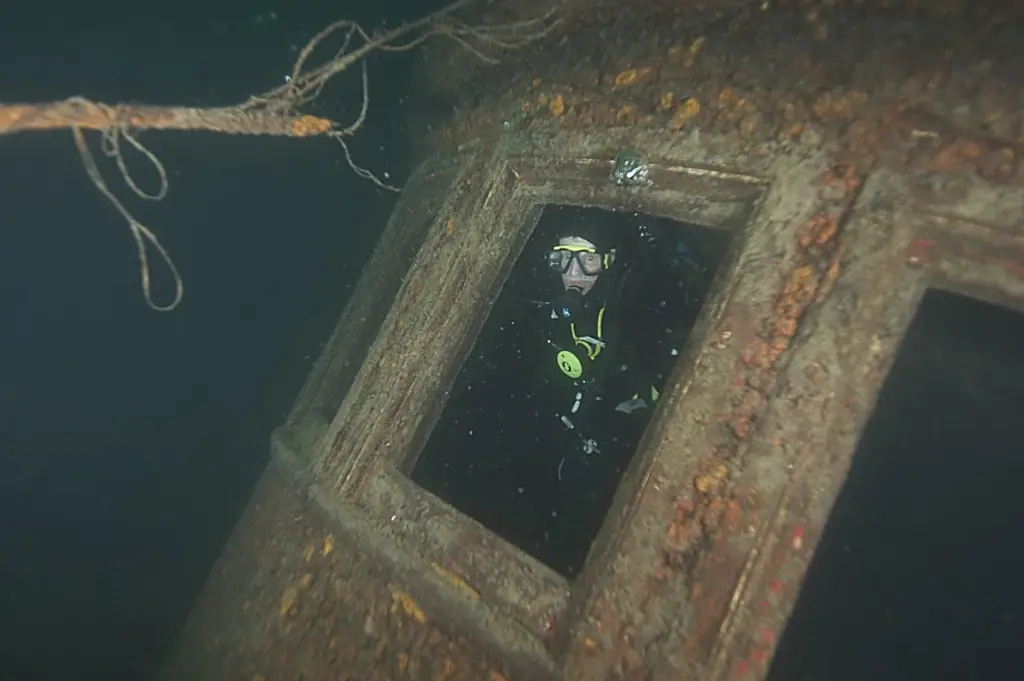
- Diver inside the Chester A. Congdon, Lake Superior: photo by National Park Service, Wikimedia Commons (public domain)
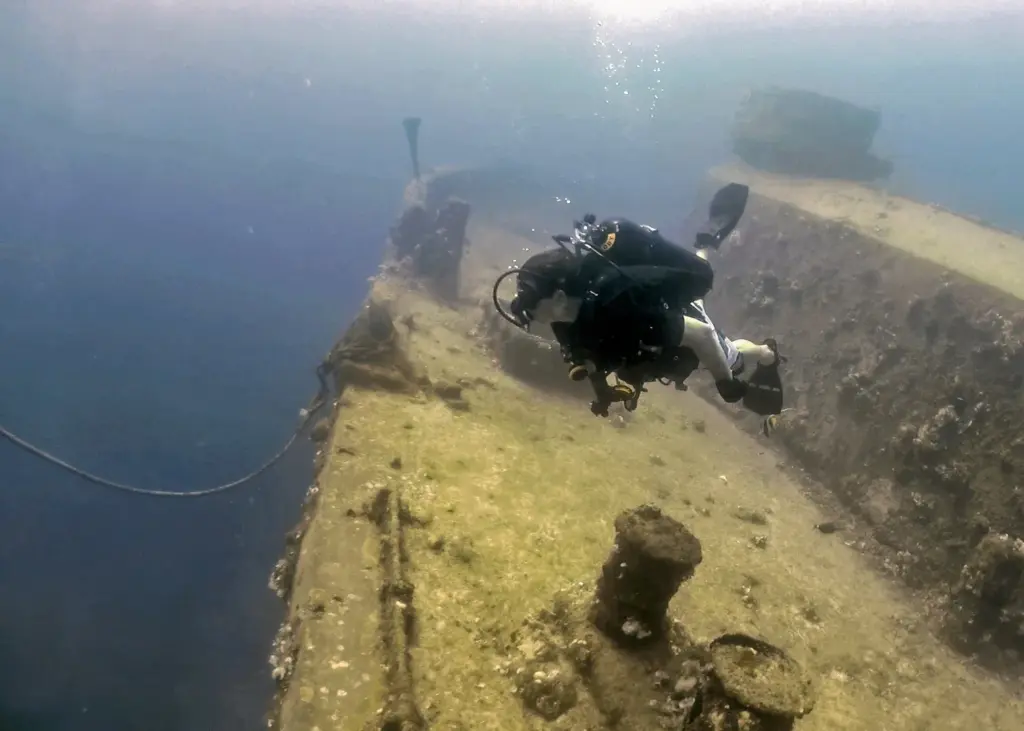
- Diver on a shipwreck in Apra Harbor, Guam (2017): photo by COMSEVENTHFLT, Wikimedia Commons (CC BY-SA 2.0)
- Turtle at the Antilla wreck, Aruba (2008): photo by Serge Melki from Indianapolis, USA, Wikimedia Commons (CC BY 2.0)
- The Seydlitz capsized at Scapa Flow (1919): photo by C. W. Burrows, Wikimedia Commons (Copyrighted free use)
- Diver at the Algoma wreckage, Lake Superior: photo by National Park Service, Wikimedia Commons (public domain)
- Curtiss Helldiver wreck, Hawaii: photo by National Marine Sanctuaries, Wikimedia Commons (public domain)


