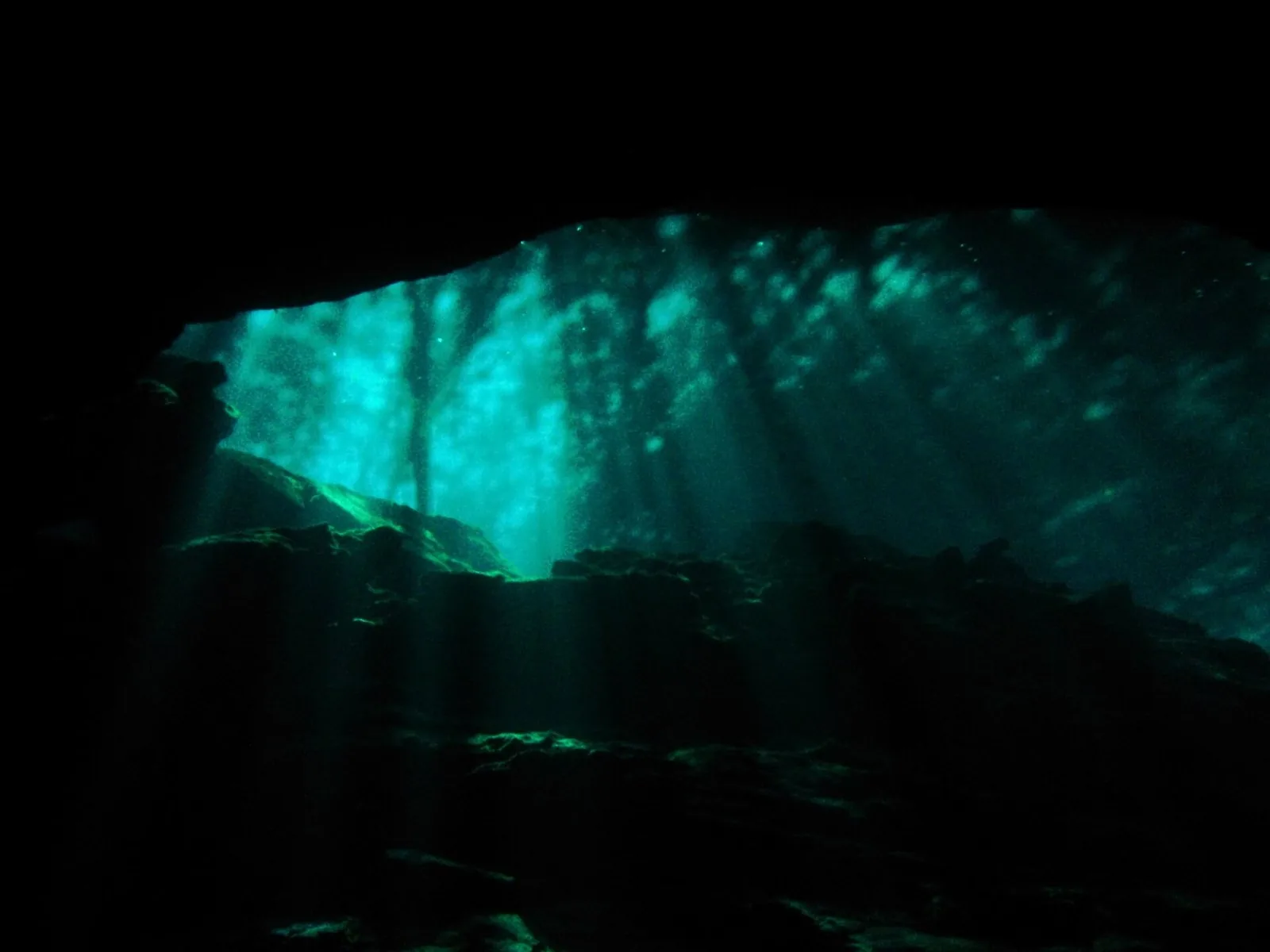
The first time most divers see a cenote from below, they stop kicking. Sunlight drops through a hole in the jungle floor and falls in beams that look solid enough to touch, stalactites hang from the ceiling, and the water is so clear you forget it’s there. Cenote diving is freshwater diving in the flooded sinkholes and caverns of Mexico’s Yucatan Peninsula, and Florida’s springs offer a close cousin within a day’s drive of much of the Southeast. It’s also diving under a ceiling, which changes the rules. Here’s what cenote diving involves, what it costs in 2026, which cenotes and springs to choose, where the line between cavern and cave diving falls, and how to do it safely.
Short answer: Cenote diving is guided cavern diving in the Yucatan’s flooded sinkholes, always within sight of daylight. You need Open Water certification (Advanced for deeper cenotes like Angelita), and two cenote dives cost about $150-$160 plus entrance fees, or $239-$249 all-in (checked September 2026). Water is about 77°F year-round.
Prices, rules and requirements on this page were checked on September 23-24, 2026 against the dive operators’, springs’ and agencies’ own websites. We name operators so you can compare like with like; none of them paid to appear here.
On this page: At a glance · What cenote diving is · Cavern vs cave diving · Cenotes vs reefs · Cost and entrance fees · Best cenotes · Tulum or Playa del Carmen · When to go · Florida’s springs · Beginners and families · Cavern and cave training · Is it safe? · Choosing an operator · How to plan it · What to bring · Getting there · FAQ
Cenote diving at a glance
| Question | Answer (checked September 2026) |
|---|---|
| What it is | Guided cavern dives in water-filled limestone sinkholes, staying where daylight is visible |
| Minimum certification | Open Water; Advanced for deeper level 3-4 cenotes such as Angelita |
| Minimum age | 15 under local rules (younger divers can dive the open part of Casa Cenote) |
| Group size | Up to 4 divers per certified cenote guide, or 3 in complex cenotes |
| Water temperature | About 77°F (24-25°C) year-round in the fresh water; wear a 5 mm wetsuit |
| Typical depth | 16-23 ft (5-7 m) on most Dos Ojos cavern dives; down to about 100 ft (30 m) at Angelita |
| Price | $150-$160 for two guided cenote dives plus entrance fees, or $239-$249 all-in with transport and gear |
| Camera fee | Typically 200-500 MXN, up to 1,000 MXN at some cenotes; some ban cameras |
| Where to stay | Tulum, Playa del Carmen or Puerto Aventuras, all reached from Cancun |
| Florida alternative | Springs such as Devil’s Den ($48 admission), Blue Grotto ($61) and Vortex Spring ($25 dive pass) |
| Cave diving | Going past the daylight zone requires formal cave training; it’s never part of a recreational cenote tour |
What is cenote diving?
A cenote (say-NO-tay) is a sinkhole where the limestone roof of a cave has collapsed, opening a window onto the groundwater below. The word comes from the Yucatec Maya ts’ono’ot. The Yucatan Peninsula has an estimated 10,000 cenotes, at least 6,000 of them on record, and a ring of cenotes traces the rim of the 112-mile (180 km) Chicxulub crater, left by the asteroid impact that ended the age of the dinosaurs.
Many cenotes are doorways to enormous flooded cave systems. Sistema Sac Actun, which absorbed the Dos Ojos system when explorers connected the two in 2018, measures about 240 miles (386 km) including dry passages and has 228 cenote entrances. It’s the world’s second-longest underwater cave system; the longest, Ox Bel Ha, runs to about 271 miles (436 km) and has more than 160 known cenotes. Recreational divers see only the entrance zones of these systems, the caverns, where daylight still reaches.
Cenote water is mostly rain that has filtered down through the limestone, one reason it’s so clear. In cenotes near the coast, that fresh water floats on a layer of denser seawater, and where the two meet there’s a halocline: a sharp boundary that blurs your vision like oil stirred into water. Some cenotes also hold a layer of hydrogen sulfide. At Cenote Angelita it forms a dense cloud across the whole cenote at about 100 feet (30 m), with a mound of fallen trees and leaves poking up through it. Those features, plus the formations and the light, are what make cenote diving unlike anything in the ocean.
Florida’s version comes from the Floridan aquifer, which feeds the state’s springs with clear water at 68-72°F all year. The springs look different, with open basins in the woods instead of jungle sinkholes, but the diving follows the same logic: an open basin that any certified diver can enjoy, a cavern zone at the edge of daylight, and cave systems beyond it that belong to trained cave divers. We cover both below.
Cavern vs cave diving: where the line is
This is the most important thing to understand before you book. Cavern diving stays in the naturally lit zone with the exit in view, typically no more than about 200 feet (60 m) of penetration from open water and no deeper than about 100 feet (30 m). Cave diving is everything beyond that: no daylight, a continuous guideline back to open water, redundant gas and lights, and formal training. When a dive shop in Tulum or Playa del Carmen sells you a “cenote dive,” it means a guided cavern dive. You won’t be taken into the cave, and you don’t need cave certification.
| Guided cavern dive (a cenote tour) | Cave diving | |
|---|---|---|
| Light | Daylight visible throughout | No natural light beyond the entrance zone |
| Distance from open water | Typically within about 200 ft (60 m) | Far beyond the daylight zone |
| Depth | Typically no deeper than 100 ft (30 m) | Set by the dive plan and the team’s training |
| Who leads | A certified cenote guide with up to 4 divers (3 in complex cenotes) | A team of trained cave divers |
| Certification | Open Water (Advanced for some cenotes) | Cavern, then introductory and full cave training |
| Gear | Standard recreational kit plus a dive light | At least three independent lights, a continuous guideline, gas planned by the rule of thirds |
Local rules add structure. Cenote dives are graded from level 1, the easiest, to level 4, the most complex. Your first cenote dive must be at a level 1 site; after that you can move up, and most level 3 and 4 cenotes require Advanced Open Water. The minimum age is 15, although younger divers can dive the open, mangrove-fringed part of Casa Cenote without entering the cavern. Groups are capped at four divers per certified guide, or three in the more complex cenotes, and some shops go further: Pro Dive International uses full-cave instructors as its cavern guides.
Our take: A guided cavern dive is well within reach for a comfortable Open Water diver with good buoyancy. Going past the daylight zone without cave training is how divers die in caves, so don’t let a guide, a friend or your own curiosity talk you into it.
How cenote diving differs from reef diving
Even experienced ocean divers find their first cenote dive a little strange. There’s no current, no swell and no boat, and the water is so still that the smallest fin flick shows up in the silt. Here’s what changes.
| Cenote dive | Reef dive | |
|---|---|---|
| Water | Fresh, about 77°F (24-25°C) year-round, with salt water below any halocline | Salt water; temperature changes with the season |
| Conditions | No current, waves or surge | Current, surge and surface conditions vary |
| Weighting | Less lead than in the sea, because fresh water is less dense | Your usual ocean weighting |
| Light | Daylight from the openings plus your dive light | Sunlight from above |
| Overhead | A ceiling for much of the dive, with the exit in sight | Open water above you |
| Entry | Usually stairs or a platform at the cenote’s edge | Usually a boat |
| Wildlife | Small freshwater fish; the formations and light are the show | Reef fish, turtles, rays and sharks |
| What goes wrong | Silt-outs and losing the group under the ceiling | Currents, surface conditions and depth |
Two practical points follow. First, do a weight check at the start of your first dive; divers who bring their ocean weighting tend to sink onto the silt. Second, think about trim. On a reef, a slightly head-up swimming position costs you little. Under a cavern ceiling, with formations above and silt below, a flat, horizontal position and gentle frog kicks keep you off both. If you’ve never worked on your trim, a buoyancy course or a few focused ocean dives before your trip will make your cenote days far more enjoyable, and your guide will notice.
How much does cenote diving cost?
Cenote dives are sold two ways: guiding only, with entrance and camera fees paid on top, or all-inclusive packages with transport, gear and some fees bundled in. These are the operators’ published prices, checked in September 2026.
| Operator | Trip | Price | What’s included |
|---|---|---|---|
| The Cenote Guy | Two-cenote trips, such as El Pit and Dos Ojos, or Angelita and Casa Cenote | $150-$160 | Guiding; entrance and camera fees extra; certified divers only |
| Ko’ox Diving | Two cenote dives from Playa del Carmen or Puerto Aventuras | $239 | Transport, full gear, lights and guide; camera fees extra; groups of 1-4 |
| Ko’ox Diving | Two cenote dives from Tulum | $249 | As above |
| Ko’ox Diving | Full day, three dives | $287 | Check inclusions when you book |
| Ko’ox Diving | Discover Scuba in a cenote | $244 | For people who aren’t certified |
| Pro Dive International | Riviera Maya cenote excursion | $115 ($103.50 online) | Entry fees included in its packages |
| Pro Dive International | “Mini Cenotes” package | $375 | Entry fees included |
| Deep Mexico | Cenote Angelita | About 4,200 MXN (about $239 at the September 24, 2026 rate) | Advanced divers only |
Cenote entrance fees
Each cenote charges its own entrance fee, set by whoever owns or runs it, and those fees change more often than dive prices do. That’s the first thing to check when you compare quotes: The Cenote Guy‘s guiding prices exclude them, Pro Dive International includes entry fees in its packages, and Ko’ox Diving lists camera fees as the extra. Ask your operator for the entrance fee at each cenote on your trip before you pay, and carry pesos in cash either way.
Camera fees are separate again. Blue Life quotes 200-500 MXN, some cenote owners charge up to 1,000 MXN, and some ban cameras outright (checked September 2026). If you’re planning to shoot, ask about the camera policy at each cenote as well as the price.
Guiding-only or all-inclusive?
Guiding-only is cheaper if you have your own gear and a rental car; all-inclusive is simpler if you’re staying at a resort without transport or would rather not juggle fees in cash. Either way, cenote days cost more than reef diving on the same coast. Pro Dive International’s 10-tank reef package in Puerto Aventuras works out to about $63 a tank at the regular price, while even guiding-only cenote dives run $75-$80 a tank before entrance fees (checked September 2026). Small groups, specialist guides and the drive inland are part of the difference. In our view it’s money well spent for anyone comfortable under a ceiling, and a poor use of a vacation day for anyone who isn’t yet.
The best cenotes for diving
Many of the most-dived cenotes lie off the highway between Playa del Carmen and Tulum. These are the names you’ll see on operators’ trip lists, roughly from easiest to most demanding. Depths and levels vary with the route your guide takes, and published figures are thin for several of them, so treat the notes below as the start of a conversation with your operator.
| Cenote | Near | Good to know |
|---|---|---|
| Dos Ojos | North of Tulum | Most cavern dives at 16-23 ft (5-7 m), about 33 ft (10 m) max near the cenotes; good for snorkelers too |
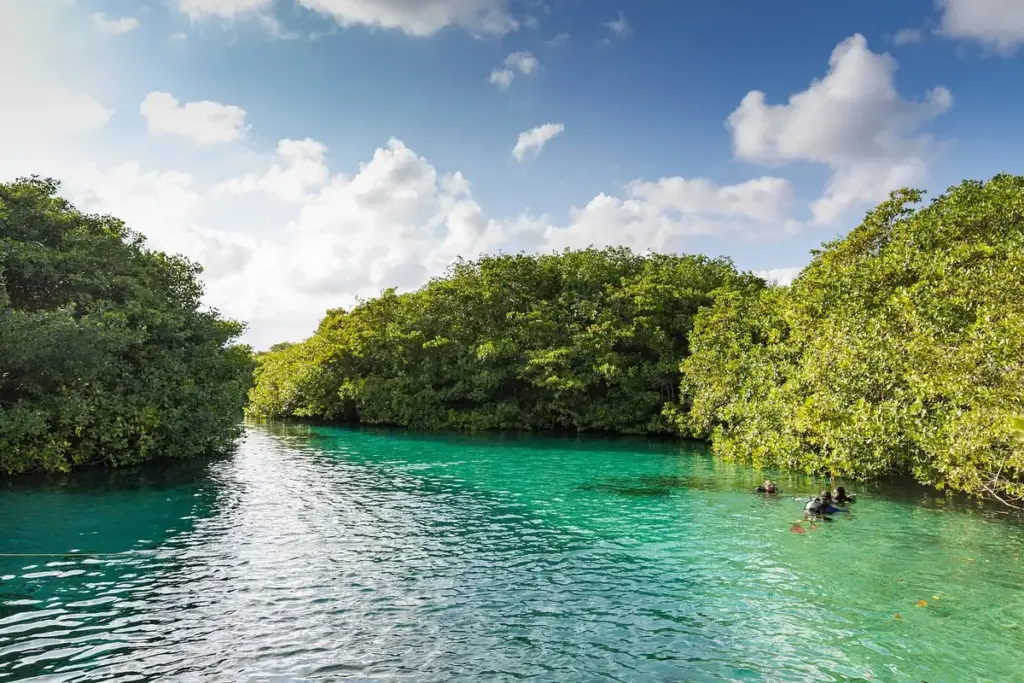
| Casa Cenote | Tulum area | Open to the sky and fringed by mangroves; divers under 15 can dive its open section |
| Carwash | Tulum area | The usual partner for Angelita; good for snorkelers |
| Garden of Eden | Riviera Maya | A halocline; good for snorkelers |
| Chikin Ha | Riviera Maya | Good for snorkelers |
| Chac Mool | Near Puerto Aventuras | Light beams through the openings; formations in a chamber called the Dome |
| The Pit (El Pit) | Dos Ojos area | Deep, with a halocline; often paired with Dos Ojos |
| Angelita | South of Tulum | Hydrogen sulfide cloud at about 100 ft (30 m); level 3, Advanced Open Water required |
Dos Ojos cenote
Dos Ojos, “two eyes,” is a pair of neighboring cenotes north of Tulum, linked underwater. They’re the entrances to a system whose exploration began in November 1987, with 28 known cenote entrances and a maximum depth of 391 feet (119 m), and which featured in the 2002 IMAX film Journey Into Amazing Caves. Near the two cenotes, though, the maximum depth is only about 33 feet (10 m), and most cavern dives stay at 16-23 feet (5-7 m) in water of about 77°F. A typical trip is two 45-minute dives with an hour’s surface interval between them.
Dos Ojos cenote diving is the classic first cenote dive for good reason: easy depths, dense formations and daylight never far away. The catch is popularity. A hundred or more visitors come on a normal day, snorkelers among them, so go early with an operator who knows the timing. The Cenote Guy pairs Dos Ojos with The Pit for $160 (checked September 2026).
Cenote Angelita
Angelita, south of Tulum, is the cenote with the cloud. Its absolute depth is 184 feet (56 m), or about 197 feet (60 m) in places according to Deep Mexico, but dives stop at about 100 feet (30 m), where a dense, acidic hydrogen sulfide cloud stretches across the whole cenote. Below it there’s no natural light, and nobody on a recreational dive goes through it. A debris island of fallen trees and leaves rises out of the cloud to about 90 feet (27 m), which gives the dive its eerie look: bare branches poking out of what seems to be a misty river at the bottom of a well.
According to Blue Life, a typical dive lasts 35-45 minutes: down to the cloud at 90-100 feet (27-30 m), then a slow ascent around the walls of the cenote. Because of the depth, Angelita requires Advanced Open Water and is a level 3 cenote, so you need level 1 and 2 cenote dives behind you first. It’s often paired with Carwash, and The Cenote Guy pairs it with Casa Cenote for $160; Deep Mexico’s Angelita trip is about 4,200 MXN, roughly $239 (checked September 2026). At that depth your no-decompression time is short and your gas goes faster, so a dive computer and a careful plan matter more here than anywhere else on the cenote circuit.
The Pit cenote
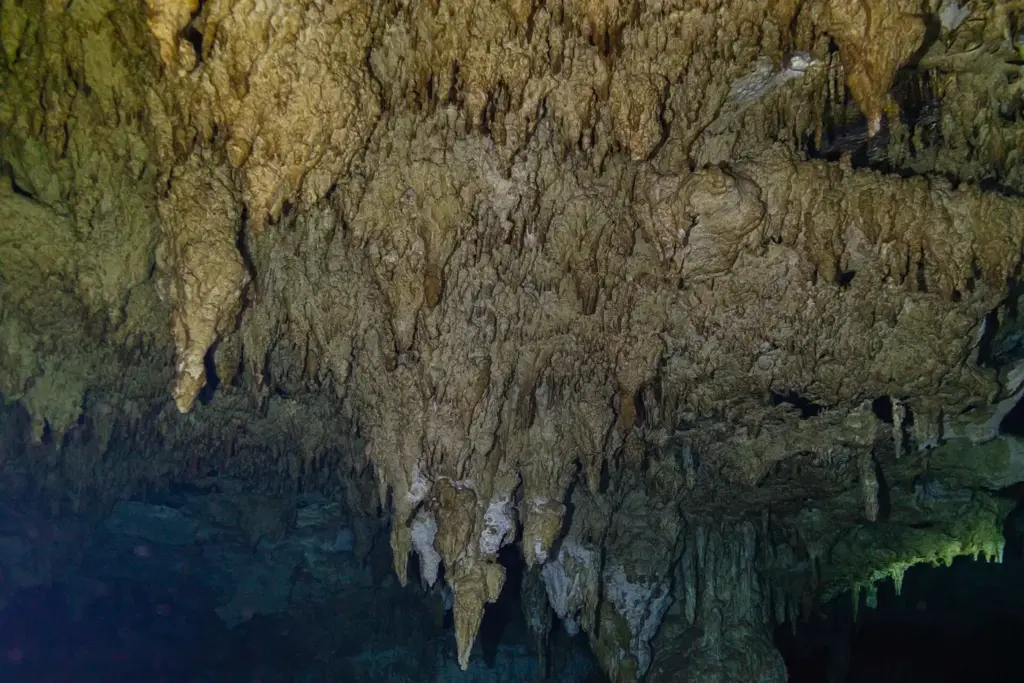
The Pit (El Pit) is a deep cenote in the Dos Ojos area, and one of the places Blue Life names for seeing a halocline. Recreational divers descend from the opening among formations like those in the photo below, staying in the daylight zone. It isn’t a first cenote dive: ask your operator which level it counts as and what certification it requires, since the deeper, more complex cenotes need Advanced Open Water. The Cenote Guy pairs it with Dos Ojos for $160 (checked September 2026). The system’s deepest surveyed point, 391 feet (119 m), is far beyond anything a recreational diver should consider.
Cenote Chac Mool
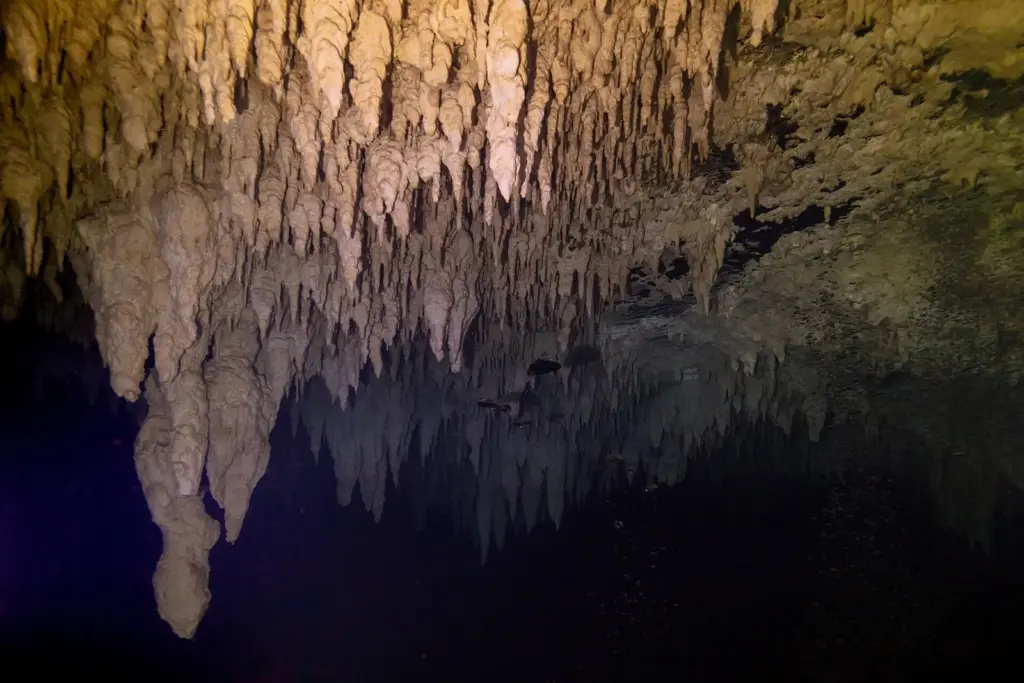
Chac Mool, near Puerto Aventuras, is where the photo at the top of this page was taken: sunlight pouring through an opening into the cavern and fanning out through the water. The photo below, from a chamber known as the Dome, shows the other reason divers come, with formations crowding the ceiling above the waterline. Chac Mool cenote diving is worth saving for a sunny day, since the beams need sun, and for your second day, after an easy level 1 dive. It’s also handy if you’re based in Playa del Carmen or Puerto Aventuras rather than Tulum.
Casa Cenote, Carwash and the easy cenotes
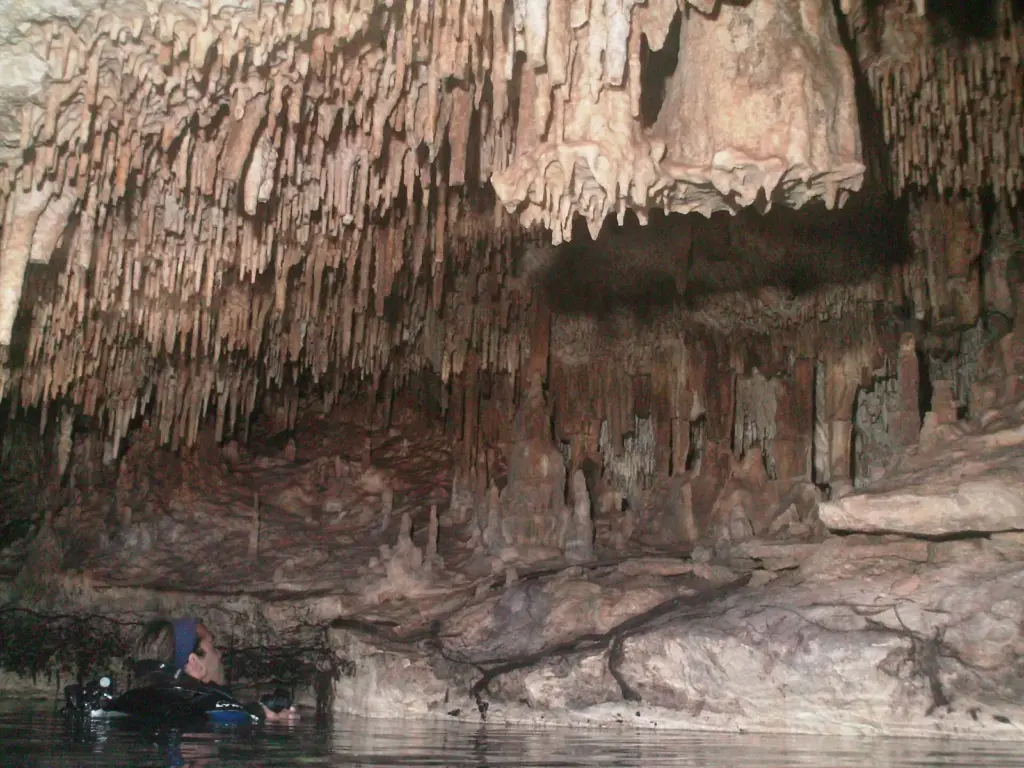
Casa Cenote, in the Tulum area, is open to the sky and fringed by mangroves, and it’s the one place under local rules where divers younger than 15 can dive, provided they stay out of the cavern. Carwash is the usual partner for Angelita. Blue Life’s cenote FAQ lists Dos Ojos, Garden of Eden, Carwash and Chikin Ha as the best cenotes for snorkelers, which makes them good choices when a non-diving partner comes along, and Garden of Eden is also one of its picks for seeing a halocline. For your first dive, your operator will choose a level 1 cenote; if you have a preference, ask which of these qualify.
Cenote diving from Tulum or Playa del Carmen?
The main dive cenotes lie between Playa del Carmen and Tulum, so either town works as a base, and so does Puerto Aventuras in between. Cenote diving from Tulum puts you closest to Dos Ojos, The Pit, Casa Cenote, Carwash and Angelita. Cenote diving from Playa del Carmen or Puerto Aventuras puts you closer to Chac Mool and to the ferry for Cozumel’s reefs. Ko’ox Diving charges $239 for a two-cenote trip from Playa del Carmen or Puerto Aventuras and $249 from Tulum (checked September 2026), so where you stay makes little difference to the price.
So pick your base for the rest of the trip. If you also want Cozumel’s reefs, Playa del Carmen’s ferry makes day trips easy. If cenotes are the priority, Tulum saves driving time on most mornings. Puerto Aventuras, a marina town between the two, suits divers who want reef and cenote days in equal measure: Pro Dive International’s boats there reach the reef in 5-10 minutes (checked September 2026).
Many visitors combine cenotes with the reefs and, in winter, with the bull shark dives off Playa del Carmen, which operators run from about November into February or March (checked September 2026). Our guide to scuba diving in Mexico covers Cozumel, the Caribbean coast’s reefs, the bull sharks and the whale sharks, so you can build a week around all of them.
When to go
Cenote diving is a year-round activity. The water sits at about 77°F in every month, the cenotes are inland and sheltered from wind and waves, and a day that’s too rough for the dive boats can still be a good cenote day. That makes cenotes a useful plan B on any reef-diving trip to the Riviera Maya.
What does change through the year:
- Light. The famous beams need sun. A clear day with the sun high puts the most light into the openings, and overcast skies mute it. If you can, save the most photogenic cenote for a sunny day and book with an operator who can shuffle the schedule.
- Hurricane season. The Atlantic season runs June 1 to November 30 and peaks around September 10, with most activity from mid-August to mid-October. A passing storm can wash out a few days of diving, so buy travel insurance and keep plans flexible in that window.
- Crowds. Popular cenotes such as Dos Ojos see a hundred or more visitors a day. Holiday weeks tend to be busier still, and starting early helps at any time of year.
- What else is in season. Winter brings the Playa del Carmen bull sharks. The whale shark season off Holbox runs June to September, peaking in July and August, and our Mexico guide covers it.
Florida springs: cenote-style diving without a passport
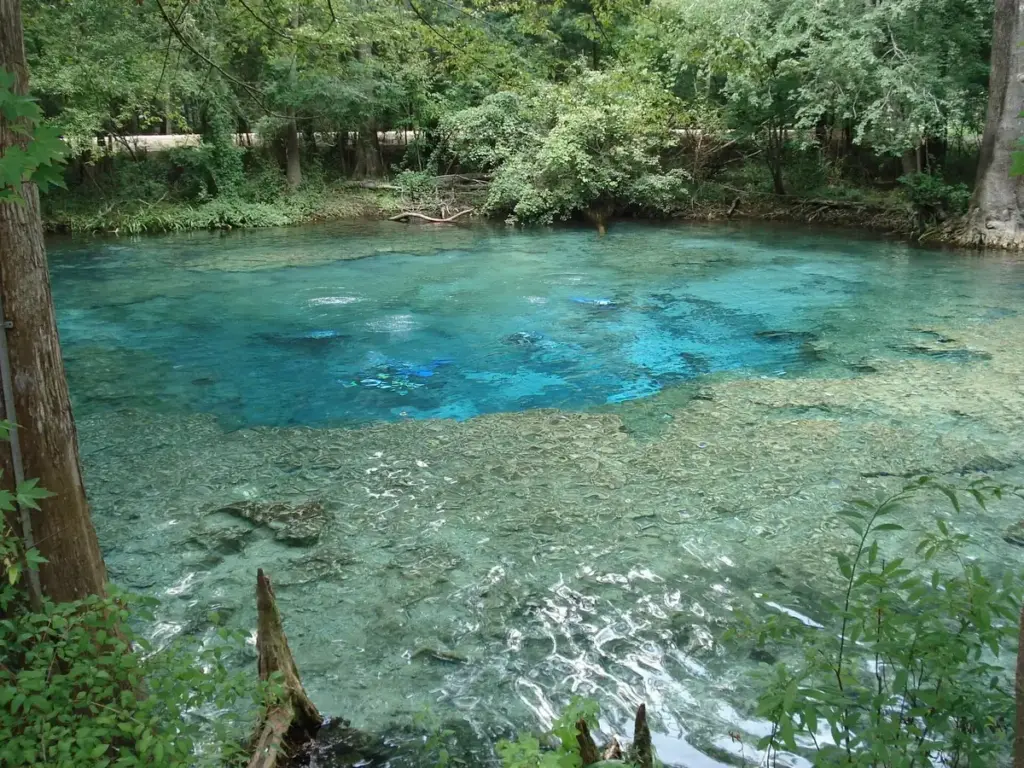
Florida’s springs offer the closest thing to cenote diving in the US: clear water at 68-72°F all year, open basins that any certified diver can enjoy, cavern zones at the edge of daylight, and cave systems beyond them for trained cave divers. Most of the dive springs sit in north-central Florida around High Springs and Williston, with Vortex Spring out in the Panhandle. For many divers in the Southeast, they’re the cheapest way to find out whether overhead diving is for them.
| Spring | Where | Admission (checked Sept 2026) | What you can dive | Requirements |
|---|---|---|---|---|
| Devil’s Den | Williston | $48 divers; air fill $10.50; full gear $60 | A spring at 72°F year-round | Open Water; buddy required; night dives only by reservation, for advanced-certified divers |
| Blue Grotto | Williston | $61 divers; $23 snorkelers; gear package $80 | Basin to 40 ft, upper cavern to 50 ft; the lower chamber needs cave training | Open Water |
| Ginnie Springs | About 6.5 miles northwest of High Springs | Check current rates | Seven springs at 72°F, including the Ballroom (over 100 ft across, 15 ft deep) and the Devil’s Spring system | Only certified cave divers may cave dive; lights restricted near the Devil’s Spring system |
| Vortex Spring | Near Ponce de Leon, in the Panhandle | $25 daily dive pass | Basin to 50 ft at the cavern mouth, then 300 ft of passage to a gate at 115 ft; 68°F | Open Water; Discover Scuba $150 |
| Peacock Springs | About 16 miles southwest of Live Oak | Check with the state park | Peacock I and Orange Grove Sink, at the entrance to a long cave system | Check the park’s current dive rules |
Ginnie Springs
Ginnie Springs sits about 6.5 miles northwest of High Springs on the Santa Fe River. It has been privately owned by the Wray family since 1971 and operating since 1976, and its seven springs hold 72°F all year. The main spring pool is about 90 feet across and 12 feet deep, and the Ballroom is a bowl-shaped basin more than 100 feet across and 15 feet deep, an easy first spring dive. The rules are strict where they matter: only certified cave divers may enter the caves, only divers registered as cavern-through-cave certified may carry lights in or near the Devil’s Spring system, and every diver without an annual pass must register by 5 p.m. Nitrox 32% is available. Hours run 8 a.m. to 5 p.m. Monday to Thursday, to 7 p.m. on Friday and Saturday and to 6 p.m. on Sunday, and a new alcohol and open-container policy took effect on April 21, 2026 (checked September 2026).
Devil’s Den and Blue Grotto
Devil’s Den and Blue Grotto are both in Williston, and both work for Open Water divers. Devil’s Den stays at 72°F year-round and opens daily from 8 a.m. to 5 p.m.; it closes early on Thanksgiving and Christmas Eve and is closed on Christmas Day. Diver admission is $48, air fills $10.50 and full gear rental $60. You need a buddy, snorkelers need reservations, the last dive starts 90 minutes before closing, and under-18s need a parent or notarized consent. The only scuba reservations it takes are for night dives, which cost $48 per diver with a $480 minimum and seven days’ notice, for advanced-certified divers (checked September 2026).
Blue Grotto opens daily from 8 to 4 and closes on Thanksgiving, Christmas Eve, Christmas Day and Easter. Divers pay $61, snorkelers $23 (weekdays or with a dive group) and non-divers $7; a gear package is $80, air fills $12 and nitrox fills $17. The basin reaches 40 feet and the upper cavern 50 feet, while the lower chamber has no ambient light and needs cave training (checked September 2026).
Vortex Spring
Vortex Spring, near Ponce de Leon in the Florida Panhandle, was open for diving in 2026. A daily dive pass is $25, guided dives cost $75 for the first and $50 after that, Discover Scuba is $150 and a NAUI Open Water course $605. The basin drops to 50 feet at the cavern mouth, and 300 feet of passage leads to a gate at 115 feet; the water is 68°F year-round (checked September 2026). It’s a long way west of the other springs, so treat it as its own trip rather than an add-on to High Springs.
Peacock Springs and cave diving in Florida
Peacock Springs is now Wes Skiles Peacock Springs State Park, 733 acres about 16 miles southwest of Live Oak in Suwannee County. Its dive sites include Peacock I and Orange Grove Sink; Olsen Sink has been closed to diving since 2002. The cave system measured about 24,300 feet (7,408 m) in 2008 and grew by about 10,000 feet with a 2010 connection. Check the Florida state parks site for the park’s current dive rules and fees before you go.
Cave diving in Florida works the same way as in Mexico: the basins and caverns are open to certified divers under each site’s rules, and the caves themselves are for divers with cave certification. Ginnie Springs spells that out in its rules, Blue Grotto’s lower chamber requires cave training, and Vortex Spring’s cave passage ends at a gate. If you’re training toward cave certification, north Florida’s springs are within driving distance for much of the eastern US, which is a big part of their appeal.
Cenotes or Florida springs?
| Mexico’s cenotes | Florida’s springs | |
|---|---|---|
| Water | About 77°F year-round | 68-72°F year-round |
| How you dive | Guided, up to 4 divers per guide | Often with your buddy (Devil’s Den requires one); guided dives at some springs (Vortex: $75, then $50) |
| Cost | $150-$160 guiding plus fees, or $239-$249 all-in for two dives | $25-$61 admission, plus gear and air |
| Scenery | Formations, light beams, haloclines | Open basins, spring flow, caverns |
| Getting there | International flight to Cancun | A drive for many divers in the Southeast |
| Cave diving | Cave certification required | Cave certification required |
Our take: If you live in the Southeast and want to know whether you like overhead diving, a weekend at the Florida springs is the cheapest way to find out. For formations, light beams and the full cenote experience, nothing in Florida replaces the Yucatan.
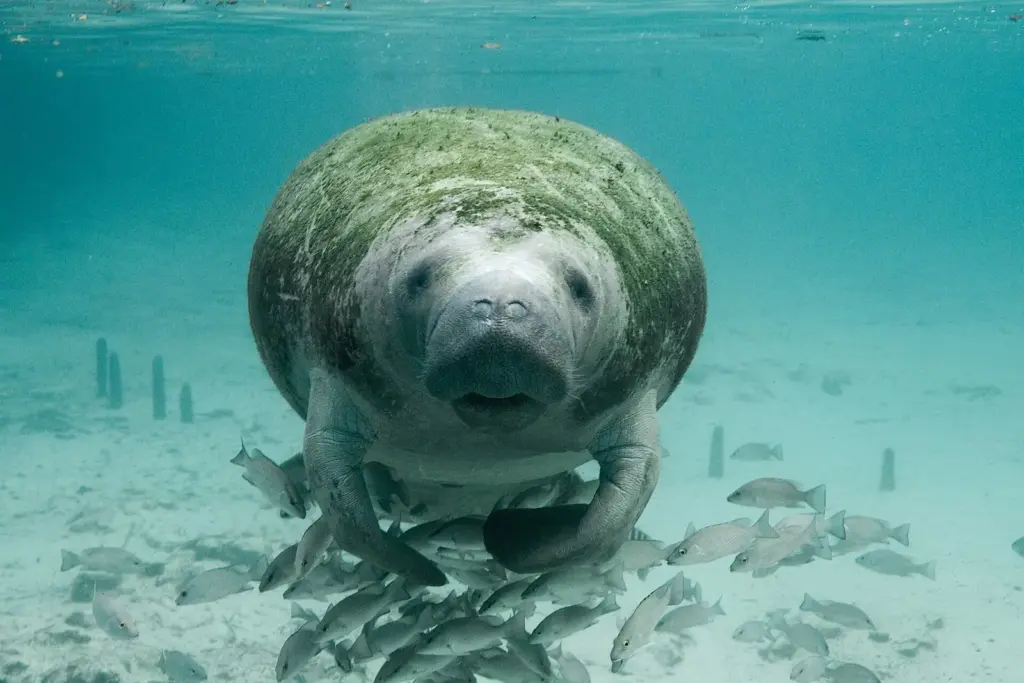
Our guide to scuba diving in Florida covers the state’s reefs and wrecks and Crystal River’s manatees, which gather in the springs from November 15 to March 31. Scuba is allowed at Crystal River’s King Spring year-round, according to the US Fish and Wildlife Service.
Cenote diving for beginners
You don’t need to be an expert to dive a cenote, but you do need to be comfortable in the water. Here’s what beginners should know.
- Open Water is the minimum. Under local rules, your first cenote dive must be at a level 1 site. Good buoyancy control matters more here than on a reef, because you’ll spend much of the dive under a ceiling.
- Not certified yet? Some operators run Discover Scuba in cenotes; Ko’ox Diving charges $244 (checked September 2026). Expect to stay close to your instructor the whole time.
- Brush up first. If you haven’t dived in a while, do a refresher or an ocean dive before the cenotes. One careless fin stroke over silt ruins the visibility for everyone behind you.
- Learn the frog kick. It pushes water behind you rather than down, which keeps the silt where it belongs. Practice it on a reef dive first.
- Expect to follow. You’ll swim in a line behind the guide, at the depth and pace they set, with your light pointed down or ahead, never in the next diver’s eyes.
- Start shallow. Dos Ojos, with most cavern dives at 16-23 feet, is a classic first cenote. Leave Angelita and The Pit for later in the week, or a later trip.
If you’re still working toward your card, our scuba certification guide explains the options, including finishing your open water dives on vacation.
Families and non-divers
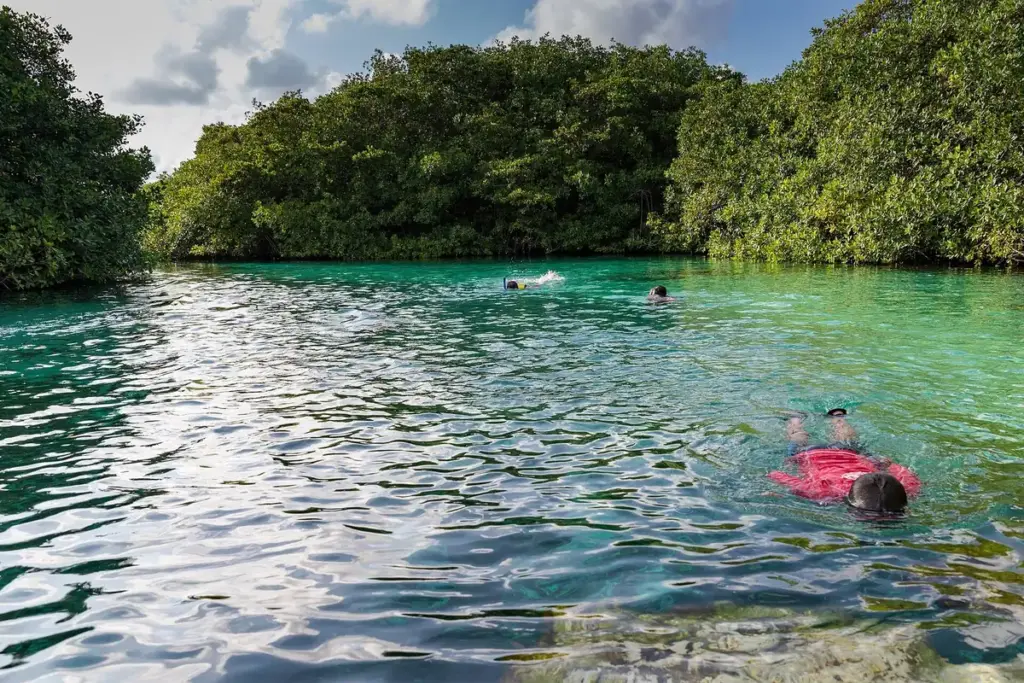
Cenotes work well for mixed groups if you plan around the age rule. Divers must be at least 15 to enter the cavern zone under local rules, but younger certified divers can dive the open section of Casa Cenote. Non-divers can snorkel at several of the cenotes divers visit: Blue Life lists Dos Ojos, Garden of Eden, Carwash and Chikin Ha as the best for snorkeling. In Florida, Blue Grotto admits snorkelers for $23 on weekdays or with a dive group, Devil’s Den requires snorkelers to reserve, and under-18s at Devil’s Den need a parent or notarized consent (checked September 2026).
Cavern diving certification and cave training
If a cenote dive leaves you wanting to see more, the next step is training, in stages.
- Cavern Diver. Your first overhead course, taught within the daylight zone. PADI’s Cavern Diver course requires Advanced Open Water and a minimum age of 18, and divers stay within the light zone.
- Introduction to cave (the name varies by agency). The first step past the daylight, with tight limits on how far you go.
- Full cave. Longer penetrations, more complex navigation and more demanding gas planning.
Cave training is offered by several agencies, including NSS-CDS, NACD, IANTD, TDI, GUE, PADI and CMAS. Both the Riviera Maya and north-central Florida have cave instructors working in these systems; Pro Dive International’s cavern guides, for example, are full-cave instructors. Cavern diving certification is worth taking even if you never go further. It makes you a more careful, better-trimmed diver in any overhead environment, wrecks included, and it teaches the habits (a guideline, gas reserves, spare lights) that the next section is all about.
Is cenote diving safe? And is cave diving dangerous?
Guided cavern diving is reasonably safe when the rules are followed. The local rules exist because an overhead environment removes your easiest escape, a straight ascent to the surface. Staying in the daylight zone, keeping groups to four divers with a trained guide, limiting depth and working up through the levels make cavern tours manageable for recreational divers with good buoyancy.
Cave diving without training is dangerous. Sheck Exley’s 1979 analysis of cave-diving accidents produced the rules cave divers still follow: get trained, run a continuous guideline to open water, respect depth limits, turn the dive after using a third of your gas, and carry at least three independent lights. Trained cave divers dive by those rules and still treat every dive seriously. A recreational diver who follows a light past the daylight zone has none of them in place. If you want to go further than the cavern, get trained first.
Cenote hazards to know about:
- Silt. A careless fin stroke can drop visibility to nothing in seconds. Good trim and a frog kick prevent it; if it happens, stay calm, stay with your guide and move toward the light or the line.
- Haloclines. Crossing one blurs your vision for a few seconds and changes your buoyancy: in the denser salt water below, you’ll float up unless you vent a little air.
- Hydrogen sulfide. At Angelita the cloud is dense and acidic, and the dive stops above it.
- Depth. Angelita is a deep dive that requires Advanced Open Water. The Pit is deep too, so ask what your operator requires.
- Formations. Stalactites break easily and took thousands of years to grow. Touching them damages the cenote and can cut you.
- Losing the group. If you can’t see your guide, stop, look for their light and for the daylight, and don’t go exploring on your own. Your briefing will cover what to do.
What a cenote briefing covers
Expect a longer briefing than on a reef dive, often beside the water with a sketch of the cenote. A good one covers the route and the order you’ll swim in, the maximum depth, how the guide will signal with a light, when you’ll turn back on gas, what to do if you lose sight of the group, and which formations and silt areas to avoid. If anything is unclear, ask before you get in. The middle of a cavern is not the place to work out a hand signal.
Emergencies. Ask your operator where divers are taken for treatment. Cozumel, a ferry ride from Playa del Carmen, has a hyperbaric chamber run by Grupo Medico Costamed, a DAN Preferred Provider. DAN’s 24-hour emergency line is +1-919-684-9111, and DAN membership ($40 a year) includes up to $150,000 of emergency medical transportation for emergencies more than 50 miles from home; dive accident insurance is sold separately (checked September 2026). The CDC advises waiting at least 12 hours after a single no-decompression dive and 18 hours after multiple dives or days of diving before you fly.
How to choose a cenote dive operator
Cenote diving is a guided activity, so the guide matters more than the brand or the website. These questions sort the good operators from the rest:
- Who guides, and with what training? Local rules require certified cenote guides, and some shops go further: Pro Dive International uses full-cave instructors as cavern guides.
- How many divers per guide? The cap is four, or three in complex cenotes. Ask whether your group will be full.
- What’s included? Transport, gear, lights, entrance fees and camera fees vary from shop to shop. The Cenote Guy’s prices exclude entrance and camera fees, Pro Dive includes entry fees, and Ko’ox includes transport, gear and lights but charges camera fees separately.
- Which cenotes, and at what level? A good operator asks about your experience and matches the cenotes to it, starting with level 1.
- Where do you meet? Ask whether the price includes a pickup from your hotel or whether you’ll meet the guide at the cenote, which suits divers with a rental car.
- What happens if plans change? Ask about cancellation and rescheduling before you pay.
Reviews help, but read them for the details that matter here: small groups, thorough briefings and guides who slowed down for a nervous diver. A cheap price that leaves out entrance fees, lights and transport can end up costing more than an all-inclusive trip.
How to plan a cenote diving trip, step by step
- Check your certification and experience. Open Water gets you into level 1 and 2 cenotes; Advanced is needed for Angelita and most level 3-4 dives. Bring your card and logbook.
- Choose your pricing. Guiding-only ($150-$160 for two cenotes plus fees) if you have a car and gear; all-inclusive ($239-$249) if you want transport and gear handled.
- Plan two cenotes a day, easy first. Operators pair nearby cenotes: Dos Ojos with The Pit, Angelita with Carwash or Casa Cenote.
- Book a small group. Local rules cap groups at four divers per guide; ask how many will be in yours.
- Bring cash. For entrance fees, camera fees and tips.
- Leave a gap before your flight. Allow at least 18 hours after your last dive before flying home, since a cenote trip usually means several dives over several days.
A three-day cenote plan
If you have three days for cenotes, this is a sensible progression for a certified diver:
- Day 1: Dos Ojos plus another easy level 1 cenote chosen by your guide. Get your weighting right and settle into following the line.
- Day 2: Chac Mool for the light, if the sun is out, and a second cenote at the next level.
- Day 3: with Advanced Open Water and the first two levels behind you, Angelita and Carwash, or The Pit and Dos Ojos if your operator agrees you’re ready.
Mix in a reef day, a day on Cozumel or a rest day, and keep your last dive at least 18 hours before your flight home. If you’re not Advanced certified, swap day 3 for more level 1 and 2 cenotes; there are plenty to fill a week.
Mistakes to avoid
- Doing Angelita as your first cenote. Start at level 1.
- Showing up with shaky buoyancy. Do an ocean dive first.
- Following a light past the daylight zone without cave training.
- Forgetting that entrance and camera fees are often extra.
- Wearing sunscreen or insect repellent into the water. Rinse off before you get in; cenotes are part of the region’s groundwater.
- Touching formations, standing on the bottom or kicking up silt.
- Flying the morning after a cenote day.
What to bring
- A 5 mm wetsuit. Water is about 77°F year-round, and two dives in a row add up; Blue Life and Pro Dive both recommend a full 5 mm suit.
- A good dive light, if your operator doesn’t include one. Ko’ox Diving’s all-inclusive trips include lights.
- Your own mask and computer, and fins you’re comfortable frog-kicking in.
- Pesos in cash for entrance and camera fees.
- A towel, dry clothes and drinking water for the surface interval, often spent in the jungle beside the cenote.
- Insect repellent for the surface interval, put on after your last dive, not before.
Photographing cenotes
Cenotes are among the most rewarding places in diving to shoot, and they reward patience more than equipment. A few pointers:
- Pay the camera fee and check the policy. Fees run 200-500 MXN at many cenotes and up to 1,000 MXN at some, and some cenotes ban cameras.
- Shoot the beams with natural light. Turn your strobes off, set a white balance for the blue-green water, and expose for the light coming through the opening.
- Light the formations. For stalactites, a video light or strobes bring out the color and texture of the limestone.
- Watch the silt. Any particle in the water lights up in a strobe’s beam, so stay off the bottom and shoot from above the silt.
- Don’t lag behind. The guide sets the pace, and the group won’t wait while you set up a shot. Buoyancy and position come first, pictures second.
Getting there
Mexico. Fly to Cancun, which has nonstop flights from many US cities, and drive or transfer south to Playa del Carmen, Puerto Aventuras or Tulum; the main dive cenotes are between them. US citizens need a passport and can stay visa-free for up to 180 days. The FMM tourist permit fee (983 MXN in 2026, about $56 at the September 24 exchange rate) is built into the airline ticket for air arrivals. The State Department rates Quintana Roo Level 2, “exercise increased caution,” and advises extra care after dark in downtown Cancun, Tulum and Playa del Carmen (checked September 2026).
Florida. The springs cluster in north-central Florida: Ginnie Springs near High Springs, Devil’s Den and Blue Grotto in Williston, and Peacock Springs near Live Oak, with Vortex Spring far to the west near Ponce de Leon. Gainesville is the nearest city to High Springs and Williston and has a regional airport, though many visitors fly into Orlando, Tampa or Jacksonville and drive. If you’re adding Crystal River’s manatees, Crystal River is about 87 miles (1 hour 50 minutes) by road from Orlando and 80 miles (1 hour 35 minutes) from Tampa.
Frequently asked questions
Is cenote diving safe?
Guided cavern diving in cenotes is reasonably safe for certified divers who follow the rules: stay in the daylight zone, dive with a certified cenote guide in a group of four or fewer, start with an easy level 1 cenote and keep good buoyancy. The danger is going beyond the daylight zone without cave training, which recreational cenote tours never do.
What is cenote diving?
Cenote diving is diving in the Yucatan Peninsula’s cenotes, water-filled sinkholes that open onto flooded caves. Recreational cenote dives are guided cavern dives that stay within sight of daylight, among stalactites, light beams and haloclines, in clear fresh water of about 77°F. Going deeper into the caves requires separate cave training.
How deep are cenotes?
It varies enormously. Most cavern dives at Dos Ojos stay at 16-23 feet, with a maximum of about 33 feet near the entrances, while Cenote Angelita is about 184 feet (56 m) deep, with dives stopping at about 100 feet. The Dos Ojos cave system reaches 391 feet (119 m) at its deepest point, far beyond recreational limits.
How deep are the cenotes in Tulum?
The cenotes around Tulum range from Dos Ojos, north of town, where most cavern dives stay at 16-23 feet, to Cenote Angelita to the south, where dives stop at the hydrogen sulfide cloud at about 100 feet and the total depth is about 184 feet. Your operator will match the cenote to your certification and experience, starting with a level 1 site.
Are there sharks in cenotes?
Sharks aren’t part of cenote diving. Cenotes are inland sinkholes of mostly fresh water, and the life you’ll see is small; the hazards are silt, depth and the overhead environment, not wildlife. If you want sharks, the bull shark dives off Playa del Carmen are ocean dives, run from about November into February or March depending on the operator (checked September 2026).
Can you drink cenote water?
Don’t. Cenote water looks clean, but cenotes are part of the region’s groundwater, which can carry contamination from the surface. Treat it like any untreated natural water. The bigger concern for visitors is the reverse: rinse off sunscreen and insect repellent before you get in, so you don’t pollute water that others depend on.
Do you need cave certification to dive cenotes?
Not for a guided cenote tour, which stays in the cavern zone with daylight visible. You need at least Open Water certification, and Advanced Open Water for deeper cenotes such as Angelita. Cavern and cave certifications are for divers who want to go further; PADI’s Cavern Diver course requires Advanced Open Water and a minimum age of 18.
How much does cenote diving cost?
Guiding-only trips cost about $150-$160 for two cenotes, with entrance and camera fees paid separately; all-inclusive trips with transport, gear and lights cost $239-$249 from Playa del Carmen, Puerto Aventuras or Tulum (checked September 2026). Camera fees run 200-500 MXN at many cenotes and up to 1,000 MXN at some, so bring pesos.
Sources and verification
Everything on this page was checked on September 23-24, 2026 against the organizations listed below, and the page is compiled from them; we don’t claim first-hand dives with the operators named. Prices are the operators’ published rates and can change, so confirm before you book.
- Blue Life: cenote diving FAQ and Cenote Angelita (local rules, levels, ratios, age, temperature, depths)
- Ko’ox Diving: diving in cenotes
- The Cenote Guy
- Pro Dive International: cenotes and Mexico packages
- Deep Mexico: Angelita and bull shark season; Xico Dive Center: sharks
- PADI: Cavern Diver
- Wikipedia: Cenote, Cave diving, Dos Ojos, Sac Actun, Ginnie Springs and Peacock Springs State Park
- Florida springs: Ginnie Springs, Devil’s Den, Blue Grotto and Vortex Spring
- US Fish and Wildlife Service: Crystal River National Wildlife Refuge
- US State Department: Mexico travel advisory
- Costamed hyperbaric chamber, Cozumel
- DAN membership and the CDC Yellow Book: scuba diving
Also checked: the Atlantic hurricane season dates, the Holbox whale shark season, Mexico’s visa policy and FMM rules, road distances from OSRM routing, and the European Central Bank’s reference rates of September 24, 2026 (17.58 pesos to the dollar).
Scuba Tourism Guide is an independent publication. It is not affiliated with any agency, park, spring or dive operator named here, and no one paid to be included.
Photo credits
- Light beams in Cenote Chac Mool (featured image): photo by Serge Melki from Indianapolis, USA, Wikimedia Commons (CC BY 2.0)
- Cenote Dos Ojos, December 2025: photo by Diego Delso, Wikimedia Commons (CC BY-SA 4.0)
- Cenote El Pit, December 2025: photo by Diego Delso, Wikimedia Commons (CC BY-SA 4.0)
- The Dome, Cenote Chac Mool: photo by Serge Melki from Indianapolis, USA, Wikimedia Commons (CC BY 2.0)
- Divers at Casa Cenote: photo by dronepicr, Wikimedia Commons (CC BY 2.0)
- Ginnie Springs, Florida: photo by (WT-de) Mistoffeles, Wikimedia Commons (CC BY-SA 4.0)
- Florida manatee (US Fish and Wildlife Service): photo by Keith Ramos / USFWS, Wikimedia Commons (public domain)
- Snorkelers at Casa Cenote: photo by dronepicr, Wikimedia Commons (CC BY 2.0)


